

CAIRO, Egypt—Nicholas Carr argues in his new book The Shallows that the short and never-ending flashes of information we receive from digital technologies are erasing book reading and extended cognition.
I’m skeptical of the universality of his argument; I did, after all, read Carr’s book on my iPod, and given the apparent success of Kindles and other digital book providers, I’m not that much of an outlier.
In the U.S., that is. In the Arab world, the story is a bit different.
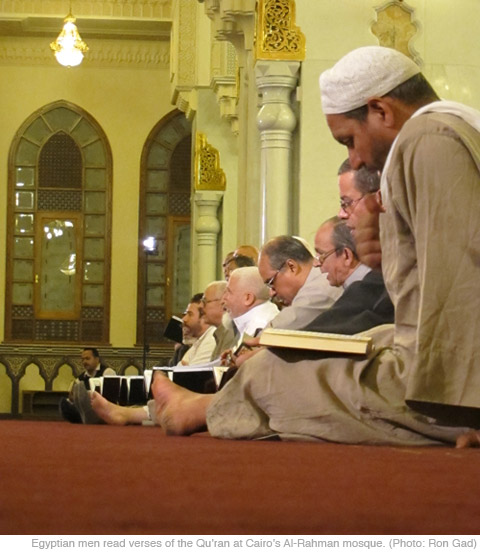
One of the things that first struck me when I started frequenting universities in the Arab world was that few people sat or strolled around with open books. Sure, some students carried books to class, but they weren’t reading them publicly.
Ride a subway, bus, or plane with a large number of Arabs, and you’ll likely also see few people reading books, except maybe a handful of folks who brought their Qur’ans along. “Book production and, presumably, reader consumption are relatively low in the Middle East in comparison to other regions with similar socioeconomic levels of development,” the Rand Corporation (PDF) reported in 2009.
This isn’t to say that Arabs are uninformed or non-consumers of information. In my experience, Arabs are more informed about current events and global affairs than Americans and are more voracious consumers of news. A Jordanian cab driver once told me he never misses an issue of Congressional Quarterly online, and then began to critique in his third language a massive defense spending bill making its way through the U.S. House of Representatives (I hadn’t even heard of the bill).
In a 2009 survey I conducted of young adults in Jordan, 91 percent reported reading a print newspaper at least once a week. If similar news use patterns were reported tomorrow morning for young adults in the U.S., journalists and editors would rush to buy cymbals and confetti.
But book reading among Arabs simply isn’t routine, and our world of snippet information consumption may make it less so.
Why is book reading less common in Arab states? Well, the relatively high cost of bound books in Arab countries, lack of meaningful library networks, censorship, low availability of classics and contemporary bestsellers in Arabic, and stubbornly high illiteracy rates (in some Arab states) all contribute to the trend.
A reality of the Arabic language, though, is the primary reason book reading in the Arab world is comparatively low.
Arabs generally grow up speaking a colloquial dialect of Arabic that differs substantially from the standard version of the language in which books, magazines, and journals are published. At a relatively early age, they also learn standard Arabic and English (and often French) in school, and frequently become quite proficient at one or more. Still, none of these formal languages are, in essence, Arabs’ “native” tongue, and yet they’re asked by professors like me to make book reading in one of these languages a permanent fixture of their leisure. If you’ve extensively studied a second or third language, you know that reading an entire book in that language isn’t leisurely. It’s downright exhausting.
If Arabs are avid news and information consumers in the general sense, though, does it matter that book reading in this part of the world is less an element of daily life? Probably, Nicholas Carr and other researchers maintain.
Citizens’ lack of civic engagement and political participation are major problems in Arab countries. Admittedly, no Arab country is a fully functioning democracy, so there are certainly circumstantial reasons for this paucity. Infrequent book reading, however, likely also impacts Arabs’ civic abstention. Researchers from the Universities of Pennsylvania and Arizona found in a 2006 study that book reading was nearly as strong a predictor of civic engagement and political awareness among fourteen to twenty-two-year-olds as overall Internet news consumption. Books like Uncle Tom’s Cabin, The Jungle, and Half the Sky, and the extended, powerful arguments they contain, motivate large numbers of people to support a cause, just as Tweets and Facebook feeds sometimes do. Engaged citizens need both.
Carr reviews research from neuroscience and cognitive psychology indicating the phenomenal plasticity of the human brain. The structure and pathways of our brains change after performing only a few extended or routine tasks. Reading a book by Thomas Friedman about Arab politics, as opposed to an 800-word column of his from Jerusalem, doesn’t just result in greater knowledge about Middle Eastern affairs, but can actually affect the brain’s structure and how it processes a unified, developed set of arguments. In other words, read Carr’s book, not this commentary, if you want to strengthen more valuable neural pathways. It’s simple: Expose yourself to lengthier arguments and you’re better neurologically conditioned to develop lengthy arguments of your own.
Students I teach, predominantly Arab, are more likely to bring their smartphones to class than books. I’m sure some professors in the U.S. lament similar trends, but I’ve found the Blackberry-to-book ratio particularly striking in this part of the world.
An ability to digitally multitask is, of course, a marketable skill in the non-specialized workplace. Traditional book reading, though, is associated with important civic and psychological processes, and as younger Arabs are choosing Tweets over Twain and Facebook over Fukuyama when their book reading was seldom to begin with, concern isn’t an overreaction.
More early childhood literacy programs are needed in this part of the world in order to better establish reading as a routine exercise, as is authorship and translation of texts in colloquial dialects so that native Arabic speakers aren’t alienated from book-length arguments. Literacy programs in early childhood and beyond should emphasize leisurely book reading on Blackberrys, iPhones, iPads, and whatever comes next, and must make more children’s books available on these mobile reading devices.
The “shallows” that concern Carr were around in the Arab world before the digital dawn, but now it’s getting even harder to spot oases of books on a drier digital landscape. And the lack of water isn’t necessarily the drinker’s fault.
Justin D. Martin is a journalism professor at Northwestern University in Qatar. Follow him on Twitter: @Justin_D_Martin