

In his version of the “What’s the matter with Newsweek?” story, published yesterday afternoon at Slate, Jack Shafer noted that the debate over the fate of the newsweeklies has been going on for a good long time, and cited a 1989 CJR story that depicted the publications as dinosaurs. (See the cover image at right.)
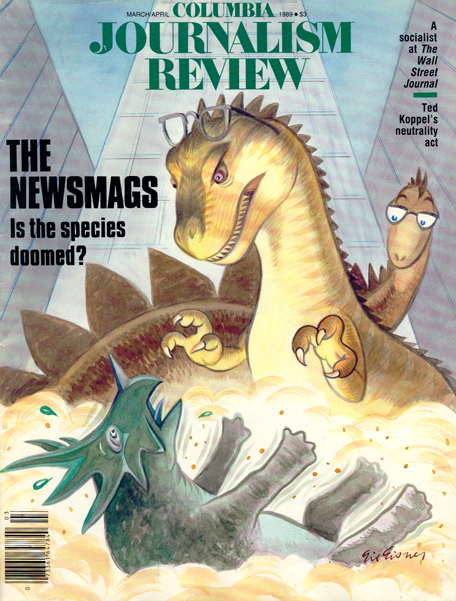 The article, by Bruce Porter, was hardly infallible in its powers of prognostication; it notes in the lead that editors at the (then three) newsweeklies, despite a staggering combined readership of 50 million, were haunted by a sense that their publications’ “existence on the earth was not guaranteed to last forever, maybe not even far into the 1990s”—a timeframe that was obviously a bit aggressive. But the story offers ample evidence that the existential question facing the newsweeklies—just what role are these magazines supposed to play, anyway?—and their efforts to remake themselves in search of an answer have been with us since well before most readers had ever heard of the Internet.
Unfortunately, our digital archives don’t go back that far, but some passages are republished here. Here’s Porter’s diagnosis:
The main problem, ironically, seemed to be that Time and Newsweek and, to a lesser extent, U.S. News & World Report, had become the prime victims of their own success. Where once the newsmagazines stood alone in offering readers a colorful, well-written digest of the week’s events, larded with sufficient interpretation to put the news into clear perspective, in recent years this endeavor has drawn a heavy amount of competition from week-in-review sections of newspapers, as well as from television talk shows, magazine shows, and weekend insider programs about economics and Washington politics. Where once the newsmagazines were the general public’s only source of news about special areas, such as the law, medicine, the press, and the environment, today all of the large dailies, including USA Today, also employ back-of-the-book specialists dealing in those subjects. And where once the newsmagazines provided residents of small towns with virtually their only source of sophisticated analysis of national and international developments, nowadays practically everyone in the country can get home delivery of The New York Times, as well as of The Wall Street Journal, not to mention being able to tune in to the substantive news programs coming over National Public Radio and the Public Broadcasting Service or to flick on the wall-to-wall coverage provided by the Cable News Network.
…Which might explain why the three newsweeklies these days are engaged in one of the biggest and most frantic renovations in their histories, trying to discover a new formula for success that, in the words of a hopeful-sounding promotional announcement to readers of Time, will yield “a magazine for the 1990s, a vital print companion to the electronic age.” Not only have they souped up their graphics, added new departments, and tinkered with the designs of their covers, but they have also altered the content of their magazines, both in the manner in which they write about the news and in the kind of news they write about.
That was the field in general. The section about Newsweek in particular, meanwhile, was introduced by the sub-hed “Staying hip while running scared,” and opened:
Whatever the case, U.S. News, assuming Zuckerman’s continued support, is probably in better shape than Newsweek, whose imminent sale by its parent, the Washington Post Company, is a subject of constant rumor. “People around here are so nervous,” one senior editor says, “that last week when the cleaners came in and vacuumed the carpet twice everyone freaked out. They thoughts the guys with the blue suits were about to come in to look over the merchandise.” Newsweek’s contribution to the earnings of its parent company dropped from 30 percent twenty years ago to 6 percent in 1987. And although the magazine boasted of a circulation increase in 1988 of 200,000, much of it was bought dearly. Insuring that cheap subscribers come back as renewals at regular rates always gives circulation directors headaches. To keep circulation from dropping requires the constant giving away of copies at bargain prices, which is an expensive proposition, especially considering that these days magazines are trying to shift some of their cost burden from advertisers to readers. Rather than paying the cost of trying to keep its own circulation up, for instance, Time decided last fall to lop 300,000 people off its lists.
Newsweek was responding to this pressure, Porter wrote, with staff reductions, and also with the “pursuit of a hip voice, a tone that would be familiar to readers of, say, Esquire or New York’s Spy magazine.” Its coverage of the 1988 Iowa caucuses was “notable for giving readers a surrealistic, heavily cynical view of the process… as if a curtain had suddenly been pulled back from a puppet show.” And, in an innovation that has survived through the most recent redesign, “a weekly column called Conventional Wisdom… tracked not how candidates were actually doing but how political pundits felt they were doing; arrows showed whether someone’s stock had risen or declined.” Of course, the supply of that sort of writing didn’t remain limited for long, either.
It wasn’t all woe-is-the-newsweeklies, though. Near his conclusion, Porter wrote:
For one thing, not everyone thinks the long-term newsmagazine economics are so gloomy. “Some say there’s just not room for three newsmagazines; I think quite the opposite,” says Mort Zuckerman of U.S. News. “In fact, I can imagine even more than three. When advertisers look at TV, with all the channel zapping and switching that goes on in that medium, I see continued and strong support for the high demographics at all three newsmagazines.”
Of course, U.S. News, as Shafer notes, became a monthly in 2008.
Greg Marx is an associate editor at CJR. Follow him on Twitter @gregamarx.