

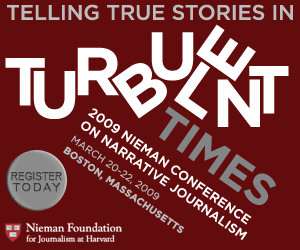
Even its logo was a narrative. This weekend’s Nieman conference (full name: “Telling True Stories in Turbulent Times: Nieman Narrative Conference 2009”) represented itself in its promotional materials through an image rendered in text. And the message of said image wasn’t subtle: the awkward interplay between the solidity (the stolidity, even) of “telling true stories” and the relative chaos of the rumbled, jumbled “turbulent times” suggests the contentious relationship between journalism and its current cultural moment. Narrative journalism is rooted in ground that is anything but solid. And under threat from our T-U-R-B-U-L-E-N-T TIMES.
The textual imagery at play here–the simultaneous polarity and connectivity between our stories and our times–makes an apt analogy for a conference that was both a receptacle for and an antidote to the tension between the two. The conference’s decidedly upbeat tone seemed to suggest, alternately, genuine optimism (emergent models of journalism offer new opportunities “to delight” audiences, “to make them love us in ways that our old models prevented,” said Joshua Benton, director of the Nieman Journalism Lab) and the reflexive self-defensiveness of a beleaguered institution. “The business model is broken. You are not broken,” the Pulitzer-winning Cleveland Plain Dealer columnist Connie Schultz declared in the conference’s opening keynote.
One wonders whether a similar assurance was offered at “Conducting Yourself: Locomotive Operators Convention 1909.”
The conference’s from-adversity-to-the-stars sensibility emphasized the cultivation of craft itself as an adversity-tackling vehicle. Narrative is journalism’s future as well as its past, Schultz told the crowd, because it provides context and background and insight–the details, large and small, that foster empathy. “People will always want and need to know,” she said, “that they’re not alone in their suffering and hope.”
It’s hard to argue with that; one principle that nearly everyone who cares about journalism–from the most ardent Webvangelist to the most hardboiled city editor–agrees on is that narrative is key to good journalism. Compelling, evocative storytelling will endure. For the simple reason that we need it to.
The question provoked this weekend is how narrative will continue to inform us and our information itself. How storytelling will evolve. How narrative authority will expand or (could Foucault have been right?) contract under the influence of a medium that is toppling our assumptions about what an author actually is.
Which is a roundabout way (sorry–I missed the “Structuring Your Story” panel, alas, which I’m sure advised its attendees of the virtues of both brevity and precision) of saying that the Nieman conference left me–as, really, the best of such gatherings do–with more questions than answers. (I should interrupt myself here to clarify that the conference’s embarrassment of intellectual riches, and its relatively short time span, meant that several–usually five or six– breakout panels took place during a single time slot, forcing participants to choose one among them; my experience was, in that sense, limited. So have your grains of salt at the ready: my sense of the conference overall–and my assessment of it–is highly subjective.) The basic question is the same one that so many in journalism are grappling with right now: basically, whence narrative? Are the standards for good narrative transcendent and therefore inviolable, or do they–must they–evolve with the times? Is good narrative a goal in itself, or is it a means to the more nebulous journalistic ends of informing, engaging, connecting, etc.?
This weekend’s panels, in regards to that last one, were split. Among the expected shout-outs to “the power of the story” and the like–celebrations of narrative that verged, at times, on fetishizing it (narrative compels! narrative informs! narrative is The Whole Damn Point!)–were treatments of new forms of storytelling on the Web: leveraging its power to employ cinematic techniques to still photography; using its immense archival capabilities to record the lives of ordinary people; employing the people formerly known as “audience” to inform and shape and tell stories.
In all this, Schultz’s invocation was one of the few times the term “business model” was used–again, from what I heard, anyway–at the Sheraton Boston this weekend. And that’s to be expected; financial concerns weren’t relevant to the conference’s main concern of the craft and the crafting of narrative. Except: “business model,” the term and the concept, was there. The thing hovered, wraith-like, throughout the weekend’s panel discussions and speeches. As participants spoke eloquently about “moving people through journalism” and the flattening force of compelling narrative (another specter was Joseph Campbell)…there it was. Jon Lee Anderson spinning exciting, charismatic yarns about his adventures in Bolivia and Iraq. (But what about the business model?) Gwen Ifill discussing the connection between a politician’s biography and our national identity. (But what about the business model?) Jenn Crandall describing the supreme trust required between herself and her subjects in creating her remarkable onBeing project. (But what about the business model?)
The tension, in this sense, between theory and practice, between church and state, between the ideal (this is what good narrative should look like) and the pragmatic (this is what good narrative can look like) suggests that now is the right time to question our assumptions–assumptions so commonly accepted that they’ve moved toward cliche–about the transcendent “power of narrative.” (What, exactly, makes narrative powerful? What about it is necessary and fundamental, and what about it is incidental? How can we put its power to use in new journalistic forms?) As Benton said during a talk on Saturday, the Web is engendering “a new openness to the kinds of things that we can deem journalistically acceptable.”
It certainly is. And we journalists, whether we’re literary or hard-news in our sensibility, reject–or, worse, ignore–that new openness at our own peril. Just as we ignore our industry’s financial woes at our own peril. Picasso could have spent hours–days–years–watching and framing and feeling the quiet undulations of the night sky; none of it would have mattered had he been unable to afford paint.
Take, again, Schultz’s “it’s not you, it’s the business model” declaration…which became, in some sense, the de facto motto of the conference overall. It’s a good line, to be sure, both simple and inspirational (with the added virtue, as they say, of being generally true). But it’s also reductive. Journalism’s current woes are much more complicated, after all, than the loss of print-ad revenue. Our problems are bigger than our business model. “We’re part of the problem,” said Maria Carrillo, managing editor of the (Norfolk) Virginian-Pilot. “We’re telling stories the same old way.”
This is a time, then, not simply for reiterating time-tested journalistic values–although it is a time for that, too–but also for re-thinking those values. For reframing our assumptions about narrative. And for rewriting the story of journalism itself.
Megan Garber is an assistant editor at the Nieman Journalism Lab at Harvard University. She was formerly a CJR staff writer.