

Here is one rule I’ve discovered as a consumer of media-celebrity coverage: if you know what a celebrity’s tongue looks like…you probably know too much about him.
To wit:
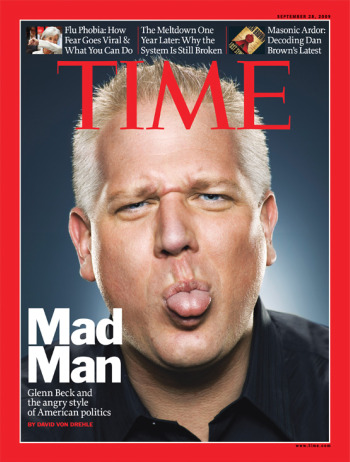
Yes. So we have, it seems, yet another way that the words “Glenn Beck” can be fairly associated with the words “too much.” This past week, the media formerly known as ‘mainstream’ have indulged in what can fairly be called an obsession with the Fox News favorite. Whether the guy’s being analyzed as a “post-modern conservative” or dismissed as “some sort of trans-partisan populist libertarian“–and whether your view tends to skew Beck’s recent omnipresence toward the messianic or the miasmic–one thing is clear: we seem to be living within (as The New York Times’s Opinionator blog put it, with only the faintest trace of irony)…the “Glenn Beck Moment.” Beck is not only on the air; he is also, somehow, in it.
The week’s coverage of Beck (grouped, via the broadest of brushes, into one Beckian bundle) suggests that he is, as a subject of journalism, one of those figures about whom you can say very much and also very little at the same time. Beck the celebrity. Beck the author. Beck the leader. Beck the rabble-rouser. Beck the fear-monger. Beck the éminence green. Beck the truth-teller. Beck the liar. He has been the subject of everything from extensive biographic narrative, to mocking TV takedowns, to straight-faced explorations, to witty deconstructions, to numeric analyses, to satiric portrayals by no less a zeitgeist factory than Saturday Night Live. The sum total of that coverage has an airy quality—or, more precisely, an errant quality (in every sense of the term). It wanders, refusing to commit to a direction. “Is Glenn Beck Bad for America?” Time magazine asks, without bothering to answer its own question.
Part of the problem is that it’s an incomplete question. Because one thing that the obsessive coverage of Beck proves is that, paradoxically, we still don’t know what the guy is in the first place–definitionally. Is he a journalist? An entertainer? A fear-monger? A demagogue? Beck is all of those things; but that’s also largely a moot point, because definitions don’t much matter, anyway.
And yet: Beck’s compound identity does matter to the extent that it presents a challenge to those who would try to assess his overall cultural value. Which is to say, to journalists. Because each identity carries with it an entirely different set of standards and assumptions: journalism here. Entertainment there. Politics…there. Et cetera. In that sense, Glenn Beck being everywhere also means that Glenn Beck fits in nowhere. As David Frum put it to Rolling Stone’s Tim Dickinson:
Glenn Beck offers pure alienation. Limbaugh denounces Democrats. Beck denounces politicians. Limbaugh is at least a little bit in the solutions business. That is to say, Limbaugh thinks if taxes were lower and the economy were more deregulated, things would be better. That’s not the point of Glenn Beck. He’s advocating a completely different approach: That there’s a dominant outside world that is hostile and alien and threatening.
And all that is, in its way, troubling. Journalists, after all, are, among other things, cartographers: they map their subjects, charting their locations upon the rocky terrain of our shared cultural life. As such, they also prefer to perceive—and present—politics as playing themselves out upon a continuum of convenient dichotomies: liberal versus conservative, establishment versus anti-establishment, etc. And they prefer those who engage in politics, from within or without, to adhere to these confines. Rush Limbaugh: conservative. Keith Olbermann: liberal. Et cetera. Journalists prefer, in other words, to set the terms of political engagement.
But Beck refuses to follow the rules. He refuses, even, to acknowledge the existence of any rules in the first place. He is not quite conservative; he is not quite anti-establishment. And the fundamental incoherence of his expressed political positions—which, as Nate Silver points out, are actually quite in line, in their incoherence itself, with the eclectic hodgepodge of most Americans’ political views—thwarts the angled lines of our narrow political frames. Beck is his own gurgling amalgam of definitions, his own strange blend of identities and anxieties. He denies, finally, to be mapped–by denying the legitimacy of the map itself. As Glenn Greenwald puts it,
Beck’s growing deviation from GOP (and neoconservative) dogma. Increasingly, there is great difficulty in understanding not only Beck’s political orientation but, even more so, the movement that has sprung up around him. Within that confusion lies several important observations about our political culture, particularly the inability to process anything that does not fall comfortably into the conventional “left-right” dichotomy through which everything is understood.
There’s something admirable about that, to be sure—something even, dare I say, American—but there’s something immensely disturbing, too. Call it the anxiety of the outlier: there’s nothing more frustrating than someone who refuses to play by the rules. And when that someone has millions of devoted followers…there’s nothing scarier, either.
And that’s particularly so within the larger context of the current moment in journalism—a moment that finds us preoccupied, even more than we usually are, with definitions themselves. Congress is currently reviewing two bills—one from the House, one from the Senate—which, in proposing a legal shield for journalists, also grapple with that perennial yet increasingly pivotal question: Who is a journalist in the first place? That’s a different question now than it was ten or five or even two years ago; and it’s a question, of course, wrapped up in the transition—gradual but also, seemingly, sudden—from journalism as a narrowly professional identity to journalism as a broader cultural activity.
The doors to American journalism are open wider than they have ever been before. That’s a good thing, generally; but it also means, of course, a decline in the power journalists have to define the spaces and set the terms of our political conversation. And it means that the story we tell ourselves about who we are no longer contains a single plot line. It is now a jumble, populated—and, increasingly, defined by—characters like Glenn Beck. In that way, Beck is a kind of printing press incarnate—revolutionary, explosive, and teeming with attendant anxieties. He is a tongue-wagging metaphor for the cognitive confusion of our journalistic moment. He is, among everything else, a reminder of the new world that professional journalists must come to terms with—a world in which one answer to the question of ‘who is a journalist?’ might just be: Glenn Beck.
Megan Garber is an assistant editor at the Nieman Journalism Lab at Harvard University. She was formerly a CJR staff writer.