

This month marks the fifth anniversary of the invasion of Iraq. For many of the journalists who have covered it, it has been the story of their lifetime, but we’ve nevertheless seen coverage of the war slip off the front pages over the last few months. While there are still plenty of reporters risking their lives doing great work in Iraq, much of the political, social, and economic complexity of today’s war seems to be getting lost in the election-year crush, even as the war continues to be a major issue in the campaign. This series is CJR‘s attempt to add a little bit of context to the whole, while digging into stories that don’t always make it into our morning newspapers.
The Rejected
“They’re gonna see us going out, and know that we have to come back this way,” Captain Glenn Helberg cautioned his men. We were walking out of combat outpost Courage, northwest of Baghdad, just before nightfall. The message was simple: the enemy studies habits, trends, and patterns just as any other military outfit does; so as the platoon left the base, Helberg wanted to make sure that his men were not complacent on the way back in.
It was a hell of a way to walk to a neighbor’s house for dinner, but that was just what we were doing on this cold, clear January night. Sheik Munder, a prominent Shia in the area, had invited the captain over for dinner, and despite the fact that his house was less than a mile from the patrol base, we would be walking across open road, with flat, open land on either side, so every precaution would be taken. This rural area had been an al Qaeda stronghold until just a few months ago, before the Sons of Iraq—groups of local men paid $300 a month to man checkpoints and keep security in their area—came out in force. Given that some of these men are the same ones who were planting IEDs last year, American commanders are taking nothing for granted.
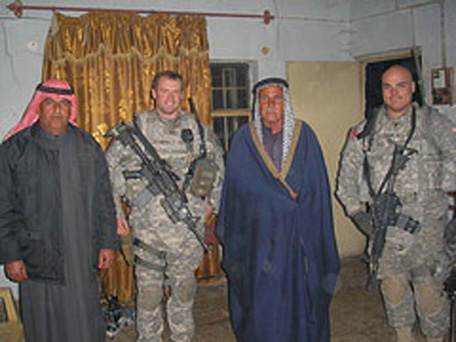
There is still plenty of daily combat going on—especially in the major remaining al Qaeda strongholds up north near Mosul, in the central “breadbasket” of Diyala, and south of Baghdad in Arab Jabour—but peaceful meetings like this are just as common. Counterinsurgency strategy places a premium on what has been called the “strategic corporal,” soldiers who have to think like an infantryman, act like a diplomat, and be able to change from one to the other on the fly. This is how the game is being played in the new, relative quiet of Iraq—especially in areas where despite the lull in daily violence, the war is still far from over.
In 1999, Marine General Charles C. Krulak wrote of the “three-block war” where soldiers in irregular conflicts “will be confronted by the entire spectrum of tactical challenges in the span of a few hours and, potentially, within the space of three contiguous city blocks.” In regions like the area around Courage, where the Iraqi national government is little more than a rumor, Krulak’s words ring true: “The individual [American service member] will be the most conspicuous symbol of American foreign policy. His or her actions may not only influence the immediate tactical situation, but have operational and strategic implications as well.”
At heart, much of this work is done by cultivating relationships—trying to show the Iraqis that American soldiers are strong but fair, an honest broker in a country rife with corruption and double-dealing, and under a government seen by most Sunnis as being sectarian at best, a tool of Shia Iran bent on violently subjugating the Sunni minority at worst.
Part of this relationship-building is figuring out who the power players are in any given region. The term “sheik,” I discovered, has become one of the more overused terms in Iraq. Once the Awakening movement (the original name for the Sons of Iraq) started in Anbar in 2006, and then moved through different parts of the country in 2007, Iraqis began popping up, assuring the Americans that they were sheiks who wielded power in their respective regions. The soldiers at Courage, (Charlie company of the 1st Battalion, 21st Regiment, 25th Infantry Division, part of the 2nd Stryker Brigade Combat Team) are new to the area, and “a lot of guys are coming out of the woodwork trying to assert themselves saying, ‘hey I’m a sheik, I’m in charge of this whole town,’ so you have to weigh that with what the old units told us about that guy operates,” Helberg told me as we walked to Munder’s house in the thickening darkness. Apparently, sheik Munder made the cut.
Not long after walking out of the T-walls protecting the 180 men at Courage, having been accompanied part of the way by two stray dogs that always follow patrols out of the gate, we stopped at a modest structure with a few cars out front. While the platoon pulled guard around the house, Helberg, his interpreter, and radio operator Timothy Wascher and I went inside. The typical rural Iraqi home is dark, dirty, and bare, with exposed brick walls and little in the way of furniture, but the sheik’s house was a small step up. He had two worn couches in the living room, a computer, and a few cushioned chairs shoved into corners. The walls were a smoke-stained blue, offset by a thick, gold curtain over the front window, and a few portraits and dusty prints clung to the walls. The front door was thrown open to the January chill. A few children ran around barefoot, and women were hidden away back in the kitchen.
No sooner had Munder passed out cigarettes and served few trays of chai tea then the lights went out. For a few minutes, the room was so dark that the only discernable objects were the cherries of five lit cigarettes moving up and down, gesturing to the invisible conversation. Power failures are so common that the sheik just kept talking; mostly about the dark days just a few months ago when al Qaeda ran the area, of the family members killed, how his sons had to drop out of school. He joked that he was thinking of renaming his tribe “The Rejected,” since that’s what al Qaeda used to call Shia.
Once the lights flicked back on, the food came out—platters of chicken, fish, rice, cucumber, tomato, and hot peppers, with stacks of flatbread. In typical gracious Arab fashion, Munder insisted that Helberg’s jundi (soldiers) come in a few at a time to share the meal.
But there was also business to discuss. The sheik complained about the shoddy nature of the local bridges. Helberg told him that he was having some engineers come up to check them out, and also to scout locations for a new road through the area. When the talk turned to infrastructure improvements, Helberg made sure to mention that he wanted the Iraqis to start going though the government to address their concerns, and not come to him with all their complaints. With the American military pushed out into the neighborhoods, American officers have become the go-to guys for everything that needs doing. Need power? Ask the Americans. Have complaints about the water quality? Tell the Americans. Want something built or repaired? The Americans. While this either means that the Americans are seen as the honest broker in the area or just have the deepest pockets, it overwhelms company commanders who need to funnel these requests up the chain of the Iraqi government, which requires dozens of signatures from technocrats all the way up the food chain for anything to get done. And in the weeks it takes to do this, the commanders are constantly pestered. The plan, now that security has been increased, is to get the Iraqis to start seeing the government as an institution that they can utilize for themselves, and stop using the Americans as the first point of contact. At this point, the idea doesn’t seem to be taking so well, so wide is the chasm between the locals and the national government.
One of the topics of discussion was a little local drama that had unfolded the morning before. Helberg had called a meeting of all the local Sunni and Shia sheiks to air their concerns, but some maneuvering by the Iraq Army’s Muthana Brigade, stationed nearby, threw a wrench into the plans. (The fierce Muthana Brigade is comprised of mostly Shia soldiers, and the residents of this area are mostly Sunni, who don’t trust the Shia-dominated Iraqi government or their Shia-majority Army.) The morning of the meeting, the commander of the brigade, General Nasser, held a rally to celebrate and publicize the fact that elements of the brigade had taken over a few checkpoints in the area. Many Shia happily attended, and there was a big show for the television cameras.
Having heard about the rally beforehand, the Sunni sheiks protested by staying home from the meeting, thinking that they were showing their displeasure with the Shia sheiks. Helberg was infuriated by the Sunni refusal to show, and refused to meet with the leaders of only one sect. It was no small problem, and one Helberg would seek to rectify the next day at a highly contentious meeting with Colonel Ehssan, the Sunni leader of the Sons of Iraq in the area, and some local Sunni sheiks. But for tonight, it was cigarettes, chai and plenty of food. Nothing of importance was decided, but some fragile bonds were established between the newly arrived American unit and a local who wields some clout. The walk home was cold and, save for the barking of dogs, quiet.
This is Part Five in an ongoing series.
Part One, “Up Close With the Counterinsurgency,” is here.
Part Two, “Meet the Sons of Iraq,”is here.
Part Three, “Fact From Fiction,” is here.
Part Four, “Dances With Strongmenm,” is here.
Part Five, “The Rejected,” is here.
Part Six, “Men With Guns,” is here.
Paul McLeary is a former CJR staff writer. Since 2008, he has covered the Pentagon for Foreign Policy, Defense News, Breaking Defense, and other outlets. He is currently a defense reporter for Politico.