

CAIRO—Isolation begets trouble. Myanmar and North Korea are isolated failures. Unvisited shut-ins die earlier than those with frequent human contact. Rumor mills grind their finest work when politicians hide out. You get it.
This is true with news organizations, too—yet in 2010, many news outlets still seem determined to close themselves off from their audiences. Most of the 6.8 billion people alive have never used the Internet, and roughly another 2 billion people will coinhabit the planet by 2050. That’s a lot of unique visitors, but plenty of today’s news organizations won’t be around to court them.
In 2006, the International Center for Media and the Public Agenda at The University of Maryland published a study examining twenty-five news websites for transparency and openness based on five criteria: 1) Willingness to openly correct mistakes; 2) Openness about corporate ownership; 3) Openness about conflicts of interest; 4) Openness about editorial guidelines; 5) Openness to reader comments and criticism.
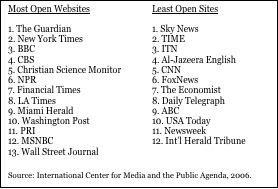
The list of most transparent news organizations contained many of the the most powerful global names in the business, and ones most likely to survive in some form. We can’t demonstrate through this categorization scheme, of course, whether the relationship between openness and longevity is directional. Newspapers with ombuds are typically more transparent than those without, for example, but news sites flush with more cash are the kinds of outfits that can afford ombuds in the first place. It makes sense that solvency would increase openness, as more resources are devoted to personalizing connections with audiences. But transparency and openness draw traffic, too, and plenty of news organizations aren’t paying attention.
Consider GlobalPost, an exciting, yet unopen, online news group scouring stories in dozens of countries. (Disclosure: I’ve contributed commentary to GlobalPost.) Their site’s contact page is a lonely little e-mail form, with no personalized contact information for editors, news desks, management, or anyone else. I’ve tossed unanswered messages into this digital darkness. The site contains no central corrections page, no contact information for correspondents, no guidelines for freelancers, and no free-trial period for their for-pay package.
For more than a year and a half following GlobalPost’s launch, readers wishing to comment on stories had to register, comment, and then often wait hours, sometimes longer, for editors to vet every assertion (commenting has since been made much easier). I highly value the work that GlobalPost is doing, and I’m grateful that they’ve published some of my work, but I have to give them a cold “F” on openness to dialog.
Compare GlobalPost’s contact page to that of Mother Jones or Politico, the latter of which has e-mail routes for everyone but the night cleaners.
We are in the “Listenomics Age,” wrote NPR’s On the Media co-host Bob Garfield in his book The Chaos Scenario. “Its defining characteristic: the herd will be heard. If you do not listen [to audiences], you are a fool…because your crowd is your greatest resource.”
It is common in online publishing to hear newsmakers lament how many dragons are lined up against them: devilishly low CPMs, noncommittal advertisers, audiences with attention spans shorter than their eyelashes. But an unimproving online draw also has something to do with shutting audiences out. Online news organizations that don’t publish e-mail contacts of their correspondents and editors, don’t have a clear corrections policy, and insist on creepily vetting every audience comment are partly to blame for any online loneliness they endure.
The vigor of online news organizations will ultimately depend on their ability to erect lasting paywalls, and a bellwether event is coming in 2011 when The New York Times raises one. But the volume of commerce within online paywalls will at least partly depend on an organization’s openness and transparency; paying subscribers demand far more openness and responsiveness than Willy the unique visitor. Additionally, even sites with paywalled news grounds, like The Wall Street Journal and, soon, The Times, will still court casual, non-paying visitors to generate ad revenue on the free portions of their sites, and they’ll need to make these visitors feel in the loop, too.
Regarding whether to give audiences e-mail contacts for reporters and editors, editorial guidelines, and visible corrections, that old axiom of academe still resounds: publish or perish.
Justin D. Martin is a journalism professor at Northwestern University in Qatar. Follow him on Twitter: @Justin_D_Martin