

CAIRO—The United States government has on occasion distressed over the nature of TV news in the Arab world and its perceived negative effect on public attitudes toward America.
During the Bush years, American officials repeatedly criticized Al-Jazeera for inciting anti-Americanism, and for its alleged flirtations with Al-Qaeda. In 2004, the United States launched its own Arabic news channel, Al-Hurra, to compete with the established satellite networks in the Arab world.
This December, the House of Representatives overwhelmingly passed a resolution encouraging the president to label satellite providers that carry TV networks of terrorist organizations as terrorist entities themselves. Those providers offering networks like Al-Manar and Al-Aqsa—run by Hizballah and Hamas, respectively—would be designated terrorist outfits.
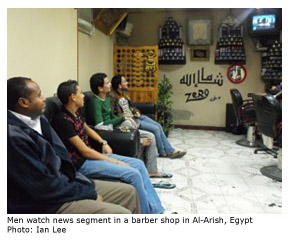 While these measures may appear proactive and meaningful, they aren’t. The United States’s televised message in the Arab world is dull and poorly managed, and the measures the government has taken to change this have yielded little perceptible benefit.
Consider Al-Hurra, a failure by any meaningful measure. I’m an Arabic-speaking American and I can’t even stand to watch it. The programming is boring, and the graphics and studios are often reminiscent of a 1970s game show.
Most damning for Al-Hurra, though, is the fact that many Arabs don’t know it exists; many of those who do believe it’s a PR tool for the U.S. military. This assumption is false, but not unreasonable, given that the network was conceived to improve America’s image in the Arab world following the Iraq invasion.
I recently conducted a survey of news use and attitudes toward the U.S. government among 321 young adults in Jordan, and just one person named Al-Hurra among the news networks they occasionally watch. The study, research for my Ph.D. dissertation at The University of North Carolina, found that young Jordanians mostly rely on Al-Jazeera and Al-Arabiya, the latter a Saudi-owned network, for their televised news. Al-Hurra was a non-entity as far as these young Arabs were concerned.
Al-Hurra, Arabic for “the free one,” is not at all free, costing U.S. taxpayers about $100 million a year, and it isn’t warming the hearts and minds with which policymakers are concerned. It’s an expensive project that isn’t part of the Arab conversation.
The United States’s image in the Arab world isn’t unsalvageable. With some necessary foreign policy modifications and a greater presence on Arab airwaves, America can shore up its image in a region sharply vital to national security. While funding its own Arabic TV network and targeting the portals of Hamas and Hizballah won’t earn the United States much affective capital in Arab countries, dispatching more Arabic-speaking U.S. officials to Arab news networks to discuss a number of specific changes in American foreign policy would.
Only once in the last year have I seen an Arabic-speaking U.S. official on an Arab TV network explaining American foreign policy, and I doubt many Arabs saw the interview, because it aired on Al-Hurra. It was an important interview, and one highlighting a major shift in U.S. policy: The closure of the U.S. prison in Guantanamo, Cuba. Interviews like this are too rare and, when broadcast on an insignificant network like Al-Hurra, inconsequential.
In 2004, former career diplomat and Arab media scholar William Rugh told Congress that “the most effective public diplomacy for Arab audiences involves dialogue by Americans willing to listen and able to explain the United States and its policies… [W]e should increase the number of trained professional officers with Arabic language capabilities who can explain America and its policies.”
I agree with Rugh, but with one qualification. In order for the United States to significantly improve its image in the Arab world, Arabs need news of necessary foreign policy corrections communicated to them on their own networks and in their own language.
In his important speech in Cairo last June, Obama asserted that the United States categorically rejects the expansion of Israeli settlements in the Palestinian West Bank, one of the clearest and boldest statements any sitting president has ever made about Palestinians’ core grievance. Fine. But why not dispatch more Arabic-speaking diplomats to Arabic news outlets to reiterate this policy when those networks assemble panels to discuss the conflict? The U.S. government isn’t bothering to effectively communicate changes in foreign policy that Arabs favor.
Ultimately, the United States will have to use Arab television to spotlight necessary adjustments in its foreign policy, in order to affect basic public opinion here. U.S. government-produced news and an opposition to extremist networks simply won’t do the job.
In January 2009, I was dining with a family of Iraqi refugees in Amman when Barack Obama’s first TV interview as president was broadcast on the Al-Arabiya network and translated into Arabic. The Iraqi family was astonished and proud. For a moment, this otherwise politically discarded family felt important, attended to, and relevant. After a few minutes, though, one family member said, “Well, that’s nice of Obama, but let’s see what happens in Iraq and with the Palestinian issue.”
Obama’s interview on Al-Arabiya, while momentarily uplifting to many Arabs, wasn’t enough. The United States must do a better job of discussing sounder policies on Arab TV in order to minimize anti-American sentiment in this part of the world.
Of course, the United States has no obligation to win a global popularity contest, and that’s not what diplomacy is about. But improving Arab public perception of the U.S. is one of our important security concerns, and it is also within the realm of the possible.
The satellite dish has for decades fed news of controversial U.S. policies into Arab homes. There’s no reason this same medium can’t be used to amplify news of our better policies.
Justin D. Martin is a journalism professor at Northwestern University in Qatar. Follow him on Twitter: @Justin_D_Martin