

Before the year ends, the president’s fiscal commission will bring forth a plan for cutting the deficit. While commission co-chairs Alan Simpson and Erskine Bowles have announced that everything that costs the government money is on the table—wars, hunger programs, agricultural price supports, entitlements like Social Security and Medicare, and thousands of other programs—only Social Security has risen to the top. That’s largely because of the public relations machine created by billionaire investment banker Peter G. Peterson and a mainstream news media that have so far paid scant attention to Social Security. (Peterson is a CJR funder.) If anything, Peterson’s message has gotten through. A Gallup poll found that more than half of current retirees expect their benefits to be cut, and sixty percent of all Americans believe that Social Security won’t be able to pay benefits when they stop working.
The stories and columns that have appeared border on the wonkish and elliptical, and have failed to tell ordinary Americans what’s at stake. What does all this talk mean for them? CJR went to the metropolitan area of Champaign-Urbana, Illinois, to find out. This is the second of a series of posts that discuss how possible changes in Social Security will affect the area’s residents. The entire series is archived here.
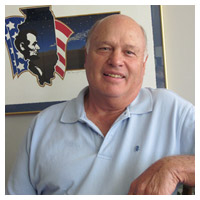 Lonnie Judy minced no words as he talked about Social Security. “It should be privatized,” he said. “If you were allowed to put money in an approved investment or savings account, that would be good. People thought their money was in a trust fund, but it’s gone into the general funds and has been used for everything else and is basically bankrupt.” In other words, Judy thought, private accounts might be safer; his contributions and everyone else’s had been used up, reflecting a misunderstanding of how Social Security works in the first place.
It’s not surprising that Judy, age sixty six, feels that way. He calls himself a conservative. He listens to conservative commentators on Fox News and Sirus XM Radio, to which he wanted me to listen with him. I did. The commentator talked about the “massive crushing debt of the entitlement programs” and said that government-run health care makes Social Security look like a joke. Judy had heard all the arguments for scrapping Social Security. “They [the media] have created so much scare talk. They [the public] are getting a very biased view of what’s happening.”
Judy is also a businessman. He owns a storage business and is well-off. He not only has a profitable firm, but also has investment income, and income generated by an eighty-acre farm his parents gave him. He told me he is “totally” against redistributing wealth. If Social Security were privatized and his personal accounts took a beating in the stock market, he wouldn’t be too fussed by the loss since his other funds would keep in fine shape during retirement. Others without his financial wherewithal would not be lucky, and Judy recognized that. “I have been fortunate to get into the right things here. My parents were fortunate.” His mother worked her way up to a senior VP at a local bank and his father, a carpenter, was also in the insurance business.
Although conservatives for years have talked about privatizing Social Security, that option isn’t on the table this time. However, some experts believe that if the system is means tested, which is being discussed, only low- and middle-income people would qualify for benefits, leading to a lack of support for the program among wealthier people. Eventually Social Security could turn into a welfare program like Medicaid as the social solidarity that underpins the program vanishes.
Judy explained the difference between Social Security and welfare. “Direct welfare programs are strictly tax supported,” he said. “Social Security is participant supported.”
Judy knew he had participated and had made his contributions all these years. When he turned sixty-two, he took his early retirement benefit—about $1100 a month. Why, I asked? “I could probably live without it,” he told me. “But I figured I may not recoup all my benefits so I said why not.” He went on. “Social Security is a contract with the government, and you’re entitled to it. I paid in and might as well draw it out.”
The conversation about taking early retirement benefits inevitably led to the singular question in the national discussion. Should the age at which someone receives full retirement benefits increase from sixty-seven to seventy? Judy did not think so. “It goes against my conservative beliefs,” he told me. He said while it might be a realistic solution, Social Security is a contract with an individual and should not be broken. “It’s a violation of the original contract. I should get what the system was set up to give me. If they want to change the rules, let them apply to new people coming into the system.”
Judy also understood that making someone wait longer for full benefits might hurt some people financially. “It’s going to be tough going. It’s going to be a hard pill to swallow.”
A new survey (pdf) released at the end of last week shows that Judy’s beliefs about raising the retirement age are in step with other Americans’ beliefs. When it came to raising the retirement age for Social Security, 65 percent of voters said no. The poll by Stan Greenberg and colleagues, commissioned by the Campaign for America’s future and Democracy Corps with support from MoveOn.org and the SEIU, found that while voters believed reducing the deficit is important, 68 percent said they would oppose major spending cuts in both Social Security and Medicare to reduce it; 28 percent said they were in favor of cuts. The pollsters said that number included 61 percent of Republicans and 56 percent of independents.
Trudy Lieberman is a longtime contributing editor to the Columbia Journalism Review. She is the lead writer for CJR's Covering the Health Care Fight. She also blogs for Health News Review and the Center for Health Journalism. Follow her on Twitter @Trudy_Lieberman.