

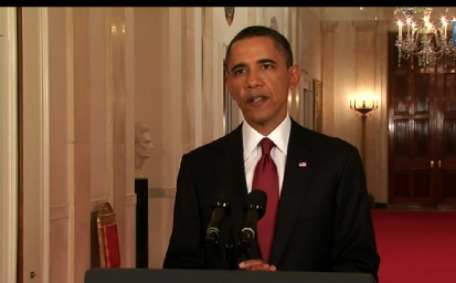
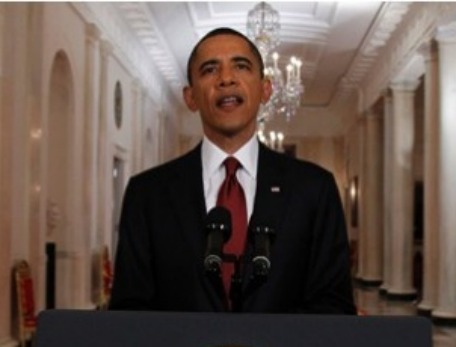
One of the images below is of President Obama delivering his historic “justice has been done” address live to the nation on Sunday night. The other image is of President Obama re-reading a portion of that address in front of a group of photographers shortly after delivering the full address to the nation (so that the photographers could get a shot of the president appearing to deliver his historic “justice has been done” address live to the nation).
Which is the reenactment photo and which is the real deal? In which image is history being made and in which is history being made up? (**Answer at the end of this post).
When you hear “reenactment,” perhaps you think “battles of the Civil War” or “crime segments on Dateline NBC.” You should also, apparently, be thinking “presidential addresses.”
Reuters photographer Jason Reed yesterday blogged about the experience of being called in to the White House late on Sunday to cover an imminent statement from the president. From Reed’s post:
As President Obama continued his nine-minute address in front of just one main network camera, the photographers were held outside the room by staff and asked to remain completely silent. Once Obama was off the air, we were escorted in front of that teleprompter and the President then re-enacted the walk-out and first 30 seconds of the statement for us.
After reading Reed’s post this morning, I wrote this on Twitter:
After prez ended live speech Sun. night, he “re-enacted…first 30 secs of statement” for photogs. (Really? Unusual?) http://reut.rs/kroEXx
And then I set out to answer my own questions by trying to track down some of the photographers who were at the White House on Sunday night. Before I could get very far, Poynter’s Al Tompkins posted a very detailed explanation addressing more or less everything I was hoping to find out (as well as several things that hadn’t even occurred to me).
To summarize Tompkins: Photographers weren’t allowed to photograph the real presidential address “because of the noise from the camera shutters and the placement of the teleprompter,” which “means the photograph that appeared in many newspapers Monday morning of Obama speaking may have been the staged shot, captured after the president spoke,” and, apparently, “this type of staging has been going on for decades.” Typically, photographers “disclose the re-enactment” in captions, though “not all newspapers reprinted those disclosures.” And, I’d add, not all news consumers actually read captions (lesson learned!).
Tompkins concludes:
It is time for this kind of re-enactment to end. The White House should value truth and authenticity. The technology clearly exists to document important moments without interrupting them. Photojournalists and their employers should insist on and press for access to document these historic moments.
In the meantime, anyone who uses these recreations should clearly disclose to the reader the circumstances under which they were captured.
On all points: agreed. And, in this case, the photo captions don’t “clearly disclose to the reader the circumstances under which they were captured.” Not entirely. For example, here is how Reed’s Reuters image was officially captioned:
U.S. President Barack Obama is pictured after announcing live on television the death of Osama bin Laden, from the East Room of the White House in Washington May 1, 2011.
“Pictured” doing what? Something that looks like an awful lot like announcing to the nation the death of Osama bin Laden. (Re-enacting!)
Here is the AP’s caption:
President Barack Obama reads his statement to photographers after making a televised statement on the death of Osama bin Laden from the East Room of the White House in Washington, Sunday, May 1, 2011.
But the president only read, according to Reed, about thirty seconds of his statement to photographers. He read–reenacted–just long enough to allow photographers to get the shot. This caption doesn’t convey that.
Brendan Smialowski, a freelance photographer who has covered White House events since 2003, was also at the White House on Sunday night working, in this case, for the European Press Photo Agency. Smialowski, too, photographed the reenactment and captioned one of his resulting photos (in which Obama’s mouth appears closed) as follows:
U.S. President Barack Obama stands after making a televised statement at the White House in Washington, D.C. on May 1, 2011.
That is, literally, what the president is doing in the image. We are told, as in the AP and Reuters captions, that what we are seeing took place “after” the presidential address. Still. I guess I’d like to see the word “reenactment” right there in all the captions. Several photographers used the r-word when talking to Tompkins for his piece. Smialowki used it when talking to me. Smialowski also told me that, as a journalist, he has “an issue” with these reenactments after photos. That he’s “always been a little uncomfortable” with them, but that he does his best to “address it in the caption, make it clear that it’s not the actual address.”
Doug Mills, a New York Times photographer, told Tompkins, “We [still photographers] have never, never, never, ever been allowed to cover a live presidential address to the nation!” Smialowski, however, recalled a time when he was able to photograph a presidential address as it actually happened: Obama was speaking to the nation from the Oval Office (Smialowski couldn’t recall the content of the speech) and photographers were “held outside in the Rose Garden and had the opportunity to photograph [Obama] through the window because the light was right.” He called this a “great compromise,” in that the president couldn’t hear the camera noise and there was “no way the president was going to look out the window and see one of us looking back at him” as it was nighttime.
A bit paparazzi, perhaps. Still, better than a reenactment.
(**Answer: The top image is a TV grab of the president delivering the address to the nation. The bottom image is Jason Reed’s photo of the president reenacting his address.)
Liz Cox Barrett is a writer at CJR.