

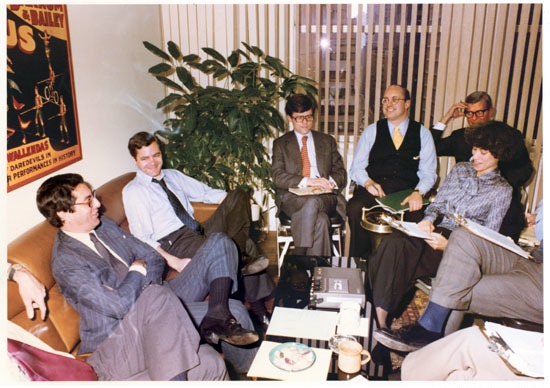
On the high wire Lynn Povich was named the first female senior editor of Newsweek in 1975. Here she is in 1977 with fellow editors (from left): Ed Kosner, Larry Martz, Peter Kilborn, Russ Watson, Dwight Martin and Povich. (Note the circus poster.)
Forty years ago in July, Ms. debuted as a stand-alone magazine. Thanks to the efforts of Gloria Steinem, Suzanne Levine (a former editor of this magazine), and their colleagues, a woman is now, by default, addressed without reference to her marital status. It is hard to overemphasize how important (and to be blunt, how unlikely to succeed) this campaign seemed at the time. And Ms. is still on the stands, having staved off a few near-death experiences.
So how about the media industry itself? Have we, to paraphrase the old Virginia Slims ad, come a long way, baby? Lately, there has been a flurry of data showing that major media outlets still overwhelmingly cite men as experts, even on women’s issues such as reproductive rights: A media watchdog called 4th Estate says, for example, that in six months of election coverage by major print and broadcast outlets, 81 percent of those quoted about abortion were men. As recent stories by CJR’s Erika Fry about the work of OpEd Project and VIDA have shown, women still write only 20 percent of the opinion pieces in traditional media, and even fewer on hard-news topics such as the economy (11 percent). There are still many more men’s bylines in the heady publications once staffed mostly by graduates of the then-all-male Ivy League (The Atlantic, Harper’s, The New Yorker, etc.). And stunningly, there were no female nominees this year in the major categories of the National Magazine Awards.
But there’s no denying that there has been progress since Ms. came on the scene. For a salute to 40 women who’ve changed the business in the past 40 years, click here. We also tip our virtual green eyeshades to 20 women we’d bet on to chart the future, as well as to Katherine Boo, a stubborn iconoclast who’s on her own singular mission.
A bit more than 40 years ago, several dozen young women at Newsweek sued for sex discrimination, paving the way for similar suits at The New York Times and Reader’s Digest. One of those who sued Newsweek, Lynn Povich, went on to become the magazine’s first female senior editor (and later, editor in chief of Working Woman and a senior exec at MSNBC.com). Her memoir about the suit, The Good Girls Revolt, will be published in September by Public Affairs. Povich has been in and around journalism since birth: Her father, Shirley Povich, was a renowned sportswriter at The Washington Post; her brother and sister-in-law are TV anchors Maury Povich and Connie Chung; and her husband is Steve Shepard, the longtime editor of Business Week who has since founded a new J-School for the City University of New York (and has a memoir of his own coming out). CJR editor in chief Cyndi Stivers spoke to Povich in June about what it was really like to sue her boss—and win.
How did you get your start at Newsweek?
When I graduated from college, half of my class got married—they earned their “MRS” degree. I wanted to go to Paris, and the only way I could get hired was as a secretary, so although I was a great typist, I had to take shorthand at night at Dutchess County Community College. Two weeks after I graduated college, I went to the Newsweek bureau in Paris as a secretary.
I met some wonderful correspondents there. One of the great influences of my life was a woman named Elizabeth Peer, the first woman correspondent in Paris. I would type their files at night on a Telex machine, which would send them back to the New York office; actually, I learned a lot by retyping things.
[In 1966,] I came back to New York as a researcher at Newsweek. Women were hired first on the Mail Desk to deliver mail, then on the Clip Desk to clip newspapers. If you were really good, you got promoted to be a researcher; at the end of the week, the women fact-checked all the stories. Only women would be hired as researchers, and only men would be hired as reporters and writers. Very few women had been promoted [from within]—there were maybe three or four. So, we were being good girls and doing our work. And then the women’s movement happened.
One of our friends, Judy Gingold, was having conversation with a lawyer, Gladys Kessler, who said, “Tell me about your job at Newsweek.” Judy explained that [virtually] all the women were researchers and all the men were writers and reporters, and the lawyer said, “You know, that’s illegal. Call the Equal Employment Opportunity Commission in Washington; they’ll tell you.” So she called, and the woman said, “Yes, it’s illegal. You ought to file a complaint.” Judy is the hero of our movement. She started talking to her friends, Lucy Howard, Margaret Montagno, and Pat Lynden, and then they came to me—I was the fifth. This was toward the end of 1969, the beginning of 1970.
Then something serendipitous happened: Newsweek decided it wanted to do a cover story on the new women’s movement. But they had no woman to write it. I had been promoted six months earlier to be a junior writer in fashion—because my boss didn’t want to write fashion anymore—but I clearly was not experienced enough to write the cover. Liz Peer was in the Washington bureau and could have written the story, but they didn’t reach out to her. Instead, they decided to go outside and hire Helen Dudar—a fabulous star writer at the New York Post.
That galvanized us. We decided that on March 16, 1970, the day that Newsweek published a story on the women’s movement, called “Women in Revolt,” 46 of us would announce that we were suing Newsweek for sex discrimination. We were the first women in the media to sue, and as you can imagine, the publicity was so fabulous—having these 46 twentysomething-year-old women suing the magazine on the day they were publishing a cover on the women’s movement. It got picked up all over the world: in Italy in La Stampa, in the London Times, and all over the place. And we knew the publicity would get to the editors, who considered themselves quite progressive, and in fact had been very good on the war and on civil rights. Osborn Elliott, the editor, put out a statement to the press later that day that said: The fact that virtually all the men at Newsweek are writers and all the women are researchers is a newsmagazine tradition that goes back 50 years. Hardly something you might want to say! Simply underscores the institutional sexism of a place like that.
When we were looking for a lawyer, it was very hard to find a woman who had employment-rights experience, because it was brand-new law. We ended up going to the American Civil Liberties Union, where we found Eleanor Holmes Norton, who was the assistant legal director. She grabbed [an issue of] Newsweek from our hands and said, “Well, the fact that there are men from here to here on the masthead, and women only in the bottom category, shows that this is a pattern of discrimination, so I’ll take your case.” What was delicious was that the editors, who were very, very liberal on civil rights, were suddenly faced in negotiations with a five-foot-seven, pregnant African-American female lawyer with a giant Afro. They were totally flummoxed. They had never, ever been questioned about their commitment to equality, and now here they were, being sued by their women, represented by an African-American. It was pretty amazing.
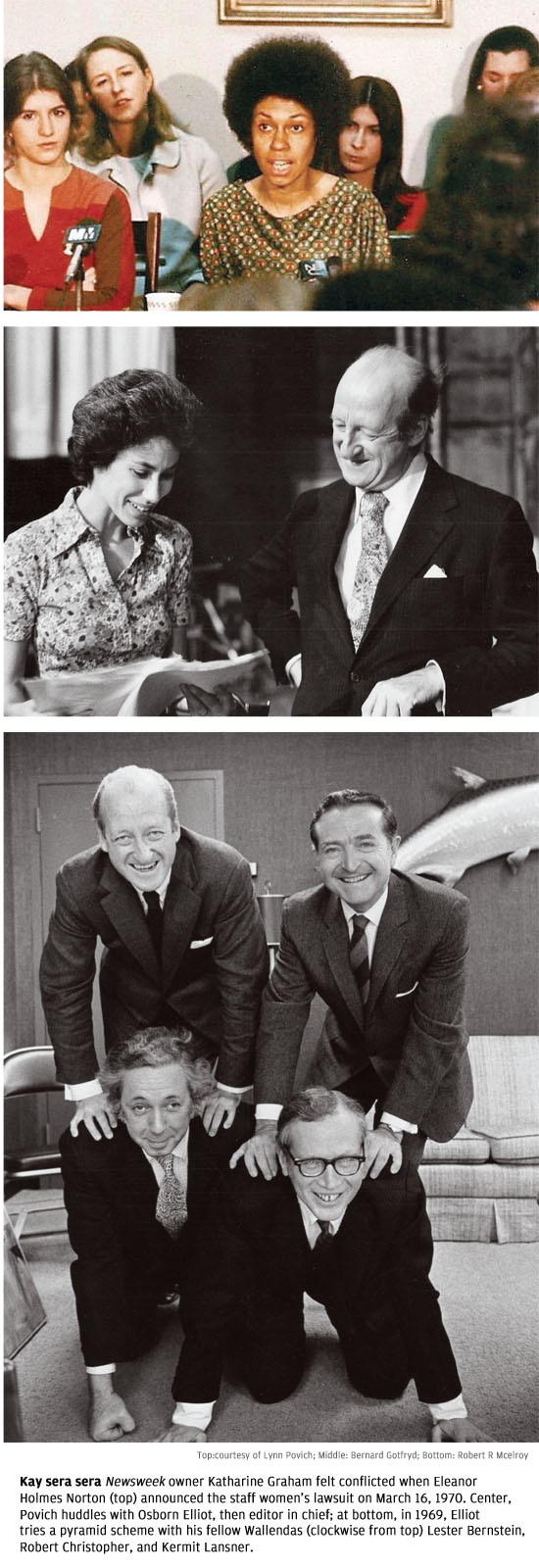
[The day the suit was filed,] we chipped in to fly our youngest researcher on the staff, Sunde Smith—because she could qualify for the student fare on the Eastern Airlines shuttle to Washington—to deliver a letter explaining why we were suing to Katharine Graham, who was the owner of The Washington Post, which owned Newsweek. Unbeknownst to us, Katharine Graham was vacationing in the Bahamas, so later that morning, after we announced our suit, Oz Elliott and the chair of Newsweek, Fritz Beebe, called Kay Graham in the Bahamas to tell her that the women had filed suit. And Kay Graham famously said, as she reported in her own book, “Which side am I supposed to be on?”
It just shows the confusion that was happening with women at that time. Suddenly, women had to challenge everything we had been raised to believe was a woman’s place in the world. And some of us had a hard time really doing it. Some of us were angry enough to be happy to do it. I wasn’t one of them. I wasn’t the first to get it, but I did see the injustice of how women were treated at Newsweek.
I have to say, there were a lot of women who came to Newsweek, saw the lay of the land right away, and left, and became very successful writers. Nora Ephron, who was hired as a mail girl—she left right away. Jane Bryant Quinn, personal finance writer; Ellen Goodman, columnist for The Boston Globe; Susan Brownmiller—they all left within a year, knowing that they would never be writers at Newsweek.
Describe the Mad Men-style office environment. That’s something people who are starting out today cannot believe.
The thing about newsmagazines [in those days] is, you have a class of young women who are coming in, and then you have all these guys: married, single, whatever. It naturally sets up this sort of “office wife” situation, because all these women are checking stories for these guys—the “holy writers,” as one of the women said. It was very tempting, and I must say, whether they were married or single, there was a lot of sex in the office. There just was. And of course, after the sexual revolution of the mid-’60s, even more so. Because there are a lot of people in their twenties, and hormones are raging, and the Pill had come, and the sexual revolution was on, so…
And there was no AIDS yet.
There was no AIDS. And most of it was consensual. It wasn’t sexual harassment, you know. As Nora Ephron said, they wanted to sleep with you, and if you said no, you didn’t have to. Nobody was really pushing you. So, on the one hand, there was a lot of sex, and people were having affairs all the time.
On the other hand, there were things that happened that today, you would say, really crossed the line. There were bosses who were having affairs with their direct reports. One of the senior editors who was having an affair with a researcher who reported to him, asked for her to get promoted, and she got promoted. Now, who’s to say why she got promoted? There was an editor who was stalking one of his researchers and said, “If you don’t marry me, you’re going to have to leave Newsweek.” Ultimately, she left.
So what happened after the suit was filed?
[The company] immediately decided to negotiate an agreement and settle; they certainly weren’t going to go to court! They would promise to hire and promote and give women writing tryouts and send some women to the bureaus. They did send some women to the bureaus, and that was successful—the women who had already been doing a lot of reporting in New York did well. The women who tried out as writers—three or four staff women—all failed, for various reasons.
After about a year, nothing much was happening. A couple women got promoted to reporters; one woman on the staff became a writer. Then they started hiring a few women from the outside to come in. About a year and a half into it, there were four new women writers, and about fifteen new male writers. So at a time when they’re supposedly aggressively looking for women, they’re hiring men at three to one. And believe it or not, two years later, we decided to sue again.
By this time, Eleanor Holmes Norton had become Human Rights Commissioner for the City of New York. So we hired Harriet Rabb, who was a new professor at Columbia teaching an employment-rights clinic. She was fabulous; she was just amazing. Now, two years later, there was enough employment-rights law that she was actually able to use goals and timetables and negotiate. We decided to sue in 1973, in the spring. At that point, Kay Graham was being sued by seven black reporters at The Washington Post called “the Metro Seven.” The women [there also] were restless and had been writing letters saying they were really unhappy with the situation for women at the Post. And now we had sued for a second time, so she was really annoyed. She called Joe Califano, who was the corporate lawyer for the Post. (He later became secretary of Health, Education, and Welfare, under Lyndon Johnson.)
Joe came up to negotiate with Harriet and a group of us on the women’s panel. At first, he was very resistant to everything. Then Harriet said, “Look, we need one third of all the writers and reporters to be women, and we need one third of the researchers to be men—to show that this is not a female job; this is a job. Anyone who is coming into an entry-level position should do this job, not just women.”
The last thing we asked for was a woman senior editor. Joe said, “No, no, that’s management; you can’t tell us who’s in management.” We said, “Well, we aren’t signing an agreement that doesn’t have a woman in the meeting where the decisions are being made.” So finally he caved in, and we signed the agreement in the spring of 1973. We said, “By the end of 1975, Newsweek will have a woman senior editor.”
How did that turn out to be you?
Ed Kosner, who was the managing editor, called me up in the spring of 1975 and asked me to try out. In August, Ed became the editor—Oz moved up to editor in chief—and Ed appointed me as the first woman senior editor of Newsweek, in August 1975. It’s unusual that one of the people who was involved in a lawsuit ends up being rewarded with a position like that. Most of the women on the front lines at Newsweek, at The New York Times, at Reader’s Digest—their careers did not go so well.
You talked to some young women for your book. What do you think has gotten better, and what hasn’t changed at all?
After 1975—I use that only because that was a moment when a woman got into management—things happened very fast for women. I would say between ’75 and ’85, in all the news organizations, women just flooded into those positions. Everyone thought, “Boy, this is it.” Our mindset was that it was a pipeline problem: We just need women in the pipeline, and of course they’ll succeed.
You know, things ebb, things flow, and that’s okay, as long as they flow as well as ebb. In 2010, three young women at Newsweek contacted me, because they had just found out that we had sued Newsweek 40 years earlier. They were very unhappy because they weren’t getting ahead at Newsweek. By 2010, there was no Research category anymore—it had been eliminated—so every woman hired at Newsweek was either a reporter or a writer. But they realized the men were getting better assignments; they were moving ahead faster. [The women] weren’t being listened to—they felt marginalized. And it was post-feminism. The sex wars were over, we were equal now, so it couldn’t be discrimination; it must be them. They must not be talented enough to get ahead. Then we talked to them about our story.
They decided to write a story in Newsweek about young women in the workplace today, and the kind of subtle discrimination that still exists—not the discrimination of our era that was so obvious, but small things: management that feels more comfortable with men around them than women, styles of how to approach things, [women] not putting [themselves] forward, and being assigned more “female” kinds of stories, not the tougher stories.
It took them a long time to get it in the magazine. I give Newsweek credit; they did publish the story. And it was a really good story. It not only talked about Newsweek and the news media, it talked about how women MBAs out of business school were hired at a lower salary than male MBAs. How women with no children, in the workforce, were still getting paid less than men.
To me, the most interesting thing about meeting these young women—and of course we all bonded immediately—was, they had no sense of history. They knew nothing about our case. They didn’t call themselves feminists.
After they wrote their story, went through their process of trying to get it published, and knowing that we were rooting them on and that we had this common history, they all became very interested in women’s issues. They now call themselves feminists.
At the Columbia commencement in May, I spoke to Gloria Steinem, who was getting an honorary doctorate, and she joked that now that journalism is a profession that’s been devalued, and is no longer trusted by the American public, women can run with it.
Well, yeah. [laughs]. I think in many ways, women are doing better; it’s just that you have to look. I think the issue now is at the very top. [Facebook COO] Sheryl Sandberg said that that’s true for women in the executive suites and CEOs and on boards—that there’s been no progress in ten years about the number of women there.
There are women everywhere in the media, and doing everything. But there is no woman at the head of NBC, CBS, ABC, CNN, or Fox News. Tina Brown is now the editor of Newsweek—for the first time we have a woman editor at the top of the masthead—and I think there’s a lot more opportunity now at Newsweek for women. Nancy Gibbs may well be the next editor of Time, and that would make her the first woman editor there.
If there’s one conversation I’ve had over and over again with women, it’s about the reluctance to put themselves forward that you mentioned. We get put into management positions because we’re empathetic, but that same quality that helps people get along means we’re often less likely to be assertive.
I think that’s true. Sheryl Sandberg has been talking a lot about an “ambition gap.” She says we’re not teaching our girls to be as ambitious as our boys. I think actually these girls are quite ambitious; it’s what happens when they show their ambition. She notes that the more successful men are, the more they are liked by men and women. The more successful women are, the more they are disliked by men and women. I think that is a societal fault; it is a cultural fault. One of the issues for men and women today is letting women be as ambitious as they want to be without stigmatizing them. She says we should teach our women to be as ambitious at work, and teach our men to be more ambitious at home.
When you look at those young women at Newsweek now, what do you think of the situation they’re facing?
The women I know are encouraged about their careers now. Their issue is still their lives—how they’re going to continue in a career they want to continue in, and still have children and other responsibilities.
Maybe the new platforms will make things easier? Or worse?
One would think that with technology, there should be more flexibility, but somehow it hasn’t worked out that way. It is now a 24/7 problem—for everybody. This is a male problem as well as a female problem. Of course men are [now] a lot more involved with their families, which is great. But it’s tough on two working parents with kids.
I really don’t know of a media organization that’s progressive in this sense. Maybe that’s one thing to look for. The International Women’s Media Foundation—I’m on the board—did a global study on the status of women in the media worldwide. Seventy or so percent of the top jobs were male, which was not surprising. What was interesting was that the regions where women were doing really well at the top were the regions where they had childcare policies—so, Western Europe, Eastern Europe, and the Nordic countries. More women were at the top of their news agencies there than anywhere else.
I think the big failure so far of our society in the United States [is] public and private support for working parents. Until we have more support, whether within the corporation or [from] government, it’s going to be a struggle for women. Every woman I know in her thirties right now is concerned about having it all, and doing it all. Being in the news is really tough. You never know when the phone call is going to come or when you’re going to be sent somewhere. You can’t plan.
That’s an area we really need to work on—for all of us, but particularly for young women.
Cyndi Stivers is a former editor in chief of CJR