

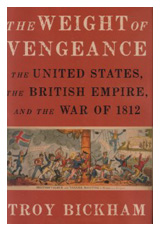
The Weight of Vengeance: The United States, the British Empire, and the War of 1812 | By Troy Bickham | Oxford University Press | 325 pages, $34.95
If any large-scale war in American history has been forgotten, it is the War of 1812. The war between Britain and the United States lasted three years and claimed the lives of 15,000 Americans. Delaware and Arkansas have memorials to the conflict, but the nation’s capital has not seen fit to honor its fallen soldiers from the war with any public tribute, even though the British burned down the White House in August 1814. One might think Washington would honor such a historic occasion.
 On this, the war’s bicentennial, the War of 1812 is especially important to recall, since it reminds us of the dangers of going to war unprepared, without clear goals, and by choice.
Texas A&M University historian Troy Bickham makes the case for the war’s importance in his new book, The Weight of Vengeance. He does so by “tak[ing] a broader view of the war, interpreting it not simply as a North American affair but as an Anglo-American struggle set against a global backdrop of armed conflicts.” In particular, Bickham shows how Britain’s struggle against Napoleonic France influenced what it calls “The American War.”
Rather than structuring the book chronologically, Bickham organizes it into chapters examining different aspects of the war. The respective American and British cases for war, and wartime opposition in both countries, for example, are all given separate treatments. This has the effect of stopping the story at riveting points, and it is unclear why opposition to the war is considered worthy of consideration as a subject, while, say, military battles are not.
The Weight of Vengeance argues that the war was very deliberately waged by the Americans. Led by President James Madison, the United States felt that its sovereignty was simply not being respected by its former colonial masters. When Madison listed his reasons for going to war in a letter to Congress, they included Britain’s ongoing interference with the international trade of the U.S.; the impressment of sailors from American merchants on the high seas; and Britain’s encouragement of American Indians to rebel against American authority. It was determined to rectify that situation, even at the cost of war. The US was eager to swallow Canada, and assumed that since Britain was preoccupied with its European problems, it would, to borrow a term from a recent war, be a cakewalk. The Brits were less eager to go to war, but they, too, were perfectly prepared to do so. “Even though Britain had no intention of reabsorbing the United States formally into the empire, keeping the former colonies as a client was a real possibility,” writes Bickham. They too misjudged their opponents, underestimating America’s resolve to become a truly free nation.
The result was a bloody, unexpectedly lengthy, and wholly avoidable conflict, which surprised and taxed both sides. The Weight of Vengeance highlights how weak and unprepared the Americans were compared to Britain, which was, at the time, the strongest power in the world. Difficult as it may be for contemporary readers to believe, the United States was then a poorly armed nation. “[T]he United States had no ships of the line, a mere eight frigates to Britain’s 124, and twelve sloops; and of these twenty American ships only seventeen were unfit for service,” Bickham writes.
For Bickham, the War of 1812 was of major significance in that it killed the last vestiges of Anglophobia in the United States, and committed Americans to republican rule. The country also committed to building stronger defenses, a pattern that lasts today, 200 years after the war began. England was forced to recognize America as a country that could not be pushed around. Indeed, the Anglo-American “Special Relationship” that arguably continues to the present day was cemented in the 1812 War. The conflict convinced Britain of America’s power. Finally, the US became more determined to expand its borders, as it proved it had fine soldiers and seamen, writes Bickham.
From this fact, Bickham concludes that the United States won the war. “[T]he true primary issue of the war of 1812—whether or not the United States would be respected as a sovereign nation rather than humbled as a quasi-part of the British Empire—was resolved, and Britain had lost,” he writes. Most historians, in contrast, see the British as the victors, since they yielded none of the points on which America declared the war: the commercial maritime rights of neutrals, the impressments of sailors from American merchant ships, and Britain’s involvement with the American Indians living within the United States borders.
Bickham’s assessment isn’t quite persuasive. American entered the war determined to annex Canada, and it completely failed in that endeavor—so much so that it never tried to do so again. It is therefore difficult to see how America became more committed to an expansionist policy. As Bickham says, even while it was preoccupied with fighting Britain throughout the war, the US also pursued an undeclared quasi-war with Spain over the Floridas, aided a rebellion in Texas, and fought a series of wars with the American Indians. Long before Britain and America fought their second war, the US had purchased Louisiana, declared West Florida to be a US possession, and acquired much of Indian territory. The US was always going to expand, regardless of its war with Britain.
Nonetheless, his broader point is correct. America emerged from the War of 1812 far more self-confident and sure of its sovereignty than it had been previously. Britain never again attempted to rule its former colonies, even informally. America is far more familiar with its Revolution, but its conflict with Britain that concluded in 1815 should not be overlooked.
Click here for a complete Page Views archive.
Jordan Michael Smith is a contributing writer at Salon and the Christian Science Monitor.