

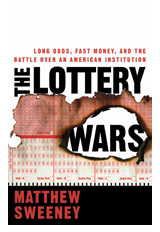
The Lottery Wars: Long Odds, Fast Money, and the Battle Over an American Institution | By Matthew Sweeney | Bloomsbury USA, 304 pages, $25
The purchase of a lottery ticket in America is an act of either supreme optimism or profound delusion, depending on your willingness to really consider the odds. In either case, the purchase is unlikely to win you much respect, as Matthew Sweeney makes clear in The Lottery Wars: Long Odds, Fast Money and the Battle Over an American Institution.
 “Lottery players are a punch line in popular culture,” notes the author. “Whether it’s a character on The Simpsons or the protagonist in My Name is Earl, a character that plays the lottery is usually a dope—a Big-Gulp-swilling, trailer-park-living piece of trash or an urban dweller, ignorant and poor. The general depiction is someone who is just dumb enough to throw away their hard-earned money on hopeless odds. These patsies bank on hitting a million-to-one chance instead of opening a savings account.”
Still, The Lottery Wars is neither an indictment nor endorsement of the lottery and its effects on participants. Sweeney doesn’t take sides. Instead, he considers the media’s fascination with the one-in-a-million, rags-to-riches stories–and they almost always are rags-to-riches stories, since the poor shell out far more money on lotteries than the wealthy. Sweeney assembles a gallery of people who have won big, and despite his sensitive treatment, the pictures are not encouraging. In almost every case, the winners have squandered their payout. They buy fast cars and big houses as old friends materialize to ask for handouts. Eventually the money runs out. Some turn to God, others denounce the lottery as the instrument of their ruin and call for its abolition. Still others lose all sense of fiscal proportion, like poet who declined to give a reading in Manhattan because the $500 fee is now too measly for him.
While the winners function as the lottery’s best marketing tool, Sweeney notes that their subsequent, often dismal stories have prompted at least some public ambivalence about the advantages of sudden, fabulous wealth. “A moral note has crept back into the culture,” he writes.
And yet lotteries are here to stay, not least because individual states have become dependent on them. As Sweeney reports, the thirty or so states that currently operate lotteries rely on them for about two percent of their budgets. This may seem like a tiny piece of the pie (no more than a rounding error, as the author puts it). But this government-sanctioned legalized gambling is big business, with much variation from state to state when it comes to how much money winners take home versus how much goes into the budgetary coffers. Though infrastructure and public schools are probably not on the minds of those who walk into convenience stores to part with five dollars for a scratch ticket, their actions amount to much more than a game in the halls of government.
Sweeney traces the lottery’s origins in America back to the Jamestown colony. It was the financially desperate Virginia Company that first instituted them to help fund its struggling overseas experiment. Here, the author points out, is an early example of the lottery’s rich and misleading tradition of sloganeering and dubious marketing. “Instead of promoting the lottery,” he writes, “they promoted the colony.” Then as now, there is no selling point like a noble cause. It certainly helped to sanitize some of the colonial lottery’s more unsavory aspects: children and the blind were commissioned to draw the tickets, as visible proof of the game’s fairness, and slaves were routinely raffled off as prizes.
The Louisiana State Lottery, founded in the 1860s, was among the first of its kind. It operated by mail and drew players from across the country, with a nickname—the Octopus—that reflected its wide reach and strong hold on politicians. Early on, the company obtained a state charter that prohibited other lotteries from forming. When the public clamored against this monopoly, the company enlisted as a spokesman the Confederate general Jubal Early, who offered a novel argument: if lotteries were so evil, it was better that there be only one of them. Congress felt differently, dissolving the Octopus in 1890. Its corruption left the public so wary that no state would touch a lottery again until the 1960s.
In the interim, an underground culture blossomed to cater to the public’s continuing hunger for the numbers game. These lotteries operated mostly in poor urban neighborhoods, and while illegal, they generally enjoyed the cooperation of law enforcement. “Established operators in the South Side and Harlem reached an understanding with authorities that included the voting power of their districts,” Sweeney writes. “When things were running smoothly between the policy kings, the police, and the politicians, signs hung in windows announcing the daily draws.”
The task Sweeney has set himself—explaining how this all came to be—has one formidable challenge: the legislation and lobbying, the taxes and state government budgets can make for rather dull reading. The result is that his exhaustive research is occasionally at odds with his storytelling. (The lottery business, he concedes, “is as much about negotiating the intricacies of state bylaws and access to those with control over contracts as it is about gambling and new technologies.”) Still, these foot-dragging passages are perpetrated in the service of a greater purpose: to bring into deep focus a single, familiar aspect of American culture, and to tell a story that most people, be they ticket scratchers or not, didn’t know was there.
Gregory Beyer is a journalist whose work has appeared in The New York Times and the Los Angeles Times.