

Strength in What Remains | By Tracy Kidder | Random House | 304 pages, $26
“The world is full of miserable places,” Tracy Kidder wrote in Mountains Beyond Mountains, his 2003 chronicle of Paul Farmer, a Boston doctor who worked to bring adequate health care to ill and desperately poor people in Haiti. “One way of living comfortably is not to think about them or, when you do, to send money.”
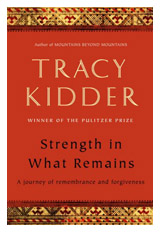 Like Mountains Beyond Mountains, Kidder’s new book, Strength in What Remains, is set in some of the world’s miserable places. Unlike Paul Farmer, however, the main character didn’t choose to be there. His name is Deogratias, and he is from Burundi, the East Central African nation that in recent decades has been as plagued by genocide and ethnic strife as its neighbor to the north, Rwanda, though its struggles loom perhaps less obtrusively in the consciousness and conscience of the West.
Raised on a mountain settlement of farms and pastures where cows are a form of currency, Deo enjoys a peaceful childhood among his parents, many siblings and extended family. Still, the agrarian existence means a life of labor for young Deo, set in a poverty-stricken landscape where children go hungry and the lack of a public health system results in widespread suffering from parasitic and infectious disease. In the face of these misfortunes, Deo’s people rely upon Christianity–imported by Belgian colonialists, who ran the country from 1918 until the 1960s–and bits of folk wisdom supplied by village elders: “When too much is too much or too bad is too bad, we laugh as if it was too good.”
Deo distinguishes himself as a student. His school, which is run by the Catholic church and where students are routinely beaten, is located far from his family’s home. Each day he makes the long trek “along paths that cut through pastures and banana groves and gardens of beans, and quickly through a dense wood where, he’d heard people say, bad spirits lurked, then down again to a stream bottom, a small piece of open flat land, where sometimes he and his classmates would meet up with kids from the Protestant school in Nanga and play soccer, or fight, or both.” As his classmates drop out or die from illness, Deo continues to excel at each level of his schooling. Eventually he enrolls in Burundi’s medical school, hoping to someday build health clinics to aid the poor.
In 1993, while Deo is still in medical school and working as an intern in a local hospital, the Burundian president is assassinated, setting off a violent panic and an explosion of simmering Hutu-Tutsi resentments. Deo, a Tutsi who has all his life only vaguely understood the country’s ethnic divisions and puzzled over the reasons behind them, is suddenly a marked man: the Hutu majority is killing every Tutsi it can find, waging low-tech total war with spears and machetes.
What follows is an account of Deo’s escape–an insufficient word, perhaps, to describe a predicament in which it is not clear what he is fleeing to or from. He runs and hides for six months. “It was impossible to plan, because he never knew where the dangers lay until he got close to them. The signs were obvious by now. Rising smoke meant burning houses up ahead, and wheeling birds a place full of corpses. Swarms of flies meant killings nearby. Sometimes he saw a dog trotting past with a severed head or an arm in its mouth. The main thing to avoid was other living human beings.”
Deo’s flight takes him across the border into Rwanda and a succession of refugee camps, where he hopes to pass as a Hutu. Eventually he manages, through the help of a medical school friend, to board a plane to America. He assumes his entire family has been killed.
Life in New York has its own difficulties. At first Deo finds shelter on the floor of a squalid Harlem building, but eventually takes to sleeping in Central Park. His job, delivering groceries for an Upper East Side supermarket, pays him fifteen dollars a day, and he can’t reconcile himself to the idea of accepting tips, which strikes him as a form of begging. But in a surprisingly short time, and with the help of several New Yorkers, Deo rises from the gutter of penniless immigrant anonymity to heights he never would have dreamed of.
Kidder divides the book into two parts, and to say that the execution is lopsided is more a compliment to its first half than an insult to its second. The events summarized above comprise the first half of Strength in What Remains. The author recounts them with extraordinary immediacy, made possible by his decision to venture into Deo’s thoughts, fears, and memories, complete with physical details.
As Deo mounts the staircase to the plane that will carry him from Burundi to New York, for example, Kidder writes: “In Deo’s mind, there was danger everywhere. If his heightened sense of drama was an inborn trait, it had certainly been nourished. For months every situation had in fact been dangerous. Climbing the stairs a moment before, he had imagined a voice in his head telling him not to leave. But now he stared at the hills and he imagined that everything in Burundi was burning. Burundi had become hell. He finally turned away, and stepped inside.”
That Kidder maintains this intensity for nearly 150 pages is a dual feat of reporting and imagination. The breathless, harrowing story of Deo’s run through the jungle is packed with violence, pathos and just enough historical context to orient the reader without distraction. And by alternating chapters between Burundi’s horrors and New York’s indignities, confusions, and pleasures, Kidder cleverly ratchets up the narrative momentum.
In short, the unremitting first section plays like an action movie. The second, however, is more like a director’s cut, furnishing deeper historical context and fleshing out the resumes of supporting characters. It also makes good on the book’s subtitle, “A Journey of Remembrance and Forgiveness,” as Kidder accompanies Deo to Burundi and Rwanda to revisit the landscape of his childhood and retrace the path of his escape.
Not surprisingly, this expository section lacks the immediacy and artfulness of the preceding pages. The book peaks at its midpoint and, lamentably, plateaus. Still, this less action-driven interval wrestles with the interesting question of Kidder’s–and by extension, the reader’s–relationship to Deo. How are we to live comfortably after immersing ourselves in the squalor and desperation of Deo’s Burundi, not to mention the trials of his life in New York?
Kidder approaches this question cautiously and responsibly–which is to say, without any pretense of truly understanding Deo’s story from the inside. At one point, the author and his subject visit a Rwandan genocide memorial situated in a former school. Inside, the skeletons of the victims are displayed on tables, their dented and crushed skulls testifying to incomprehensible brutality. Looking at the bones, Kidder is unsettled by his complicity in what can only be called the tourism aspect of the tragedy, especially as a “group of white-skinned people with cameras” comes scuttling up the path toward the museum.
And then there is the uneasy relationship between Deo and his benefactors in New York. It is never quite articulated, but subtly demonstrated over the course of many interactions, that Deo is frustrated by the suspicion that he is being shown off. There is, for example, the woman he meets while delivering groceries to her church. She is immensely helpful to the penniless immigrant, which doesn’t prevent him from feeling like a conversation piece: “He disliked spending time with her inside the rectory, because invariably a parishioner or priest would happen by and Sharon would say, “Oh, Father So-and-So, this is Deogratias,’ and then he would have to listen, half comprehendingly by now, as she told what she knew of his story, and often the third party would say he’d heard about genocides over there in Africa and that terrible thing between Hutus and Tutsis, and which was Deo, Hutu or Tutsi?”
Such moments deepen Deo’s character and highlight the inequality of nearly every one of his New York relationships. His benefactors are eager to help. Yet Deo–robbed of his family, his future, and his country–is reluctant to accept their assistance, or even to admit that he needs it. The book’s inspiration is watered by an awful lot of humiliation and suffering. But by interweaving the good and the bad, and by illustrating the almost sadistic symbiosis of the two, Kidder deftly punctures whatever self-congratulating comforts we might take from Deo’s story. And to his credit, he ensures that readers will emerge both inspired and unsettled by the story, and grateful for the convergence of its author and subject.
Click here for a complete Page Views archive.
Gregory Beyer is a journalist whose work has appeared in The New York Times and the Los Angeles Times.