

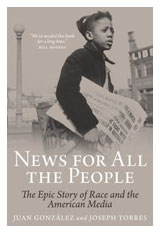
Juan González is a staff columnist for New York’s Daily News, a two-time winner of the George Polk Award for commentary, co-host of Democracy Now!, and former president of the National Association of Hispanic Journalists, where he was inducted into its Hall of Fame. With Joseph Torres, he is the co-author of News for All the People: The Epic Story of Race and the American Media, recently released by Verso. Ernest R. Sotomayor recently talked with González about some of the issues explored in the book. (Disclosure: Sotomayor was consulted by González for feedback on the book as it was written.) This transcript has been edited for clarity.
 Give us a lesson on what really happened when it came to people of color in this country, and their place in developing news media.
People of color were involved almost from the very beginning of the country in terms of developing their independent voices. They were able to do that for two reasons. One, they were excluded from the existing news media systems of their day because no African Americans or Latinos or Native Americans were involved in the early newspapers. And, two, there was government policy that allowed them to do that, and it was called postal policy.
You had over thirty African American newspapers before the Civil War, you had close to a hundred Spanish language newspapers before the Civil War, and twenty five in the city of New Orleans alone, you had a half dozen Native American newspapers and several Chinese newspapers, all developed before the Civil War because there was a government policy that if you could print a paper, the government would deliver it.
The main job of the postal system for more than a hundred years was delivery of newspapers, not letters. And this was the result of policy decisions made by the founders of the nation that dissemination of news and information was vital to the preservation of the republic. This was an information policy decision and a communications policy decision that allowed the United States to have more newspapers per capita than any other nation in the world.
Your journalism career has intertwined with a lot of activism in social issues, and always with the stated goal of promoting democracy. How did that affect you as you did this book?
My main concern was my frustration with the inability of those of us who are journalists to do our job well. And with all the pressures that the industry is under, and all of the other problems it has encountered in recent years, it was increasingly clear that it was becoming difficult for journalists to do their job, but I did not understand precisely why—not only just in terms of providing the kind of information that the American people need, but also in dealing with this intractable problem of racism, of coverage that was not racially inclusive, and that of the lack of diversity in the newsrooms. So what I was trying to do was get a sense of how our system of news got to where it is today. That’s what caused me to embark on this journey, to go back to the earliest period of journalism and take it to the present, to try to understand—independent of individuals, independent of companies, independent of enlightened strategies—why our system has been so resistant to change.
Do you feel, after examining what has happened in the last 300 years, that there is really a future ahead where the “system” is going to be far more accommodating, especially as we go into the Internet age?
What I learned is that there has been a general sense of progress, from a media system that began in Colonial times essentially as intelligence for the elite, and gradually became more and more of a system that at least purports to or attempts to provide news and information to the vast majority. So there is an arc of history from the news for the few to news for all. However, government policy plays a far greater part in that media system than I had expected or understood. Yes, there has been progress; however, that progress can be set back unless the new round of decisions about the Internet and about the digital era respond to the needs of the majority of the people.
You talk about how the government and regulators developed the newspaper industry though legislation like the Postal Act, but also hampered media in the hands of people of color: by stamping out amateur radio properties that could have developed to inform people of color; by giving licenses to known activists in the KKK; and by helping to build monopolies like in the telegraph and cable systems and radio. Have we forgotten those lessons, and are we headed down that same road with the Internet and cable and wireless businesses today?
Every new communications technology subverts the existing order, and then requires the government to step in to fashion new rules for the operation of the new media. Every new technology has started with the same promise: of liberating humanity, of providing new opportunities for diverse news to flow. That was the promise of radio, of cable, and now the Internet. However, after the new technology has been around for ten, fifteen years, then the real decision points happen: How will this new system really operate? That’s when the key issues have to be decided. So while there i¬s great promise in the Internet—there’s no doubt that the Internet has unleashed enormous amounts of citizen journalism, has broken down the gatekeeper functions of the old media companies, the major television stations, the networks, and the newspapers—there’s no assurance that ten years from now that will be the landscape that we confront because now what’s happened is that the gatekeepers are no longer the main producers of content. The gatekeepers are now those who control the pipes. The media powers of today are not really The New York Times and ABC and NBC. They are Comcast and Verizon and Google and Apple and Yahoo.
But you refer to some of that access that people have to the media as the “browning of the Internet,” with Latinos, and blacks and Asians and Native Americans and South Asians and others who have a great presence that they didn’t have before. So despite what is happening with the companies that control the delivery systems, you don’t think they really stand a chance to reach some equalization with other parts of society?
They do but the problem is: What will be the government policies that will allow them to continue to develop? For instance, we mention a lot in the book the future of net neutrality and the ability of small entrepreneurs and small producers of media to have their content transmitted at the same speed as the major companies. That’s one huge issue. The issue of the future of public access on cable is another. Public access programming on cable throughout the seventies and eighties became a major place where racial minorities could put on their own programming, could be heard. Public access programming is, of course, very uneven in its quality, but some of it is very good, and most importantly it’s local. The local cable company has to provide local public access, and therefore you get coverage of local elections and school board issues on public access television that the regular NBC or CBS affiliates don’t cover. So therefore to the degree that public access is preserved, then so will citizen access to cable be preserved. To the degree that public access is increasingly marginalized, and as cable systems expand from sixty to a hundred to five hundred to a thousand channels, what will happen to public access?
Some companies, newspapers particularly, have offered apologies for the roles they played in fomenting riots and violence against people of color. The Tallahassee Democrat, the Charlotte Observer, the Raleigh News & Observer have apologized for printing blatantly false reports. Should more companies do this?
Yes, I think so. We did provide several examples of media companies that have made public apologies for their blatantly erroneous and biased coverage. However, they are still a tiny percentage of the companies that had these practices, and to the degree that every community that was in one sense or another maligned by their local press, they all deserve an apology from these media companies. And I think it’s part of the process of healing, of showing that you’re moving forward for all of these companies to go back into their history and say “what was our role in fomenting racial bias, what was our role in fomenting pogroms or race riots or lynchings in the United States?” And I think that’s a process that every media company needs to go through.
In the last few years, the whole idea of racial, ethnic, and cultural diversity has been pushed to the backburner, in some cases completely wiped off media companies’ priority lists. How do we get that back to being something of importance to the people running these companies?
It became a priority in the 1970s as a result of immense racial and political disturbances, race riots, throughout the United States in the sixties. It was only after this period of massive upheaval that the media companies of America recognized that they had played a role in the racial divisions of the past and they needed to rectify their role. So they began in the seventies and eighties a process of greater inclusion. It did succeed in a lot of ways. To some measure it improved the situation, but not dramatically.
But now we’re in a situation, you’re correct, where racial diversity is the last thing that any major media executive in America is thinking about these days. They’ve got all these other problems that they’ve got to deal with to survive in the changing environment. However, the reality is the country continues to become more racially mixed and it will soon be facing the reality that the white population of the country is going to become a minority within a minority. So the reality is that the non-white communities of the United States are going to be the consumers, and sooner or later these companies are going to recognize that it’s not just a question of exploiting this new growing market. It’s also serving this public. It’s also providing the kinds of news and information that this new majority of America needs. And you don’t do it just by putting your least expensive editorial product into these communities to be able to get advertising dollars, but you actually have to serve the community.
Would social media allow communities of color to push these companies to action?
I don’t think so. I think social media is playing an important role. However, unless we get straight what is going to happen with net neutrality and the ability of that information to flow over the Internet in a non-discriminatory fashion, you have the potential to replicate on the Internet the same kinds of inequities that existed in old media. So that’s why my co-author Joseph Torres and I agree that the fundamental issue right now in terms of media policy in America is what happens to government policy on the Internet. And it’s not just net neutrality. It’s the issue of surveillance, and to what degree our companies and government are allowed to surveil everything that people do on the Internet; what are the privacy rights of Americans; and it’s the issue of as the advertising driven model of journalism, professional journalists, disappears, will there will be replacements, or must everyone become a citizen journalist, working for virtually nothing?
Have you found that people, by virtue of the Internet, have become more empowered just by being able to interact through engagement with social media?
Yes, but it is largely still a class and racial situation. Remember one third of the American people still do not have high speed Internet and that one-third is largely poor, disproportionately black and Hispanic, although with mobile devices and with phones that’s changing a little bit. But in terms of home-based broadband access, I get a lot of tips and information now from people on the Internet that I normally wouldn’t have gotten in the old days, but it’s still skewed to those who have, and are more familiar with, broadband access. You’re getting a significant percentage of the American people who still do not have broadband access. That’s the part of the population with the most problems.
You paint a somewhat dire picture for what lies ahead and you even ask in your book whether we’re headed toward a de facto apartheid system of media in the United States, in which the divide really deepens. Do you think we’re going there?
I think there’s the potential to go there if the citizens and the journalists do not get together to pressure for government policies that will change things. For example, in the seventies, as a result of enormous pressure on the government, under the Carter administration they passed the Minority Tax Certificate Program, which basically provided incentives to major broadcasters that were selling stations to sell them to racial minorities. As a result you had a significant increase in the number of radio and television stations owned by racial minorities throughout the late seventies and early eighties, until the Minority Tax Certificate Program was eliminated in 1994. Since then the pendulum has swung back the other way.
Similarly, the government could fashion tax policies that would favor independent ownership of Internet sites, that would favor entrepreneurial investment in minority-owned companies on the Internet, that would favor locally based media, because the problem with the Internet is that there is very little locally based media on the Internet. Everyone wants to reach India and Pakistan and California, but what about the neighborhoods right there in your own city? Depending on what kind of government policies are adopted that would favor and provide preferences for minority ownership of our media system, even on the Internet, then that will determine whether this citizen journalism develops in a different direction or whether it goes back into the old patterns.
What is the next book that needs to be written about the media?
The story of the Internet really has not been told yet. What were the political decisions that were made, not only in the United States, but around the world, to create this incredible information system? What were the decisions that could have been made to move it in a different direction? The Internet plays such a huge role in the lives of so many Americans, but most Americans really have no knowledge of how it developed. And I think that’s something I’d want to read; not necessarily write it, but I’d sort of like to read it.
Click here for a complete Page Views archive.
Ernest R. Sotomayor is assistant dean for Career Services and Continuing Education at the Columbia University Graduate School of Journalism. He was previously president of UNITY: Journalists of Color.