

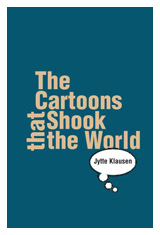
The Cartoons that Shook the World | By Jytte Klausen | Yale University Press, 240 pages, $35
Many Americans will remember the Danish cartoon controversy of 2006, which prompted violent riots, consumer boycotts, and death threats. Few will remember the cartoons themselves, and with good reason. In the United States, only a handful of magazines and newspapers reprinted the notorious drawings.
 Editors weighed arguments for free speech against concerns for public safety. They worried that republishing the cartoons might provoke more anger and bloodshed–and in the end, many, including The New York Times, declined to do so. In an editorial, the Times defended this position as “a reasonable choice.” After all, the drawings, which had originally appeared in Jyllands-Posten, a Danish newspaper, were “so easy to describe in words.”
In actuality, the images are quite confusing. There are a few exceptions, characterized by their horrible simplicity and simple horribleness (Muhammad with a bomb in his turban, for instance). But elsewhere, the cartoonists attempt jokes in Arabic, Danish, and English, mingle Muhammad with Saint Peter, and make esoteric allusions to Danish mores.
Now Jytte Klausen, a Danish-born professor of political science, attempts to make sense not only of the images themselves but of the controversy surrounding them in The Cartoons that Shook the World. As she explains, the ball got rolling in 2005, when the editors of Jyllands-Posten learned that an author was having trouble finding someone willing to illustrate a children’s book about Muhammad.
As an experiment–or perhaps more accurately, as a gimmick–Flemming Rose, the paper’s culture editor, wrote a letter to forty-two caricaturists in Denmark’s union of newspaper illustrators. He asked each artist to “draw Muhammad as you see him.”
Jyllands-Posten received twelve cartoons, which it printed in its culture section on September 30, 2005. They were accompanied by a provocative headline, “The Face of Muhammad,” and a rambling essay about free speech, immigration, and Islam, which Rose wrote. According to Klausen, “the feature was supposed to be a summertime prank with a serious edge, but readers did not see the cartoons as a joke.” Nor did Rose or his boss, Carsten Juste, have any inkling of what would happen next.
The outrage spread quickly, directed at the artists, the newspaper, and Denmark itself. Religious leaders tacked the offending images, which were widely available online, onto bulletin boards in mosques. Other offensive images, which Jyllands-Posten never printed, were circulated no less widely. The editors and cartoonists soon received death threats. By late December, Muslims in several countries had begun to boycott Danish-made goods. And by February, there were riots. Across the Middle East, protestors attacked Danish consulates and embassies.
As Klausen points out, diplomats tried to assuage the situation. Many experts believe that the situation could have been diffused if Anders Fogh Rasmussen, Denmark’s neoconservative prime minister (and now the secretary general of NATO), had apologized for the cartoons quickly and forcefully.
Instead the situation was allowed to fester indefinitely. As recently as October of this year, two Chicago men were charged in what officials said was a plot to attack employees of Jyllands-Posten. In that sense, the cartoon controversy is far from over, and Klausen’s history remains a timely one.
There is, however, a glaring omission in The Cartoons that Shook the World. None of the twelve cartoons has been reproduced in the book. In August, Yale University Press announced that it would suppress the controversial images, citing advice from a handful of academics, diplomats and journalists, including Marcia Inhorn, John Negroponte, and Fareed Zakaria. According to the publisher, “the decision rested solely on the experts’ assessments that there existed a substantial likelihood of violence that might take the lives of innocent victims.”
Klausen reluctantly agreed. After all, by her own count, the publication of the cartoons had already been responsible for at least 200 deaths and 800 additional injuries. Yale University Press had to tread lightly, and it was certainly within its rights to do so.
To justify its decision further, the publisher noted that curious readers could easily view the cartoons online. Here, at least, Klausen is clearly at odds with her publisher. In the text, she warns readers that “the longevity of such sites is unpredictable and they are often marred by obscene commentary and misleading translations of the Danish captions.”
In any case, it is important to understand the context in which the author, a professional scholar, proposed to publish the drawings. Yale had the opportunity to reprint the images accurately, with precise translations, under the aegis of one of the world’s foremost universities. And there was in fact a precedent: in 2006, Harper’s ran the twelve cartoons with an accompanying essay by Art Spiegelman, who wrote that “these now infamous and banal Danish cartoons need actually to be seen to be understood.”
That is the fundamental argument the press chose not to heed. Klausen has still written an important, thorough history of the Danish cartoon controversy, based on sound scholarship. It is unfortunate that her publisher prevented it from being a comprehensive one.
Click here for a complete Page Views archive.
David Gura is an associate editor at National Public Radio.