

In the spring of 2009, New York Times reporter David Rohde was being held captive by Taliban gunmen in a house in Waziristan, a mountainous region on the Pakistan side of the border with Afghanistan. Aerial drones soared overhead, filling him and his kidnappers with a sense of dread, until one day, he later wrote, “Our nightmare had come to pass.” A drone fired missiles near their house, killing several militants on a road and terrifying people in the area. The house withstood the attack but, Rohde wrote, “the plastic sheeting covering the window hung in tatters.” He learned about the efficiency of the drones on that day and also saw the wrath they incurred: “My captors expressed more hatred for President Obama than for President Bush.”
Rohde is one of the only Americans to see the drones up close: not, it turned out, as a reporter, but as a prisoner. His first-hand perspective on the strike is rare, and the novelty of his reporting underscores the difficulties of covering this new kind of war, a remote-controlled campaign officially denied by the US government that is unfolding in a region where Pakistani officials have forbidden reporters to travel independently.
Journalists are struggling under these challenging circumstances. Even those reporting safely from afar have not succeeded in digging down to basic questions about drone attacks: How are targets chosen? Under what legal authority? How successful are drones in killing enemies and sparing civilians? Are the drones helping win the war against would-be terrorists?
War reporting is one of journalism’s highest callings, and for good reason: citizens need to know if battles are successful, and what the costs are in blood and money. But it is difficult to grasp the new war that Americans are fighting in Pakistan. As described by former US officials who participated, it is conducted not by military generals but by cia officers who are guiding drones from offices in Langley, Virginia, that kill people in a country with which the US is not at war.
“I think this is an issue that we—both as a profession of journalists and the public—have accepted without sufficient debate,” said Washington Post op-ed columnist David Ignatius, who often writes about the CIA and national security issues. “There is something about assassination from ten thousand feet that is more acceptable than it would be from one foot, by the bayonet.”
Indeed, the existence of this large-scale, secretive program that is designed to “neutralize” people has become one of the biggest and least understood stories of the Obama administration. Because it is hard for journalists to bear witness, it is difficult for citizens to get a clear picture of what is being done in their name.
Drone Strikes Ramp Up
President Barack Obama has authorized 193 drone strikes in Pakistan since he took office in 2009, more than four times the number of attacks that President George W. Bush authorized during his two terms, according to the New America Foundation, a Washington-based public-policy institute.
Unmanned aircraft became part of the US arsenal in the 1990s, as reconnaissance drones recorded images of terrain in the Balkans. After the September 2001 terrorist attacks, President Bush signed a directive that authorized arming the drones, called Predators, with Hellfire missiles to try to take out terrorism suspects, according to military officials. He later widened the directive to allow strikes against anyone working inside terrorist camps, not just individual suspects.
Today, according to military officials, the United States is running two drone programs: the military is in charge of drones in Afghanistan, where the country is officially at war; the cia, meanwhile, runs the drone program in Pakistan, an ally in the war in Afghanistan. The drone operations in Afghanistan are relatively straightforward and US officials routinely release information about the attacks. In Pakistan, where the CIA is running the show, the situation is different.
Jane Mayer, the New Yorker writer who published in October 2009 one of the most penetrating stories on targeted killings by drones, said the Predators were “much more than just a breakthrough in technology—they were also a new frontier legally, politically, and morally.” In an e-mail interview, she described an intricate policy behind the secrecy: “It’s not, technically speaking, something that can be done under cover. But when the CIA is asked directly and on the record about its role, it denies having one.”
International politics play a role in that decision. The US government’s official denial, Mayer continued, “is in large part in deference to the Zardari administration in Pakistan, which prefers to mislead the Pakistani public about its acquiescence to the US drone strikes.” That acquiescence was always conditional and uncomfortable between the two allies, each of whom harbors suspicions of the other. In mid-April, Pakistani officials demanded that the CIA dramatically reduce its presence in Pakistan and that drone strikes cease, according to news reports, but, like so much of the US operations in Pakistan, it is unclear what is actually happening there.
In an interview with this author published by Newsweek earlier this year, former CIA acting general counsel John A. Rizzo pulled back the curtain a little and described the protocol set up to authorize a drone strike. One of the approximately ten lawyers in the CIA’s counterterrorism unit would review intelligence information and draft a memo asserting that an individual posed a risk to the security of the United States. After weighing the evidence in the memo, Rizzo, who retired in December 2009, would sign his name, noting that he “concurred.” The strike was then authorized.
Despite Rizzo’s unusual candor in that interview, he and other officials have fought to keep most information about the Pakistan drone war out of the public eye. Journalists have been unable to get answers to legal questions such as on what basis the government decides to kill. This is known as “distinction” in international law; in other words, how are those CIA lawyers discriminating between civilians and non-civilians who pose a grave threat to the United States? Also, how many civilian deaths can be justified? This is the question of “proportionality” in international law.
At this point, so little has been written about the way the CIA chooses its targets and executes its missions that some legal scholars argue it is impossible to know whether the program is legal. “I’ve been concerned that we don’t have the right kind of permission from elected officials,” said Mary Ellen O’Connell, an international law professor at the University of Notre Dame Law School. “Pakistan is not Somalia. They have a government we respect. It can be a weak government, but international law doesn’t allow you to act as if there is no government.”
A spokesman for the White House National Security Council, who spoke only on condition he not be named, rebuffed questions about why the administration refuses to speak with reporters on the record about the program. “You’re going to have a lot of people on the outside, and they all love to talk,” he said. “We can’t do that.” And, the official added, if outsiders are talking about the drone war, “that means they don’t know very much.”
Ignatius, of the Post, explained that Obama administration officials are sometimes willing to discuss drone operations in an attempt to promote the White House’s counterterrorism strategy. In February 2010, for instance, Ignatius was able to write a detailed account of the escalation of drone strikes because officials were eager to demonstrate that Obama was more aggressive in his pursuit of al Qaeda than Bush was.
“These rules about covert activities can be bent when it becomes politically advantageous,” Ignatius said. “When it suits them, you get quite a detailed readout.”
Yet rather than demand more consistent transparency from officials or undertake investigations that delve into the program, journalists often have simply relied on what US and Pakistani officials have told them. When reporters depend too heavily on government sources to report on a war, they end up following the narrative that White House officials have created, and in this way provide a one-sided view that obscures reality. The aerial strikes in Pakistan have been underway for nearly a decade, and yet many questions surrounding their use remain unasked and unanswered.
A Shadowy World
The Pakistani media have covered civilian deaths from drone attacks more consistently than Western reporters. Tallies from leading Pakistani media organizations report that as many as eighteen hundred civilians and mid- and low-level fighters have been killed in attacks since Obama took office, as compared to the twenty “high-value” militants the US managed to kill in that period, according to New America Foundation researchers. The number of civilians and low-level militants who have been killed are sketchy and have thus far proved impossible for US journalists to verify. News stories often cite anonymous Pakistani officials in their accounting of the dead.
“You’re left with this kind of shadowy world, and you pick up every discrete fact that you can—knowing all the while that you’re only getting a glimpse of something and not the whole thing,” said Yochi Dreazen, a former Wall Street Journal reporter and now a senior correspondent for National Journal.
Jonathan S. Landay, senior national security and intelligence correspondent for McClatchy Newspapers, said that when reporting in Pakistan, he has been forced to rely on the few Waziristan journalists and local officials who are reachable by cell phone for accounts of strikes. “There’s a network of tribal journalists who are very good, but one doesn’t know if you’re getting an exact count because you can’t eyeball it,” Landay said. “You can go in as an embed with the Pakistani military, but all that’s a dog-and-pony show.”
Pakistanis following news of the war get a completely different picture than those in the United States. For the past two years, there has been a drumbeat of death in the Pakistani media, with headlines like these on the website of Geo News, one of the biggest television networks in Pakistan: “U.S. Drone Kills 22 in North Waziristan”; “U.S. Missile Attack Kills 30”; “Death Toll in U.S. Drone Strikes Climbs to 19.” The victims are often impoverished teenagers who have gotten caught up in the Taliban, and are now dead, according to former CIA officials who had operated in the region. The picture that emerges through this war coverage—including in Pakistani newspapers like Dawn and The Daily Times—is one of incremental killing of bandits, drug dealers, and marginal characters by airborne missiles.
When the Western media do attempt to cover drone strikes that miss any high-value targets—and which, consequently, no US official is willing to discuss—their stories are thin. An example is a July 8, 2009, Associated Press report that ran in The Washington Post: U.S. DRONE ATTACK KILLS 12 IN NORTHWEST. Like dozens of other stories about the killings in Waziristan, the article tells readers nothing about those who were killed, why they were killed, or whether killing them had an impact on the terrorist groups that were targeted. Western reporters often learn of drone strikes from stories published in Pakistani media and, when they write their own stories, the reporters necessarily rely on local Pakistani stringers for details of the strikes beyond any scant Pakistani government information.
Pakistani citizens, not surprisingly, denounce the US drone attacks. In December, people took to the streets of Islamabad to protest the strikes and to show support for a Waziristan resident, Karim Khan, whose son and brother were killed in a 2009 strike and who has filed a lawsuit against the US, charging a CIA official for their deaths. In March, protests broke out in two more remote Pakistani towns. Student activists burned a US flag and an Obama effigy at one protest, saying the strikes were a violation of international human rights.
Pakistani journalists who have worked in Waziristan describe it as one of the most dangerous places in the world to be a reporter. They have not forgotten what happened to Hayat Ullah Khan, a journalist who freelanced for PBS’s Frontline. Khan, thirty-two, reported for a Pakistani newspaper on the death of an al Qaeda leader, Abu Hamza Rabia, along with four others in December 2005. They had been killed by Hellfire missiles in a strike orchestrated by Americans, and not, as the Pakistani government had declared, by an accident in their illegal bomb-making lab. Khan took photos, proving it was a drone strike, and the story prompted protests over the infringement of Pakistani territory.
The day after his story appeared, Khan was kidnapped. His body was found months later. “He could have been killed by Pakistani security forces or the Taliban,” said Iqbal Khattak, Peshawar bureau chief of the Pakistani newspaper Daily Times, and one of the few reporters who has done stories about the drones in Waziristan. “We don’t know.”
Another reporter who has braved that danger is Pir Zubair Shah. Shah grew up in a roughshod region of South Waziristan, where his father sent him to school and also gave him a rifle, so that he would feel comfortable both among the educated and the tribal members of society. This allowed Shah to float between the world of intelligence agents and the one inhabited by Taliban fighters, and his reporting helped The New York Times win a 2009 Pulitzer for a package of stories depicting the deepening US military and political challenges in Afghanistan and Pakistan.
Shah’s first bylined article, which appeared in Newsday in January 2006, was about a drone strike in Bajaur, in North Waziristan. The CIA operatives who launched the strike had been trying to kill a man thought to be al Qaeda’s number-two leader, Ayman al Zawahiri, but he escaped. Eighteen people were killed, and Shah took pictures of jagged, metal pieces from the missile that had exploded, as well as the fresh graves.
“It was just a scene of devastation,” he recalled in an interview. He spoke with people who lived in the area about the assault, and through his reporting on this and other strikes, American readers were able to get a rare glimpse of how the war was unfolding in Waziristan.
Shah, thirty-three, was taken captive by the Taliban in 2008 and released after the intervention of a local tribal leader. He is no longer pursuing risky stories. Instead, he will join Harvard in the fall as a Nieman fellow.
Selective Secrecy
Three days after Obama was sworn in as president, his administration launched its first drone strike, according to numerous news reports. A missile reportedly hit a house in Koresh Kot, a village in South Waziristan that was believed to be a Taliban hideout.
News accounts of the incident had few, and conflicting, details, underscoring the difficulty of getting basic facts. A January 23 article on Pakistan’s Geo News website said the attack was “reported to have killed 10 people,” but did not identify them. A January 23 New York Times article reported that the missile strike killed seven, including three children, citing Pakistani news reports. The story added, “American officials in Washington said there were no immediate signs that the strikes on Friday had killed any senior Qaeda leaders. They said the attacks had dispelled for the moment any notion that Mr. Obama would rein in the Predator attacks.”
A January 24 Washington Post story cast the incident in a somewhat celebratory tone, saying it was “the first tangible sign of President Obama’s commitment to sustained military pressure on the terrorist groups.”
The news articles mentioned only briefly the most disturbing part of the story: the drone struck the wrong target. Rather than being a militant, the homeowner had been a tribal elder who had attempted to organize a peace movement and was just the kind of person that CIA operatives had been hoping to encourage in their efforts to fight extremism. The supposed Taliban hideout was actually an eight-bedroom house that had cost $21,000 to build, a fortune in a country where the average annual income is roughly $500. The deaths of the father and others, along with the property destruction, left the family, including an eighteen-year-old son, destitute. The teenager called for revenge.
Those details were not gathered by reporters, but rather by a human-rights investigator, Chris Rogers, who was working with the Campaign for Innocent Victims in Conflict. His report, released months after the attack, shone a spotlight on the fact that civilians were killed in the assault. Rogers explained in an interview in Washington that he got the information by traveling to Peshawar, where he met with members of the homeowner’s family. Their accounts were supported by Pakistani government documents.
Journalists know that finding non-official sources is crucial in covering the drone war, especially under the tight-lipped Obama administration. “The only time I’m allowed to talk to senior staff or the nsc is for stories that make the administration look good,” McClatchy’s Landay said.
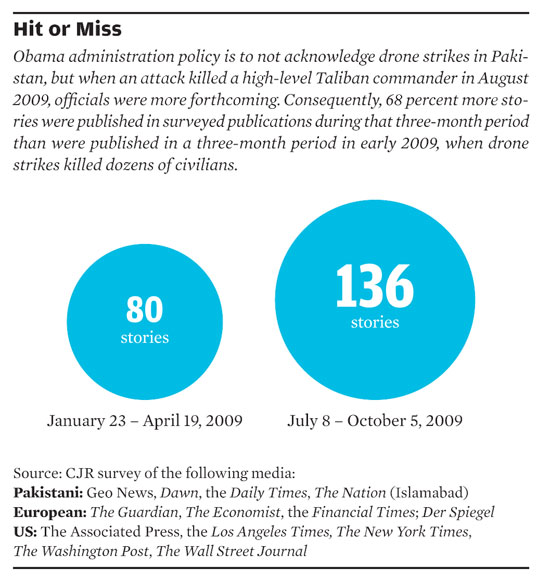
According to a survey of selected publications conducted by CJR, there were eighty stories about Pakistan drone strikes in major media outlets that regularly cover international news in the first three months of the Obama administration, when no “high-value” Taliban or al Qaeda figures were killed but at least 115 others died. But in the three-month period starting that summer, when a drone strike killed a Taliban commander, 136 stories appeared—68 percent more than in the earlier period (see graphic, page 45). Because reporters could only get sketchy information about the early strikes, they received little coverage. But when the commander was targeted and killed, the dire need for secrecy melted away.
At about 1 a.m. on August 5, 2009, a missile struck a villa in South Waziristan, while a Taliban commander named Baitullah Mehsud was resting on a balcony alongside his wife. He suffered from diabetes, and a medical practitioner was administering an intravenous drip to him, “according to two Taliban fighters reached by telephone on Friday,” an August 8 New York Times article reported.
A Pakistani official quoted in the story, who had seen a video of the assault, described what happened after the missile landed: “His torso remained, while half of the body was blown up.” Mehsud was killed, along with his wife, the owner of the house, and others. Three children were also injured.
Many of the articles that appeared in the US press had a celebratory tone and reflected the mood of American officials. Mehsud was, as Washington Post reporters wrote in an August 8 article, “something of an obsession for the CIA.” US officials were proud of the fact that they had finally taken him out and, over the course of several weeks, spoke candidly with journalists. For example, Mehsud’s wife had been “giving her husband a massage” on the balcony before the missile hit, according to a March 21, 2010, Washington Post article.
It is revealing to see when officials are forthcoming. One mission of the secretive Joint Special Operations Command became known during the Bush administration—when officials told journalists these soldiers helped track Saddam Hussein down to his hole in the ground in 2003. Obama administration officials broke their tradition of silence to describe the assault on Mehsud.
This is selective secrecy, and it inhibits the kind of reporting that would help Americans answer a very basic question: Is the drone war working?
“Drones are here to stay,” explained the New Yorker’s Mayer. “So being for or against their use isn’t really where the interesting controversy is at this point. The argument is over who is a legitimate target, how that is decided, what legal framework covers this sort of warfare, and how many innocent lives can be justified as so-called ‘collateral damage’ in a drone strike—morally, legally, and politically.”
Some of the most resourceful reporters in the news business have pushed hard for more access to information about this remote-controlled battle and a few have made some progress. But too often, journalists have settled for only meager morsels to fashion their stories. A more whole-hearted pushback is in order, with top newsrooms banding together, backed by their legal departments, to try to force a more substantive and open public policy debate on whom and how the US decides to kill with the push of a button.
Tara McKelvey is the author of Monstering: Inside America’s Policy of Secret Interrogations and Torture in the Terror War and is a 2011 Guggenheim Fellow. Research assistance was provided by Jed Bickman of the Investigative Fund at The Nation Institute, which also provided financial support for preparation of this article.