

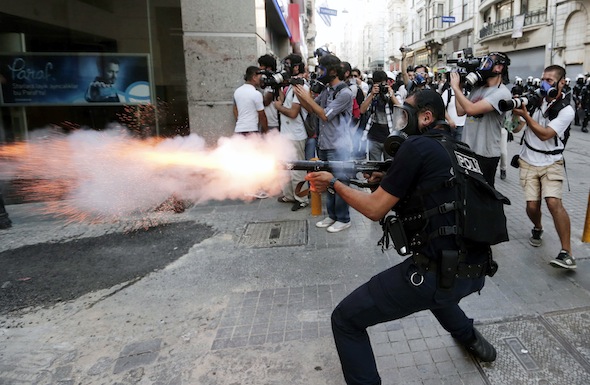
Are you a journalist? A Turkish police officer fires tear gas during an anti-government rally near Taksim Square in Istanbul in July. With everyone carrying cellphones and various digital gear, police had trouble distinguishing actual journalists from protestors. (EPA/Sedat Suna)
When young people took to the streets of Istanbul in June to rally to preserve a downtown park, the mainstream Turkish media ignored the protests. One major station aired a documentary about penguins, another broadcast a report on mental illness. Furious, demonstrators attacked a news van and assaulted several reporters. They also developed their own alternative sources of information, using Twitter and other social media to get the word out.
Turkish authorities, meanwhile, claimed the media were biased against them. Police targeted the press that did cover the demonstrations, while officials lashed out at the international news outlets, including CNN and the BBC. The Turkish prime minister denounced Twitter as a “menace,” and the mayor of Ankara used his personal Twitter account to attack the BBC correspondent, a Turkish national, whom he called a “traitor.”
As the protests raged in Taksim Square, the scene became so bewildering that NBC’s chief foreign correspondent, Richard Engel, actually expressed some sympathy for the Turkish police as they sought to distinguish protesters from the professional media. “There were people with big cameras, there were people with small cameras, and there were people with cellphones,” Engel told the UN Security Council at a July 17 briefing on threats to journalists around the world. “There were some people with cellphones who wore gas masks who were clearly part of the conflict and of the clashes that were ongoing.”
Engel urged the Security Council to make a distinction between “freedom of expression,” to which everyone is entitled, and the realm of special protection that applies only to professional journalists. This special journalistic realm Engel described would exclude, for instance, Syrian state television broadcasting pro-Assad propaganda and media activists using social media to document atrocities committed by the Syrian military. “Just as representatives in the diplomatic community need protection to be objective, if the international community wants professionals who are objective, we need some protection as well,” Engel argued.
For professional journalists who take pride in their objectivity and thoroughness, Engel’s notion may have appeal. But any effort by governments to grant privilege and protection to one class of journalists while excluding others is, in fact, a form of licensing, which is anathema to journalism. Moreover, the global information environment has become so complex that the traditional media–including the international media–is now just one source of news and information, and in some cases not the most objective one.
Take Egypt, for example. While the Egyptian media became more diverse and more open following the fall of Mubarak, they also became more polarized. Many journalists–including prominent professionals like Ibrahim Eissa, an editor and TV commentator–said the boundaries between journalism and activism had broken down. “As a journalist, your job is to seek the truth and defend your freedom, and that makes you an activist in this environment,” Eissa told me during my visit to Cairo in March. When the military moved in to topple the Morsi government, Eissa expressed active support for the troops. The military shut down media outlets that were sympathetic to the Muslim Brotherhood, claiming they were engaged in “incitement.” Reporters for Al Jazeera, whose coverage in Egypt was widely perceived to reflect the foreign-policy objectives of the Qatari government that had backed Morsi, were harassed, detained, and expelled from press conferences.
In Brazil, even as journalists covering public protests were arrested and attacked by police, they were also set upon by angry demonstrators who, as in Turkey, burned a news vehicle and harassed reporters. And in Russia, where television is subservient to the Kremlin and print media, with certain notable exceptions, generally respects the government’s red lines, Aleksei Navalny used his anti-corruption blog to gain prominence as an opposition figure and candidate for Moscow mayor. In July he was convicted on trumped-up corruption charges and sentenced to five years in prison.
Rather than erect barriers in the form of special laws, journalists should be breaking barriers down, recognizing that their ability to do their job depends less on defining a separate realm in which they operate and more on finding ways to ensure that freedom of expression is broadly defended and preserved–for journalists and non-journalists alike.
The issue is relevant not only on the front lines in Taksim and Tahrir, but also in the United States, where the issue of special protections for journalists is very much in the public debate.
In May, the Justice Department sent a letter to The Associated Press acknowledging that investigators had seized its phone records as part of a leak investigation. A week later it was revealed that investigators from Justice had obtained phone and email records for Fox News reporter James Rosen, who was named a “co-conspirator” in a separate leak investigation. In response to the widespread outcry, the Justice Department has revised its internal guidelines for obtaining information from the media. A proposed federal shield law would institutionalize these standards.
Meanwhile, prosecutors in the Bradley Manning trial argued (unsuccessfully) that Manning, who admitted to leaking thousands of classified documents to WikiLeaks (and who came out as a transgender woman named Chelsea after the trial), should be convicted of espionage and “aiding the enemy” because she knew that the documents she leaked, once public, would be accessed by Al Qaeda. Had that argument been sustained, it would have posed grave dangers to the mainstream press, according to some commentators.
Journalists can’t do their jobs if they can’t protect their sources, and they can’t do that if the government is monitoring their communication. This is why media organizations are fighting for a federal shield law. But journalists in the US need to be cognizant that allowing the government to develop a legal definition of journalism has tradeoffs and potential consequences, particularly in places around the world where the rule of law is weak and the separation of powers ill defined. A government definition of journalism in Egypt or Turkey, or even one put forward by the Security Council, could easily be used as a basis for licensing, a mechanism that would make it much easier to exclude critical voices from the public debate.
None of this means that journalists are indistinguishable from activists. In fact, the need for professional standards is even greater precisely because we are awash in information, and informed news consumers rely on media outlets they trust to sort it out for them.
But journalists need to understand that seeking to preserve their own privileged position is counterproductive in the current environment. Journalists need to fight to keep open an information space that allows them to operate and accept that within that space there will be all sorts of others using information for different purposes. It’s a messy, vibrant, volatile space, full of contradictions and shortcomings. But it’s a space that journalists need to defend.
Joel Simon is the founding director of the Journalism Protection Initiative at the Craig Newmark Graduate School of Journalism.