

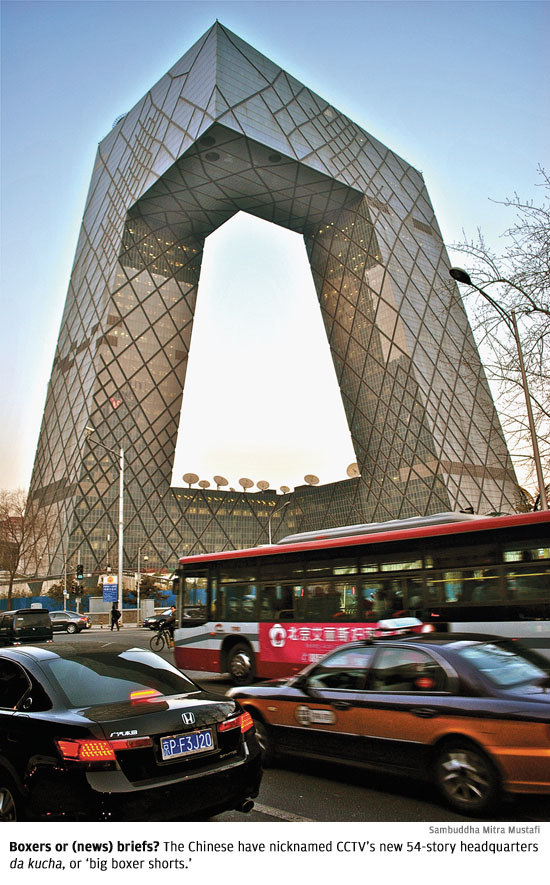
Locals call it da kucha, or “big boxer shorts,” because of its shape. China Central Television’s future headquarters in Beijing is 54 stories, twin towers of glass and steel connected by an angular wedge at the top. Overlooking the Central Business District, it stands out in a city whose architecture is a mix of imperial grandeur, gray communist-era buildings, and dazzling modern construction. Da kucha will be a striking symbol of CCTV’s expanding budget and global ambition.
And of China’s other global media ambitions as well. Among other things, the government is building an English-language world service that will compete with BBC News—but with what is said to be 19 times the annual budget of BBC, currently the world’s largest news organization.
Having already achieved the status as the world’s second-largest national economy, China has decided that it also needs soft power, the ability to influence world public opinion to promote its commercial and foreign-policy interests. “To some degree, whoever owns the commanding heights of cultural development, and soft power, will enjoy a competitive edge internationally,” declared a communiqué that came out of the October 2011 plenary of the Communist Party’s Central Committee. Toward that end, the Chinese government allocated $8.7 billion in 2009-2010 alone to “external publicity work.”
The beneficiaries of this largesse are mostly the Big Four state-owned media corporations—CCTV, China Radio International (CRI), Xinhua news agency, and The China Daily newspaper and website. From inside da kucha and other news bureaus across the world, the Communist Party hopes to remake the negative image of China that it perceives in coverage by Western broadcasters. It hopes to replace the images of urban pollution, self-immolating Tibetan monks, and sweatshop workers with those of its rapidly growing cities and a prosperous new consumer class.
The makeover is already well under way. “This is Africa Live from CCTV News,” declared Beatrice Marshall, a CCTV anchor in Kenya, as she launched the network’s Nairobi broadcast center in January. This was followed in February by the launch of CCTV America, with headquarters in Washington, DC, and about 100 journalists and support staff hired so far across the Americas. CCTV America launched three new programs in February alone.
If you happen to switch on your radio in Galveston, TX, about 50 miles southeast of Houston, don’t be surprised to hear, “You are listening to China Radio International.” KGBC, a small AM station in Galveston, carries English-language programming by CRI, as do 13 stations in North America, including WILD in Boston and WNWR in Philadelphia. Around the world, CRI broadcasts in more than 60 languages, nearly double the number on the BBC World Service.
One of the world’s premier advertising spaces, an electronic billboard at 2 Times Square, also blinks a Chinese message. Last July, Xinhua, the government-owned news agency, leased a 40-by-60-foot LED sign there, a few months after it moved its North American headquarters from Queens to a tower on Broadway. Xinhua is already among the largest news agencies in the world, with more than 10,000 employees in 107 bureaus. In the developing world, especially, it competes on an equal footing with The Associated Press, Bloomberg News, and Reuters. Xinhua’s Web-based English-language TV unit, CNC World, plans to expand into 100 countries.
At a time when most Western news outlets face budget cuts and retrenchment, the Chinese are rapidly expanding their global media presence. Hillary Clinton told the Senate Foreign Relations Committee in March 2010 that the US is losing the “information war” to new entrants like Al Jazeera and Russia Today—and CCTV.
In January, President Hu Jintao, writing in the Communist Party magazine Qiu Shi (“Seeking the Truth”), called on the Chinese to push back against Western cultural colonization: “The overall strength of Chinese culture and its international influence is not commensurate with China’s international status….International hostile forces are stepping up efforts to implement their strategies of westernizing and dividing China, with ideology and culture being key areas fields of their long-term infiltration.”
Money opens doors, but what exactly is China selling with this new soft power? What is the Chinese version of the American Dream? As Han Han, a 29-year-old blogger, put it in a recent essay on Chinese art and culture: “The restriction on cultural activities makes it impossible for China to influence literature and cinema on a global basis. Or for us, the culturati, to raise our heads up proud.” Is this also true for China’s journalists? How can they reconcile the pursuit of truth with their government’s history of trying to control the story?
I traveled to China last winter to get a glimpse of how China plans to make itself more attractive to the world. And more specifically, how it plans to begin to address a central question: Can many billions of dollars buy China’s international media the credibility it so desperately seeks?
Initially, at least, the signs didn’t look promising to me. Over two months and through several sources, I tried and failed to get access to the CCTV headquarters in Beijing. E-mails brought no replies, and people I spoke to were discouraging. It is almost impossible for an outsider, I was told, to get permission to visit the CCTV office. In desperation, I told CCTV that “access denied” would only reinforce the stereotype of China as a closed society. At the last minute, I received an e-mail from Liu Ge, the chief editor of CCTV News, who agreed to an interview.
CCTV’s current headquarters is an imposing, spartan building, a far cry from da kucha. The guards at the front gate let you in only with an escort, and another layer of security awaits at the building’s entrance. Inside, though, the mood is more relaxed. With spring festival around the corner, the lobby is decked with red lights and streamers. A chirpy intern guides me through long corridors and up a winding staircase until we reach a surprisingly small corner on the first floor— the newsroom and live-production hub of CCTV News, the global, 24-hour English-language news station.
Liu Ge greets me warmly and takes me to the production control room, where busy producers survey a maze of screens, deciding what to put on air. This is in January, and as I watch the anchor cuts to a correspondent in Abu Dhabi, where the Chinese premier, Wen Jiabao, has just arrived for the World Energy Summit. Two days earlier, when Jiabao was in Riyadh, Chinese companies and the Saudi oil giant Aramco had signed a deal to develop a 400,000-barrel-a-day refinery on the Red Sea coast. Politically, too, the premier’s visit to the Gulf was significant, as the Arab Spring has caused some anxiety among officials in Beijing. Naturally, China’s global media coverage of the visit trumpeted its non-interventionist approach in Arab nations.
It provided an opening for me to ask Liu about what I saw as a significant obstacle to China’s notion of going head to head with the likes of the BBC. Because state-controlled media can be a platform for the Communist Party to air its views, its news becomes suspect to audiences who are used to journalists asking difficult questions of leaders.
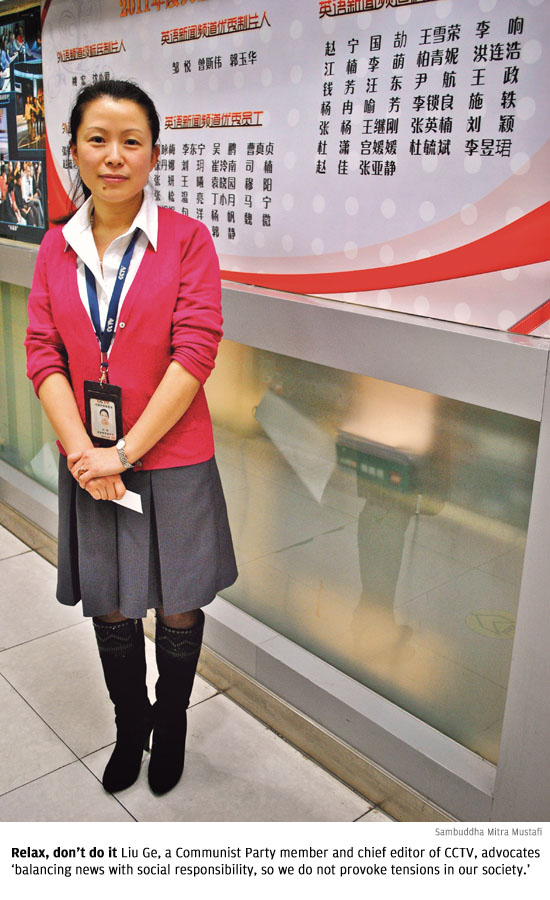
Liu, who has worked in CCTV’s international news team for 16 years and has seen English programming go from 30 minutes a day to a 24-hour operation, defended her team. “The West believes that bad news is always good news,” she says. “In China, we believe in balancing news with social responsibility, so we do not provoke tensions in our society.”
Like many of her colleagues, Liu is a member of the Communist Party. She has risen through the CCTV ranks over the years, but claims her party membership and journalistic career are unrelated. “We are doing news here, not propaganda,” she insists, “and people must know that. No media is without agenda. If you look at BBC or CNN, they won’t harm their national interest. So you cannot expect CCTV to go against Chinese interests.”
So Liu does not claim to be objective. She just says that there is no such thing as objective journalism, that it’s all agenda-driven. Fair enough. There are plenty of media critics in the West who feel the same way. Still, some of China’s state media reports seem straight out of the foreign-ministry spokesman’s mouth. For example, as Western governments and media criticized China and Russia for vetoing the UN Security Council resolution against Syria in February, CCTV published a Xinhua piece on its website headlined, “Harsh rhetoric against China’s veto of Syria resolution is misleading.” The story that followed lacked the kind of balance or nuance that Westerners associate with quality journalism.
Liu knows it will not be easy to change long-held perceptions of China in the West. “I don’t think it’s a problem that we are state-owned,” she says. “A lot of our revenue is dependent on advertising, so we don’t have as strong ties to the government as some may think.”
Can CCTV become the next Al Jazeera, a serious new player on the global broadcast field? Some people familiar with the inner workings of CCTV are skeptical. One, Wang Xiqing, worked for CCTV News for nearly eight years before joining the BBC as a producer in the Beijing bureau. “They have the ambition, but I am not sure they have the wisdom,” he says.
The tradition of top-down decision-making is a key flaw, in Xiqing’s view: “Senior party officials call the shots, and sometimes they give you orders that do not fit into the world of journalism,” he says.
At least one foreigner in the CCTV newsroom, Zakka Jacob, has a different take. Jacob was a TV presenter with India’s Headlines Today before moving to Beijing as a CCTV News anchor. He points out one advantage of being a state broadcaster: “The single guiding factor for any TV channel in India was ratings,” he says. “The absence of ratings gives me more elbow room to cover a story for what it is worth.”
Jacob says he has never heard of stories being influenced by orders from the top. He is among nearly 50 non-Chinese journalists who work at CCTV News’s Beijing headquarters, and many more are being recruited. Most are native English speakers, hired as copy editors to smooth the rough edges of the language barrier.
CCTV’s top management and editorial positions, meanwhile, are held by Chinese staff members, and the channel heads or presidents have to follow the diktats of the Propaganda Ministry, headed by Li Changchun. He is fifth in the pecking order of the Communist Party and Forbes magazine ranked him the world’s 32nd most powerful person in 2010, describing him as the man who “controls what 1.3 billion Chinese see, hear and speak.” CCTV’s recently appointed president Hu Zhangfan was editior-in-chief of the party-owned Guanming Daily. Last year, at a conference, he was quoted as saying, “The first social responsibility and professional ethic of media staff should be understanding their role clearly and be a good mouthpiece.” A lot of CCTV’s success will depend on how much independence these high-ranking party officials give the journalists.
China’s global media dreams hinge, to some degree, on covering regions and issues that Western broadcasters tend to ignore. “Your link to Asia” is the CCTV News tagline, and officials are betting that viewers from Asia and from developing nations will trust Chinese media more than they do their Western counterparts.
In Africa, for instance, China’s widespread investment in local industries and infrastructure has led to growing economic clout and goodwill. For Africans weary of the West’s bad-news-only coverage (poverty, political turmoil, natural disasters), CCTV offers a welcome alternative. On February 26, Talk Africa devoted its entire half hour to a London conference that brought together representatives from 50 countries to discuss solutions for Somalia. “New hope for Somalia” sounds like an overly optimistic title, but when you consider that the conference received almost no mention in the Western press, you begin to see how Chinese media can appeal to an African audience.
Still, China’s ultimate target audience remains the big economic powers of the world, the nations and regions that make or break decisions in multilateral forums: the US, Europe, Japan, India, and South Korea. These are also China’s geopolitical rivals, of course, and the most resistant to its influence.
So far, CCTV’s primary effort to reach those targets is through its business programs—Biz Asia and Biz Asia America, the latter presented from Washington, DC, and from the NASDAQ in New York. Both shows emphasize China’s position on key economic issues.
In addition to Biz Asia America, which is on daily, CCTV America airs two weekly programs. The Heat is a Saturday talk show on political topics in the US and Asia. On Sundays, the magazine program Americas Now takes an in-depth look at the Americas, particularly Central and South America. Produced by former 60 Minutes hand Barbara Dury, Americas Now will have contributions from CCTV’s 15 bureaus across the Americas, including Havana.
The DC bureau has journalists with solid American network experience, from NBC, CBS, CNN, and Fox. They have been joined by two Chinese correspondents from Beijing, along with their boss, Ma Jing, the director general of CCTV America. CCTV News America can be seen in the Washington, DC, area through MHz networks as well as on Comcast and Dish TV. Wider distribution is planned.
An angry dragon on a postage stamp was causing a stir while I was in Beijing. China Post had just released the stamp to commemorate the Chinese New Year, and this is the Year of the Dragon. But the fearsome creature on the stamp was accused by critics of scaring the world, and even some locals. Weibo, China’s Twitter, was full of sarcasm about the fire-breathing diplomacy. “This shocking creature on the stamp could well be the emblem of the Foreign Ministry,” read one Weibo post.
Dragons have been a symbol of Chinese imperial power for centuries, but the government actually prefers the cuddly panda bear, often using it as a diplomatic gift to other countries. After all, what’s more softly powerful than a panda?
The dragon furor provides a glimpse into China’s struggle with its image. The Chinese media effort to win global credibility is part of that struggle. Their mission is to bring what they see as China’s “true picture” to the world in a way that seems, well, credible. “We have a young team that needs some time to develop its reporting skills,” says Liu Ge, “but we have all the technology and other resources to compete with BBC or CNN. It is matter of five years; you shall see us in the top league.”
Perhaps. But a news organization looking to make a global splash needs a big story to put it on the map. Al Jazeera English was nowhere until the Arab Spring bloomed, a story on its home turf that it covered better than its more seasoned competition. CNN did the same with the first Gulf War, and became a household name across the world. The success of China’s global media effort may depend on whether its media can identify that big story when it arrives, and then let the coverage prove their journalistic mettle to the world in a way that declarations from well-meaning editors and officials never will. If CCTV can become the go-to channel for everyone in the world, even if only for a few days, it could change the game for good.
And when such a moment does arrive, journalists must be able to ask tough, relevant questions, even of the Chinese leadership. Does the leadership have the stomach for that?
It would be easy to dismiss CCTV ’s global push as an expression of government propaganda, but the reality is more complex: it also reflects the growing influence of China’s private sector, the peculiar brand of public-private capitalism that has powered the Chinese economic boom. While American soft power was largely a result of the creativity of its private sector, which made brands, technology, and cultural products that found global adulation, the Chinese version seems an efficient, assembly-line attempt. What’s unclear is whether it will have the same creativity and attraction for the world.
Tao Xie is one Chinese intellectual who is critical of the leadership’s narrow interpretation of soft power. Xie is an associate professor at Beijing’s Foreign Studies University, with a PhD from Northwestern University and an acclaimed book on Sino-US relations. He describes himself as someone who likes to push the boundaries with the Chinese leadership, and he often criticizes party policies, even on “hostile” networks like the BBC.
Xie sees an economic motive behind his country’s drive to globalize China’s media, movies, and academics.
“How long can you keep investing in railroads, highways, and airports?” he asks. “At some point, you will run out of urban projects. And there are signs that the economy is slowing down. The leadership thinks these low-pollution, capital-intensive cultural industries could be the next growth engine for China, at least for a short period of time.”
But can it work? “It looks increasingly to me that unless China has fundamental political change—transforming into a democracy—its security dilemma with US, India, or Japan will be difficult to soften, to say nothing of being eliminated,” he says. “Unless our system becomes more transparent, so foreigners know what our military is doing, how our decisions are made internally, and the process of foreign policymaking, outsiders will continue to suspect us. And they will invite the US to maintain strategic balance in the region.”
In soft-power terms, if the country with the better story wins, then China’s political system just may be the villain of its own piece.
Research for this story was supported by a grant from the Investigative Fund of The Nation Institute, for which we are grateful.
Sambuddha Mitra Mustafi is a Fellow with Swaniti Initiative based in Delhi. Follow him on Twitter @some_buddha