

At a story meeting for California Watch, the nonprofit investigative news startup, employees sit around a conference table as Robert Salladay, the organization’s senior editor, begins to describe the findings of a six-month investigation by one of his state capital reporters. “It gives me chills,” Salladay tells the group. “Each paragraph could be its own story.” Robert Rosenthal, the founder of California Watch, peers over his glasses at an open laptop, then nods in agreement. “The reporting is so amazing,” he says.
This is a sweet moment in any investigation, a charmed time that used to feel familiar in newsrooms, back when editors could afford to detach reporters for a few months of digging. Corey G. Johnson had used his shovel well. The California Watch reporter amassed twenty boxes of documents—so many that one government agency he’s probing set up a private office for him to go through the material. Now Johnson was laying it all out for his editors, certain he had uncovered something important.
The editors agreed; this was big. But then the conversation veered in a direction unfamiliar to traditional newsrooms. Instead of planning how to get the story published before word of it leaked, the excited editors started throwing out ideas for how they could share Johnson’s reporting with a large array of competitive news outlets across the state and around the country. No one would get a scoop; rather, every outlet would run the story at around the same time, customized to resonate with its audience, be they newspaper subscribers, Web readers, television viewers, or radio listeners. California Watch’s donors—at this point, a handful of high-powered foundations—expect it to publish high-impact investigative journalism about California as widely as possible.
“If we do six hundred schools [in a mapped database] . . . could we get KQED to come work with us?” Rosenthal asked.
“Maybe The Sacramento Bee or The Orange County Register could help with graphics,” suggested Louis Freedberg, California Watch director.
“Could we ask Long Beach to do the history . . . pull some stories and photos from their files?” asked Rosenthal, adding that perhaps they should enlist a few college students to help with on-site interviews. pbs was interested in the story, as were each of the television networks, Rosenthal said, ticking off a list of colleagues he’d already contacted to share the story’s gist.
“Okay. There are a lot of balls in the air here,” warned Mark Katches, California Watch’s editorial director. “How are we going to keep track of all this?”
California Watch is one piece of what Charles Lewis, the well-known founder of the Center for Public Integrity, calls “an emerging ecosystem of investigative reporting.” Nonprofit investigative news centers aren’t new; Lewis founded the Center for Public Integrity back in 1989. The Center for Investigative Reporting was launched even earlier, in 1977; it is the parent of California Watch and shares its offices in Berkeley. Rosenthal is CIR’s executive director and has overall responsibility for both it and California Watch.
What is new is that nonprofit centers have moved from the margins into a core role in investigative news production. This trend has been under way since 2007, when Paul Steiger, the former Wall Street Journal managing editor, announced that a foundation established by Herbert and Marion Sandler, the California thrift magnates, had given him a $10-million-a-year grant to fund what has become ProPublica. In April, the announcement of ProPublica’s first Pulitzer Prize helped solidify the sense that the investigative world is changing. (For a PDF chart showing the size, budget, start-up date, and founders of selected nonprofit investigative newsrooms, click here.*)
Some predict that commercial media will largely abandon high-cost investigations. “When I look at the next ten years, investigative reporting is going to die in corporate settings,” said Nick Penniman, executive director and co-founder of The Huffington Post Investigative Fund. “Nonprofits are the only place this reporting will survive and thrive over the long haul.” In a broad, social sense, he acknowledges that people do see the intrinsic value of a newspaper as its watchdog function. But the sad truth is, he continues, “it’s very difficult from a profit perspective to see the value of sinking millions into investigative reporting.”
Others, like Marc Duvoisin, deputy managing editor for projects at the Los Angeles Times, disagree. “I don’t know where it will settle out,” he said, allowing that perhaps as many as 40 percent of the investigations done in U.S. media could eventually be donor-funded. But—assuming revenue stabilizes (admittedly a large assumption)—he expects at least 60 percent of investigative work will continue to be done by mainstream media organizations.
Duvoisin thinks it’s great that philanthropies are stepping up in this emergency situation, as commercial media owners scramble to fix a broken business model during a prolonged economic slump. He compares investigative reporting to opera, which was popular entertainment, enjoyed and supported by the masses, in the nineteenth century. Today, it needs wealthy patrons to survive; hence, he said, “Mobil Oil ads in your opera program.” But that is not the path he believes investigative reporting will follow in the end, or should: “I’d hate to see this work given over entirely to nonprofits.”
Most everyone agrees that it’s still early in the nonprofit investigative news experiment, and hard to know what will eventually happen. Many use the “Wild West” cliché to describe the environment. Numerous centers of various size and scope are up and running and publishing their work, writing their rules as they go and attempting to engage new readers through social networking and other methods enabled by the Internet. Several others are teed up, trying to raise enough money to launch. Their hurried steps and missteps will determine whether the nonprofit model develops and endures or returns to its previous perch on the margin.
The overwhelming question faced by each organization is how to build multiple, stable sources of funding while maintaining journalistic integrity. It’s way too soon to know what those answers will be, except to say that there likely will not be a one-size-fits-all solution.
Lewis, in the hunt with the rest of them, has established his fourth nonprofit journalism venture, the Investigative Reporting Workshop at American University. And while he and others are figuring out how to sustain their operations, serious journalism is being committed in new and interesting ways at new and interesting places.
Despite drastic cuts in newsroom budgets over the past decade, it seems that investigative journalists are persistent sorts, hard to kill off. They continue to push for ways to do their work, even if it means founding new organizations to support them. “I do have a need to investigate the bastards,” Lewis said, smiling.
The new California Watch office, just down the street from the University of California, Berkeley campus, has the feel of so many similar offices set up at the beginning of the dot-com boom some fifteen years ago. It’s quirky and modern. The reporters work in an open space in a loft area at the back of the long, narrow, four-story storefront building, while Katches and Freedberg occupy the only two offices at the top of a landing. Others, including Rosenthal, sit below on the first floor in tiny, glass-walled cubicles. A few empty desks await new arrivals, but it already feels packed in.
The creative tension and excitement at today’s California Watch echoes, say, Yahoo! in 1995. Today’s sketchy plans for “multiple streams of revenue” at nonprofits sound a bit like the hazy hopes for “paths to profitability” at the dot-coms.
But there are distinct differences, too. Dot-coms blew up by the thousands, chasing “buzz” and “eyeballs,” squandering millions to get both, but without a clear business model. Today’s nonprofits can only hope to get their next round of donor cash if they produce something tangible—stories that create a buzz and, ideally, change something. So they prize “collaboration” and “transparency” and plow whatever money they can raise into substantive journalism. “My goal is to support and pay journalists to do high-quality work, not to earn twenty-two to twenty-five-percent margins,” Rosenthal said.
There is also a difference in scale. The money flowing into nonprofit journalism is a pittance compared to the venture-backed billions of the ’90s. It’s also a pittance compared to what’s been cut from traditional newsrooms.
Rick Edmonds, media-business analyst at the Poynter Institute, figures the newspaper industry has cut $1.6 billion in annual reporting and editing capacity since 2005, or roughly 30 percent. It is unclear how much of that hit investigative journalism—“We’ve tried to slice it a couple of ways, but it’s a very hard number to get,” said Mark Horvit, executive director of Investigative Reporters and Editors (ire). But, he said, there’s no question that investigative and enterprise reporting, especially in state capitals, has been slashed.
In any event, philanthropies have begun opening their wallets. According to a running tally kept by the J-Lab at American University, about $143 million of foundation money has flowed into news media enterprises between 2005 and April 2010. More than half of that has gone to twelve investigation-oriented news organizations, according to a tally by CJR.
That is not enough to replace what has been lost, of course. “National funders are not going to fund all of us,” said Maggie Mulvihill, co-founder of the New England Center for Investigative Reporting at Boston University. “They want to see us collaborate. We have to help each other.”
The imperative to collaborate has given rise to the new buzzword for this era: partnership. These investigative nonprofits all talk about their distribution “partners,” (i.e. newspapers, television news programs, Web sites, and radio broadcasters who run their work); their reporting “partners,” (i.e., traditional media reporters who team with the nonprofits, or university students who work with a nonprofit’s professional journalists, or groups of nonprofits who combine their efforts to nail a story); their user “partners,” (i.e., those who respond to crowd-sourcing queries or donate a few bucks via Kachingle or agree to pay for a membership or join a Facebook fan page or even those who simply post a comment on a story). Some even call their donors their “partners,” though others are wary of that because they fear their work being seen as supporting a donor’s cause.
The Center for Public Integrity has long partnered with commercial and nonprofit media on investigations, but its collaborations today “are at a new level than what we had seen,” said Bill Buzenberg, the center’s executive director. “It’s new. It’s different. It’s exciting. It’s a lot of work.”
Mark Katches was very busy. On his screen was a 147-inch story that he was cutting to a six-inch box that The Fresno Bee had agreed to run, though the Bee would refer readers to the California Watch Web site to see a full multimedia package. The stories were based on a four-month investigation by reporter Erica Perez about public university buildings in California that are judged to be dangerous to occupy in an earthquake. Next up was re-editing the story to a fifty-inch version to send over for a look-see to The Orange County Register, the San Francisco Chronicle, The Sacramento Bee, the Torrance Daily Breeze, and others. Nearly all the papers wanted a few graphs up high about the campus buildings in their circulation areas, and Katches knew from previous collaborations that a few editors would have good suggestions for tweaking the lede or tightening the nut graph. It’s not edit-by-committee, he said; it’s more like “a collective brain.”
Each nonprofit in this new ecosystem operates a little differently when it comes to distributing its stories, although all are hoping for the biggest possible impact. ProPublica offers its work for free, and often partners a reporter from its staff with one at a major news outlet. The two co-publish the exclusive work and then others are free to re-publish, with credit. “We’ve published about 225 stories with nearly 50 different partners over the last 21 months,” Steiger wrote in an e-mail. “Many of these have been bilateral partnerships, but some have been much more complex.” He cited ProPublica’s stories on police violence in New Orleans after Hurricane Katrina as one example. “We’ve worked first with The Nation magazine, and more recently (and simultaneously) with The Times-Picayune and Frontline.”
The HuffPo Investigative Fund generally works alone and then sends alerts out when a new piece is published on its Web site. Media organizations are encouraged to re-publish the Fund’s stories for free, with a refer to the Fund’s Web site. The Fund’s for-profit sister, The Huffington Post, often does; other news organizations, less so. Although he has not asked anyone specifically about the lack of substantial pickup, The Fund’s Penniman said he suspects the reason is an “aversion to work with what’s perceived as a competitive brand.”
Some media critics have questioned whether the HuffPo Investigative Fund should qualify for nonprofit status at all, because they perceive it as feeding the for-profit Huffington Post. Penniman rejected the criticism and stressed that The Huffington Post is treated like other major news outlets when he sends out feelers to see if an organization is interested in publishing an upcoming investigation. All of the Fund’s work is published open-source, and it collaborates with others to provide work for the public benefit. “It would be really hard to argue that we have not fulfilled the requirements for nonprofit status,” Penniman said, though he allows that the brand connection with The Huffington Post “is strategically advantageous for us.”
When The Huffington Post picks up a Fund story, it does get read. One of its first stories in a series about insurance-claims denials featured a rape victim whose mental-health expenses were rejected for reimbursement. “We did that story in multimedia. The woman looked right into the camera and told her story. It was so powerful,” Penniman said, noting that several bloggers jumped on the story, followed by a few television journalists. Then several female members of Congress drafted legislation to deal with the issue. “It was instant impact,” Penniman said. “I was so gratified to see that as a journalist.”
Most new nonprofits have to work hard for that kind of reach. The Wisconsin Center for Investigative Journalism, launched in January 2009 by Andy Hall, a veteran investigative reporter who had just left his job at the Wisconsin State Journal, generally e-mails editors and news directors around the state offering a story for publication, usually targeted to the upcoming Sunday editions. Those who are interested can download embargoed versions of the story, at full and condensed lengths. Local editors can add their own staff reporting to the stories and are not required to run the story on a specific day. Indeed, Hall said sometimes a newspaper or television station will run a story a week or two after it’s been released for general use and has been posted to the center’s Web site, Wisconsinwatch.org. Many other centers—including California Watch—attempt to fix a specific publication date, to give the story the biggest possible bang.
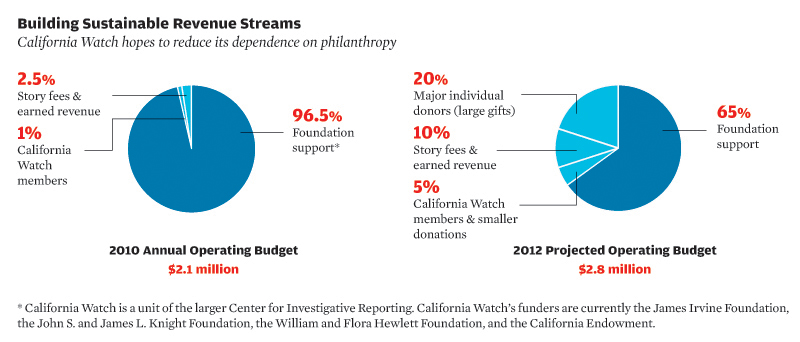
California Watch generally charges for its stories, although the amount slides from around $75 to $500, Rosenthal said, based on the size of the news outlet. The fee can be reduced if the publisher agrees to barter services, like taking photos or designing graphics that can be used by others that are publishing the story. La Opinión, for example, often gets its California Watch stories for free because it agrees to translate the pieces into Spanish for free; California Watch then redistributes the stories to other Spanish-language media.
Having worked for hours to tweak and insert and trim different versions of the same story for various partner papers, Katches vows that “these are introductory rates.” Rosenthal said he knows some editors who are willing to pay more. “I’m comfortable seeing what the market will bear, based on the quality of our stories,” he said.
(Click on image above for a larger version.)
Rosenthal said he initially hoped to build a destination Web site for California Watch’s journalism, but that’s no longer the main focus. This is a new media/old media collaboration: the first seven stories California Watch delivered this calendar year were published in newspapers with a combined circulation of 6.8 million, Rosenthal said, a huge reach that no start-up Web site could muster. He hasn’t had time to calculate the additional number of listeners and viewers reached by the radio and television stations that have run those stories.
That’s not to say that growing Californiawatch.org is not a high priority. Each reporter is expected to help keep the site current by posting a blog item daily. Deadline is 10 p.m. A copy editing intern works until midnight on the files, which are posted before 1 a.m. so that an influential state politics blog, Rough & Tumble by Jack Kavanagh, can decide whether to link to any of them in his morning’s suggested reads.
Katches also wants reporters to be as open as possible about their work. Each story they write is displayed on the site in a frame that links to their photo, bio, a general description of what they’re working on next, what they’re reading, and their latest tweets.
All this transparency was new to Lance Williams, a veteran investigative reporter who helped break many exclusive stories on the BALCO steroids-in-baseball scandal, along with reporter Mark Fainaru-Wada, when they were at the San Francisco Chronicle. Williams is now California Watch’s senior reporter. He admits being a bit baffled about Twitter at first, but then he realized that penning short bursts wasn’t that different from his days on a newspaper rewrite desk. “You don’t have to always do newspaper-style narratives,” Williams said, to communicate what’s important or interesting news: “A good tweet is like a good hed.”
Kristen Lombardi, a staff writer for the Center for Public Integrity in Washington, was the linchpin to what is perhaps the most ambitious multi-organization reporting project to date. She had worked for a year on a series about sexual assaults on college campuses that often go unpunished. Last fall, as the Center planned to release the first round of stories detailing the results of her investigation, her editors suggested she collaborate on a second round of stories with an emerging organization, the Investigative News Network.
That fledging group (see “Great Expectations,” CJR, September/October 2009) was forming under the direction of Buzenberg, Lewis, Rosenthal, and Brant Houston, the long-time executive director of ire, who now holds the Knight Chair in Investigative and Enterprise Reporting at the University of Illinois at Urbana-Champaign. Houston, who also served as chairman of the group’s steering committee, hosted weekly conference calls among the twenty or so member nonprofit journalism groups as they tried to find a pilot project they could truly collaborate on—a sort of “proof-of-concept” story to show donors that investigative journalists really can work together and deliver a story of major impact across the country.
Lombardi’s story made sense for the pilot. Many of the new nonprofit centers were housed at universities, so the reporting could resonate and influence those most directly affected by the issue. She had developed several good data sets that could be broken out for individual universities, including one of schools that participated in a federal grant program to reduce campus assaults. Lombardi said she didn’t feel territorial about her work. “I thought, ‘if only we had a giant team, we could create a huge ripple effect. . . . A lot could be uncovered with on-the-ground reporting.’”
Lombardi and her editors got five regional nonprofit news organizations as well as National Public Radio to sign onto the project, a feat made easier when the Center for Public Integrity secured a $40,000 grant from the McCormick Foundation to fund the collaboration. Her first wave of stories ran in December and the second set was planned for February. As she was in final edits on her first piece, she began working closely with reporters in Boston, Denver, Houston, Madison, Wisconsin, and Seattle as they scoured their campuses for information about what was happening in their regions. “I’m not going to lie. It was very hard to do,” Lombardi said.
At the Wisconsin Center, Hall agreed. The Center was one of the collaborators, and “I stayed up thirty-three straight hours at the end of the project,” he said. Not only was he overseeing the biggest project his center had undertaken during those hours. He was also meeting a deadline to finish a fundraising and sustainability plan for his center, discussing several upcoming stories with radio and television partners, and speaking to a reporting class about another project planned for this spring. “I’m also trying to run a startup news organization,” he said.
Hall was pleased when the University of Wisconsin responded to the report by pledging to review its policies and having its dean of students post an open letter underscoring that sexual-assault allegations will be taken seriously by school administrators. Other Investigative News Network collaborators also said the package hit the mark.
At the University of Massachusetts, Amherst, officials set up a commission to review their policies after the New England Center for Investigative Reporting led its story with a student who, after confessing to having raped a friend on campus, had been allowed to remain enrolled and escape significant discipline. Collaboration can get complicated, however. Despite its solid reporting, the story attracted some controversy because the version that ran on the front page of The Boston Globe omitted a sentence that was in other versions noting why Boston University, which houses the Center, was not included in the report.
When Maggie Mulvihill and Joe Bergantino, the associate director and director of the center, exchanged e-mails with a reporter from the Boston Phoenix who questioned the omission, the reporter wrote a story saying they had threatened him with libel, quoting a statement that read, in part, “An article that depicted our center as deliberately leaving BU out of the sexual-assault story so as to either protect the university or act as its public-relations agent would be totally inaccurate, defamatory, and display a reckless disregard of the truth.” Mulvihill and Bergantino told the reporter in an e-mail that their statement wasn’t a threat, but was just stating the truth. Bergantino said later that it would not make sense to try to sue the Phoenix, since the paper’s parent company also owns one of the center’s publishing partners.
The incident prompted Globe editor Martin Baron to publicly disassociate the paper from any libel threat. But he said the Globe will continue to work with the Center, calling it an “evolving relationship.” “I’ve made clear publicly that we are not a part of that incident,” Baron said. “People do things we don’t approve of all the time, sometimes on our own staff. No one incident would cause us to disassociate from someone.” Baron said the two organizations are working through structural questions about how stories are handled. For example, Baron signaled that he doesn’t much like being forced to run a story on a particular day because other publishing partners are doing so. “We like to work on our own schedule,” he said.
Other sites have had hiccups, but so far, big blowups have been avoided, despite the speed and multi-tentacled process by which sensitive stories are being handled. For instance, no one has yet suggested that any site secretly takes money to promote a funders’ political or policy agenda, something some investigative journalists worry could happen in the philanthropic model. The Investigative News Network, in fact, specifically excludes members that don’t publicly disclose all donors on their Web sites.
How far the influence of donors and their causes will creep into stories is being watched closely. “For investigative startups that depend on benefactors, it certainly is possible to see a time when the interests of the benefactors come into conflict with the inquiries of the journalists,” said Duvoisin of the Los Angeles Times. “I’m confident the editors at these organizations can manage potential conflicts, but it may take vigilance over time as this plays out. One shouldn’t assume nonprofit equals independent. It’s much the same battle journalists have fought for years to preserve their independence.”
Jeff Leen, who heads the investigative team at The Washington Post, is not worried that donor influence will produce slanted reporting or unjustified conclusions, because investigative projects get such scrutiny. “The hardest thing is to get your investigation noticed,” Leen said. “To do that, you have to have the goods.” No amount of hype or slick presentation can cover over thin investigative reporting, he said. “If it’s not any good, the whole project just drops down a deep well.”
Leen compared the path of investigative reporting to that of Hollywood. In the old days, studios controlled the process: they employed the writers, the actors, the producers, the designers. Today, studios produce some of their own films, but there’s also a thriving pool of independent producers who pitch their ideas to the studios. “You have to make a lot of movies to get a few good ones,” Leen said, adding that he welcomes both the competition and the collaboration with these new independent investigators.
Besides, Leen added, the nonprofits are employing many friends and journalists he deeply admires, who were forced to leave their newspaper jobs.
Can it last? At California Watch, Freedberg believes that his group is creating something that will endure beyond a few funding cycles. “We’re on this innovation curve, going in an upward direction, as opposed to a survival curve,” he said. But they’re taking nothing for granted. When editors realized too late that their big story on university building safety was going to run during spring break, they turned to a time-honored tradition to get the news out: as the U.C. Berkeley students streamed back the following week, Katches and other California Watch staffers stood outside their office near campus and distributed fliers advertising the story. “It’s all about getting stories into the hands of people who are impacted by our journalism the most—one at a time, if need be,” Katches wrote in a blog item.
Indeed, the need to investigate the bastards runs deep. Rosenthal describes how he was hooked. Stuffed between his desk and a glass wall in his cluttered California Watch office is a heavy-paper mat, made with the impression from the printing-press plate of the front page of the June 13, 1971 edition of The New York Times. The lead story: the Pentagon Papers, a piece drawn from the secret history of the war in Vietnam as compiled by the U.S. Department of Defense. In one of his first assignments as a Times copy boy that year, Rosenthal was assigned to the secret Hilton Hotel team that was combing through the documents, looking for sections to describe and publish. He slept in the room with two filing cabinets that held the Pentagon Papers, and got to Xerox several parts of them. The reporters and editors, he said, accepted him as part of the team.
So began a glorious adventure into investigative reporting of the highest caliber. And it ain’t over yet.
* Correction, 5/12: In its original version, the chart that appears here gave incorrect information about the number of employees at the Center for Public Integrity and the Investigative Reporting Workshop at American University. The chart has now been corrected. CJR regrets the error.
Jill Drew is a 2009-2010 Encore Fellow at CJR. She was an associate editor at The Washington Post until August 2009. For nine of her fourteen years at the newspaper, she was assistant managing editor for financial news.