

The cashier at the fancy foods store was from Bosnia. “I have so much hard time with English,” she said. “Why when you add one letter does whole word change?”
She had asked the customer if she had a “dim,” and the customer was flummoxed. “A dim,” the cashier kept repeating. “A dim. Ten cents.”
“Oh, a dime,” the customer finally realized. Which led the frustrated cashier to remark on the difficulty of English.
Few languages have as many quirks of spelling as English, since it arose from adaptations of so many other languages. As we’ve said before, one letter can sometimes make all the difference in the world.
Let’s look at those words whose meaning is drastically changed by adding (or subtracting) one letter from the beginning or end.
The “silent e” is responsible for many of these, and many of us know them, as the earlier column noted, because of Tom Lehrer and his song for The Electric Company:
Who can turn a cub into a cube;
Who can turn a tub into a tube …”
Here’s but a partial list of those:
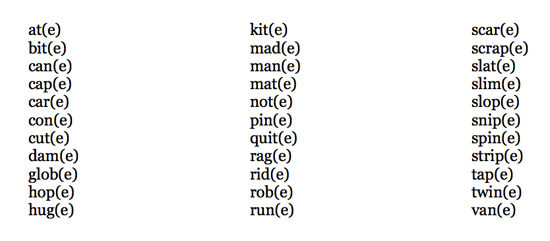
Note what they all have in common: They originally ended in a “short” vowel and a consonant, but the “silent e” changes the “short” vowel into a “long” one. (If you’ve forgotten the “long” vowel sounds just like the letter itself, as in “ohhh,” “eye,” and “you.” The “short” vowel doesn’t.)
That silent “e” works for more complicated words, too. Take “stamped,” which runs amok when “e” makes it “stampede.”
“E” isn’t the only letter that changes a word when tacked on the end, of course. Take “jam,” which is congestion, a difficult position, or a nice topping for toast, until a “b” is added to the end. Then it becomes a “jamb,” the vertical frame of a door or other opening. Probably because that “silent b” doesn’t change the pronunciation (unlike changing “tom” to “tomb), “door jam” appears in Nexis about half as often as “door jamb.” But “door jam” would probably make the door stick, and is incorrect to boot.
Add an “r” to “live” and you get “liver.” Add a second “s” to “needles” or “cares” and you get “needless” and “caress.” Note that none of those additions change the vowel sound (unless you were pronouncing “live” to rhyme with “hive”).
You can add letters at the beginning, as well, to change them significantly. Our “cut” above becomes “cute” with silent “e,” then turns “acute” with an “a” at the beginning. And the winner in the ability to morph with a single letter may belong to “end,” whose meaning changes when you add a “b,” “f,” “l,” “m,” “p,” “r,” “s,” “t,” or “v” to its front.
Finally, some vandals with a sense of humor turned one Brooklyn business into something else entirely. On a sign that read “LIVE POULTRY SLAUGHTER,” a square of white obliterated the “S.” Then, just in case you didn’t get the joke, the vandals spray-painted below it “Comedy Club.” While the employees claimed the sign was in bad taste, the alteration was still there seven months later, keeping to the spirit of the change, if not the letter.
Merrill Perlman managed copy desks across the newsroom at the New York Times, where she worked for twenty-five years. Follow her on Twitter at @meperl.