

 Meet Barbara Joy Whitehouse, known as Joy, whose life story seems to constitute a catalogue of misfortune.
The widow of a long-haul truck driver killed in a highway accident, she is a cancer survivor whose lung disease keeps her attached part-time to an oxygen tank. At 69, she resides in a mobile home near Salt Lake City and subsists on a modest Social Security payment and the cash she earns by recycling aluminum.
Whitehouse’s situation has been rendered particularly dire by the loss of the death benefits promised by her husband’s company. After four years of payments, the company went bankrupt and that obligation was erased, leaving Whitehouse penurious but still upbeat. “You put your pride in your pocket, and you learn to help yourself,” she says.
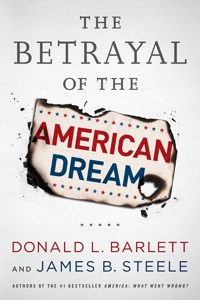
It is telling that Donald L. Barlett and James B. Steele, the ace investigative team that has won two Pulitzer Prizes and two National Magazine Awards, dedicate their latest book, The Betrayal of the American Dream, to Whitehouse’s memory. The dedication reveals the emotional heart of their enterprise: Not merely number-crunching chroniclers of middle-class decline, they are invested in the fate of the people who exemplify it.
Barlett and Steele’s preeminent talent is their knack for combining the micro and the macro. They look systemically at issues and policies, from the US tax code to healthcare. The questions they ask are both pragmatic (Does the system work?) and ideological (Who is benefiting, and at whose expense?). Their conclusions are buttressed by details gleaned from public records. But they also use the paper trail to track down the system’s apparent victims, people like Joy—the laid-off, the discarded, the pensionless, and the uninsured.
Now contributing editors at Vanity Fair, the two men have collaborated for an astonishing four decades, initially at The Philadelphia Inquirer (1971-1997) and then at Time magazine (1997-2006). Their stories have examined the growing economic divide between the rich and everyone else in America—Barlett and Steele were talking about “the top 1 percenters” well before Occupy Wall Street. This divide, they argue, is the product of government policies that favor big business and the wealthy. They write as crestfallen progressives, with faith in the power of the federal government to promote economic justice and dismay at how far short it has fallen of that goal.
The Betrayal of the American Dream, their eighth book, won’t seem revelatory to anyone who has been following the team’s reporting, reading Paul Krugman and David Cay Johnston, or watching MSNBC. The idea of an imperiled middle class—for some reason, hardly anyone talks about the poor anymore—has become commonplace in our political discourse. Here, Barlett and Steele lay out the factors responsible for middle-class decline—in effect, updating their iconic 1992 work, America: What Went Wrong? The new book is a useful addition to the debate, even if it doesn’t diagram convincingly just how to make things go right or how to truly reform a political system dependent on big money and susceptible to corporate lobbying.
America: What Went Wrong? expanded on an ambitious series that Barlett and Steele wrote for the Inquirer (where I was once their colleague). That series was, in turn, a follow-up to a riveting, Pulitzer-winning series on the Tax Reform Act of 1986, which showed how the revised tax code, sold as a move toward greater fairness, disproportionately benefited specific corporations and individuals. (Barlett and Steele have been mucking about in the thickets of the US tax system a very long time. They won their first Pulitzer, in 1975, for an examination of unequal enforcement by the Internal Revenue Service, and have since written two books on taxes.)
Though it also draws on stories of displaced middle-class workers, America: What Went Wrong? is dense with facts and figures. (Betrayal is a more accessible, less data-driven read.) But America does a masterful job of explaining how “the government rule book” of the 1980s promoted trade imbalances and hastened the destruction of American manufacturing; deprived workers of secure, well-paid jobs; helped dismantle the private pension system; and shifted the federal tax burden away from the wealthy by lowering both marginal rates and capital gains taxes. The book is a wide-ranging, painstakingly documented indictment—not just of business practices, but also of our democratically elected government. “Congress,” the authors write without equivocation, “has stood for the rich.”
Barlett and Steele make much of two relatively arcane features of the US tax code: the ability of businesses to reduce taxes by carrying net operating losses forward for several years, and by deducting interest payments on loans. They demonstrate how these tax breaks helped propel the merger-and-acquisition boom of the 1980s, and how the assumption of massive debt led to the contraction, and often destruction, of otherwise healthy companies.
This last refrain resurfaces, with a vengeance, in The Betrayal of the American Dream. One of the book’s case studies recounts a story well-known to media insiders: Barlett and Steele blame a single investor, the Florida-based money manager Bruce Sherman, for forcing the sale of the Knight-Ridder chain, owner of The Philadelphia Inquirer, The Miami Herald, the San Jose Mercury News, and other newspapers. Barlett and Steele describe the repercussions of Sherman’s involvement:
The troubles affecting former Knight-Ridder properties are part of an industry-wide trend that has hit all newspapers in the Internet era. But Sherman’s acquisition of a large bloc of the company’s stock on behalf of his clients served to drive up the company’s stock price in excess of its value and was a contributing factor to the papers’ later weaknesses in dealing with debt. Every former Knight-Ridder paper has gone through layoff after layoff, killed pensions, frozen benefits, mandated unpaid furloughs, or taken other harsh measures to try to remain viable.
The valuation of these newspapers continues to plummet, as a revolving cast of owners, publishers, and editors struggles to define an uncertain future. (At the beleaguered Inquirer, the rapid exits and entrances are starting to evoke farce as much as tragedy.) Meanwhile, Barlett and Steele tell us, Sherman has retired and lives in a condominium he purchased, in 2003, for $9.5 million.
Sherman’s wealth and good fortune may inspire the opposite of Schadenfreude, but they reflect our expectations for Wall Street types. Within the lower-salaried, rapidly shrinking media industry, similar windfalls seem especially irksome—at least to journalists. Newspaper executives continue to receive six-figure bonuses and seven-figure golden parachutes after shedding personnel and driving their businesses into the ground. Meanwhile, displaced staffers are forced to find new careers, or resort to freelancing at pay rates that keep spiraling downward.
To be fair, the special travails of journalists and journalism are just synecdoche for Barlett and Steele—one instance of larger trends toward inequality and job insecurity.
Often, they make their points in black-and-white terms that verge on parable. “America is now ruled by the few—the wealthy and the powerful who have become this country’s ruling class,” they write. “Lacking a civic or moral compass, it’s a peer group . . . with no mission except to wall in the money within its ranks to an ever-greater extent.” This group consolidates its power via political spending—an old story, made worse by the super-PAC phenomenon. “We have become a plutocracy,” they write, “in which the few enact programs that promote their narrow interest at the expense of the many.”
Presumptive GOP presidential nominee Mitt Romney’s campaign promises, including more tax cuts for the wealthy and a further unraveling of the safety net, seem to forecast more of the same. But Barlett and Steele implicate the Democrats as well, noting that President Obama’s healthcare law, however maligned by conservatives, “still leaves most of the power in the health industry in the hands of private insurers.”
Yet it is not only the elite who are to blame. Large swaths of the electorate, enraptured by the ideology of success, often vote against their own economic interests, or fail to vote at all. (Warren Buffett may vote against his interests, too, but he is outnumbered by middle-class voters who support tax breaks they’re not getting. Not to mention Tea Party members who love their Medicare and Social Security, but think that health-insurance subsidies for the merely middle-aged and financially needy constitute “socialism.”) The authors know this, but they resist indicting the ignorance and political apathy of the people they are trying to rescue.
Nor do they note that President Obama’s rhetoric has ricocheted between what the Republicans call “class warfare” and a misleading inclusiveness. Witness his repeated conflation of the middle class with individuals earning up to $200,000 and households earning up to $250,000—a definition that makes sense only in a few high-priced urban enclaves, excludes just the top 2-to-3 percent of taxpayers, and shifts the debate rightward.
While Barlett and Steele don’t make this precise point, they do correct the record. Using the median household income of $50,599 as a guide, they define as “the heart of the middle class” those reporting “overall incomes” of $35,000 to $85,000 on their 2009 tax returns. That represents 34 million individuals or families, or 30 percent of returns. About 58 million returns report even lower earnings. (It’s not clear whether Barlett and Steele are using gross income, adjusted gross income, or net taxable income.) That leaves 20 percent of returns as upper-middle class, affluent, or rich, they say, and they suggest that an extended middle class could include incomes up to $115,000.
And for the middle class, the news, even apart from the Great Recession, is not good. The current emphasis on deficit reduction means that “the ruling class is becoming agitated over the spending on working people,” Barlett and Steele write. Rather than raise the top marginal rate on earned income (as high as 94 percent in the 1940s, and now 35 percent), some in Congress are talking about slashing Medicare, Social Security, and food stamps—a further assault on people like Joy Whitehouse.
Barlett and Steele spend much of Betrayal lamenting globalization, which now affects both white-collar and blue-collar workers. They realize the trend can’t be halted entirely, and that products made in low-wage foreign factories save US consumers money. But they would prefer that government cushion the impact on American workers.
Free trade, as supported by Washington, has been a disaster, they write, leaving “employees and small industries at the mercy of unscrupulous sweatshop operators abroad and opportunistic multinational corporations at home.” They hark back longingly to a lost Golden Age of paternalistic employers who embraced their employees and communities and guaranteed lifetime jobs. (One might argue that their portrait of this era is too rosy, reflecting neither discrimination against women and minorities nor the conflicts that often led to unionization.)
They cite the longtime symbiosis between DeWitt, NE, and a family-owned business that manufactured an innovative tool known as the Vise-Grip. When, after several ownership changes, control of the company passed in 2002 to the multinational Newell Corporation, pay cuts followed. In 2008, the plant was closed and production shifted to what turned out to be a massively inefficient plant in China. Meanwhile, DeWitt workers retired early, accepted lesser jobs, or endured long commutes to work. America: What Went Wrong? readers will remember Newell as the villainous outfit that shut down the Anchor Hocking glass plant in Clarksburg, WV, with similarly grievous results.
Even high-tech jobs have come under assault, Barlett and Steele remind us. The now-familiar case of Apple (which the team covered in 2011 for the Investigative Newspaper Workshop) is Exhibit A, with thousands of jobs moving from successful US plants to factories in China with “slave-like working conditions.” And there are other, even more tragic tales—like the story of Kevin Flanagan, a 41-year-old computer programmer for Bank of America. Flanagan was ordered to train his replacement, a programmer from India, or lose his severance package. Afterward, he shot himself in the head.
The Betrayal of the American Dream covers a panoply of ills, many reprised from America: What Went Wrong?: mounting student debt, tax inequities (from “carried interest” to the stashing of wealth overseas), disappearing private pension plans, and the chaos unleashed by deregulation of transportation and banks. Barlett and Steele write that “the foreclosure crisis was in part a result of runaway greed by an out-of-control, unregulated industry,” a common enough view. But they fail to apportion any responsibility to careless home-buyers who signed contracts providing for adjustable-rate mortgages without reading or understanding them. Or, for that matter, to the power of the American Dream itself, which so exalts home ownership.
In their final chapter, Barlett and Steele offer what they describe as “the bare minimum of steps…to restore the vibrancy of middle America.” They want, first of all, higher taxation of the rich, and point out that “tax simplification” has little to do with simplifying the rate structure. “The tax code is complex,” they write, “but not because of the rates.” Amen to that.
But their solution is too simple: for individuals, a single-page tax form listing all income and allowing for no deductions, credits, or exemptions. That means the loss of charitable deductions (a big hit for the nonprofit sector); the housing-mortgage deduction (tough on those who counted on it when opting to buy rather than rent); and the deduction for retirement savings (another blow to those who have already lost pensions). It’s unclear whether Barlett and Steele really intend for businesses to lose deductions for supplies, equipment, and other essentials.
When it comes to trade, they want tougher enforcement of existing laws, plus, if necessary, tariffs on imports. They support government investment in infrastructure, better job-retraining programs, and the prosecution of white-collar criminals who contributed to the financial and housing meltdowns.
“For all this to change, the people will have to prevail,” Barlett and Steele write. “Middle-class Americans, still the largest group of voters, must put their own economic survival above partisan loyalties.” But campaigns are still expensive, politicians will be hard-put to ignore lobbyists, and democracy is at best a crude cudgel. Given the ease with which Americans have been hoodwinked before, it is a stretch to imagine that Barlett and Steele’s populist miracle will transpire anytime soon.
Julia M. Klein is a longtime CJR contributor and a contributing book critic for The Forward. She is a cultural reporter and critic in Philadelphia. Follow her on Twitter @JuliaMKlein.