

Killing the Messenger: A Story of Radical Faith, Racism’s Backlash, and the Assassination of a Journalist | By Thomas Peele | The Crown Publishing Group | 441 pages, $26.00
It’s said that the devil is in the details, and experienced writers would agree that the tiniest details can make or break a story. This may tempt authors to emphasize or embellish aspects of a story that reinforce a theme; to present the facts in a way that fits the frame.
One may receive impressions of this in the first 40 pages of Killing The Messenger, Thomas Peele’s new book about ideology, murder, and journalism, set primarily in Oakland, CA. For instance, one may wonder why the author, who in the first paragraph of the introduction describes Oakland as “little more than a place I passed through to get anywhere,” should choose to inform readers that Oakland’s Lake Merritt “had been created from a drained swamp in the 1860s,” or at low tide the area where the lake drains into the San Francisco Bay (actually the Oakland Estuary) “reeked of rotting mussels ripped open by hungry gulls.”
He might have said that Lake Merritt is the largest saltwater lake located within an urban area and is quite picturesque. And what could be more natural than seagulls feeding on mussels? But, of course, he was trying for gritty atmosphere; just as one could add grit to San Francisco’s image by mentioning that much of the riprap around its Aquatic Park is composed of old tombstones leftover when the city moved most of its graveyards to Colma in the early 20th century.
Likewise, the author repeatedly describes the neighborhood around the (former) Your Black Muslim Bakery on San Pablo Avenue, home base for the semi-legit organization that this book is about, as being the “North Oakland ghetto.” This reviewer, having frequented this bakery for fish sandwiches, and who still passes through the neighborhood at least once a week, can attest that while it’s not one of Oakland’s upscale communities, it’s far from a ghetto. Nor did this reviewer ever find the bakery’s staff anything less than pleasant, neat, clean, or observe the “compound” being guarded by “thugs in bow ties” or “the frenzied pit bull and mastiffs,” though that would have certainly been wise at night, and many area businesses take similar precautions.
None of which is to say that this reviewer admired the Black Muslims or agreed with their doctrine—though the sandwiches were killer—but rather to note that the deployment of superfluous details, especially when one already has an ironclad case, may undermine one’s credibility.
Earning readers’ trust is especially important when an author is writing about black people, who are so accustomed to being misrepresented and negatively portrayed that many automatically distrust or outrightly dismiss anything written about them, especially by a non-black author. It is therefore unfortunate that the first three chapters of Killing The Messenger appear as if Peele was trying too hard to set his stage.
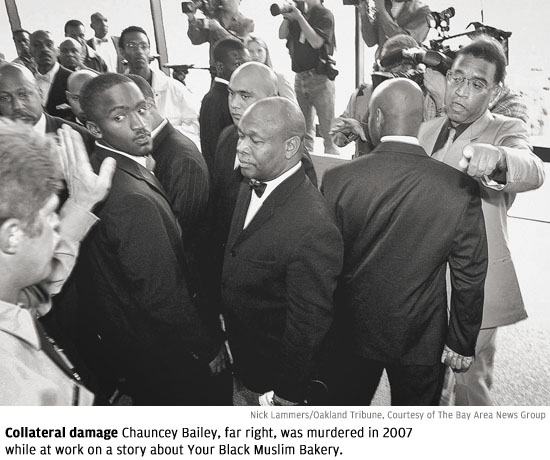
While Part One of this book, opening with the August 2, 2007 gangstuh-style murder of Chauncey Bailey, an Oakland Post editor who was working on a story about Your Black Muslim Bakery, abounds with descriptions of thugs, thuggery, and Dashiell Hammett-meets-Boyz n the Hood atmosphere, one quickly forgives Peele when he settles down to solid journalistic writing, especially since Peele was a principal in the Chauncey Bailey Project, an ad hoc group of journalists dedicated to reporting the circumstances of Bailey’s death.
Though the hook is the murder of Bailey, an undistinguished journalist whose article, Peele notes, would probably not have been very good, Bailey is actually a minor character. The real story is about the Black Muslims, and particularly the Oakland-based Bey family. For decades, Peele reports, the Beys used their health-food bakery as a front for criminal activity, operating largely untouched by police. (The bakery’s founder, Yusuf Ali Bey, actually ran for mayor of Oakland in 1994.) It was only when the erratic, overmatched Yusuf Bey IV assumed control in 2005 that everything began to crumble.
With exceptions noted and forgiven, Killing The Messenger is a very well-written and thoroughly researched book; this becomes apparent as one gets deeper into it. Like James A. Michener, Peele begins at the roots of his subject, in this case a man named Wallace Dodd Ford, a.k.a. Walli Dodd Fard (and many other aliases), who filled out a draft card on June 5, 1917, stating his birthplace as Shinka, Afghanistan, his birth date as February 26, 1893, and his race as “Caus” (presumably an abbreviation of Caucasian). This is ironic, since he was the co-founder of what would become the Black Muslim faith, after teaming up with a spiritual charlatan who styled himself Noble Drew Ali from Morocco, though he was reputedly born Timothy Drew from North Carolina. (Peele makes clear that the Black Muslim “faith” is Islamic in name only, just as the Ku Klux Klan bills itself as a Christian organization.)
The book, backed up by 74 pages of acknowledgments, notes, and bibliography, traces the history not only of the group itself, which was based upon “Tricknology” (a term coined by its founders to describe the misinformation and outright lies foisted upon black people by whites to keep them confused and disunited), but also the individual histories of the principal men involved. Unlike the Black Panther Party, which had its roots in Oakland and was for the most part purely political, the Black Muslims cloaked their militancy in pseudo-religion, encouraging violence not only in their brainwashed believers but also providing a justification to those who simply wanted to act out their hatred by killing. Peele brings vital historical context to the contemporary aspects of his tale: the establishment of the Bey family in Oakland, the rise and fall of Your Black Muslim Bakery, and the eventual murder of Chauncey Bailey—a foolish, arrogant, and typically thuggish act, which, rather than removing a perceived threat to the organization, actually brought it down.
As he does for virtually all the dramatis personae in this book, Peele offers detailed studies of their origins and backgrounds, often not without sympathy in regard to conditions, environment, and events in their lives which may have contributed to what they became. For example, we learn the life history of Devaughndre Monique Broussard, who would become Bey’s hit-man for Chauncey Bailey’s murder. It is an all-too-typical story of a young black man raised in a soul-crushing environment of poverty, drugs, and violence in Richmond, CA, and who wasn’t strong enough to somehow rise above it.
As Peele acknowledges, though most of these men had seedy backgrounds, it was pretty difficult for any black man, especially during the first half of the 20th century, to be squeaky clean in regard to white laws, morals, and values. Peele’s extensive research on the oppression of black people in the US through most of the 20th century, explains part of the book’s subtitle: Racism’s Backlash—the backlash being the rise of an organization claiming to be a religious faith that professes hate toward white people. Peele is not hesitant to give white devils their due, whether murderous police, racist politicians and journalists, or discriminatory policies. He describes several attacks by police upon Black Muslims in various cities that ended in outright murder of black men, the officers involved invariably cleared of any wrongdoing. No wonder that, then as now, certain young black men would be attracted to an ideology that encouraged them to fight back.
Throughout the book’s 350 pages, Peele presents detailed accounts of how various individuals became involved with and/or ensnared by the Black Muslim movement; some idealistically, many—especially young black men intellectually stunted by the public-education system and emotionally scarred by the judicial system—because it offered opportunities no one else was offering. Broussard, for example, a once-promising student who lost his way, is Peele’s Exhibit A: an impressionable youth who was lured by the financial and emotional shelter the Beys provided.
Did anything positive come out of this? While Peele seems a bit cloudy on this point, he also appears to imply that the answer is yes. Though he may have somewhat embellished the grit and grimness of Oakland, he also acknowledges the thousands of young black men taken in off the streets, or when fresh out of prison, who would have likely been behind bars—or behind bars again—had they not been offered productive jobs and educated in matters of self-worth, physical and mental discipline, and personal integrity, and who may well have gone on to live better lives by using these teachings as a basis to self-educate and think for themselves. In other words, Peele seems to realize there are shades of gray in everything—no absolute evil, no untarnished good, and few saints or devils without their own motives.
Killing The Messenger may well be the best, most thoroughly researched, and—with exceptions noted—most objective book thus far written on this subject, and is no doubt destined to become required reading in many colleges and universities. Hopefully, it will also be read in prisons, to educate young black men that Tricknology comes in all colors. If the devil is indeed in the details, Peele has given us many demons to exorcise.
Jess Mowry is the author of 15 books and numerous short stories, mostly about black youth in Oakland, California. He lives in Oakland.