

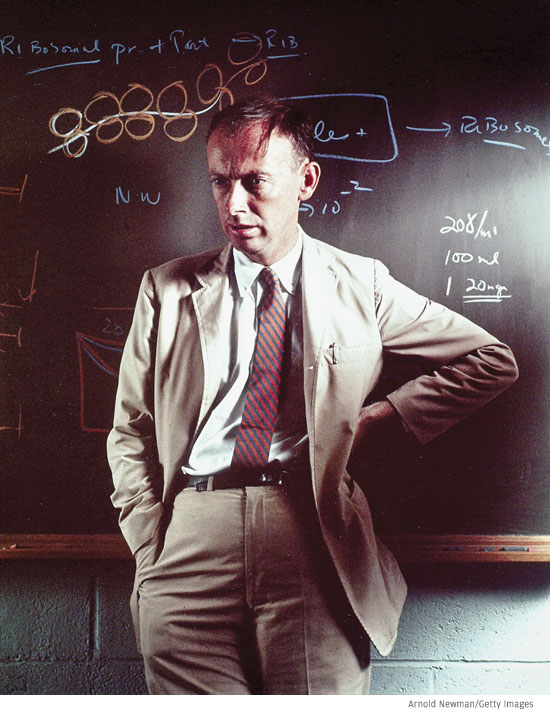
W hen The Double Helix appeared in the winter of 1968, I reviewed it for The Laureate, the literary magazine at Classical High School, in Providence, Rhode Island. I was a freshman.
It was my first effort as a science writer, and now, after four decades, I feel lucky to have started there. The Double Helix: A Personal Account of the Discovery of the Structure of DNA by James D. Watson, is one of the best books ever written about science, and it happens to have been written by one of the great scientists of the 20th century. And I happened to read it at the very best age—when I still didn’t have a clue what I wanted to be.
The Double Helix is the story of a race to solve one of the central problems in science, the secret of the gene, which looked to many scientists at mid-20th century like the very heart of life itself. Biologists already knew that genes are the material through which traits are passed from generation to generation—the keys to identity, physiology, evolution. But no one knew the structure of the gene; and until scientists knew that, they couldn’t figure out how genes work. Watson went after the problem in the fall of 1951, at the age of 23, when he was still a graduate student, and he scrabbled his way to the solution before he was 25.
In telling the story, he produced a great work of literary nonfiction. Watson expanded the boundaries of science writing to include not only the formal, public face of Nobel-winning discoveries but also the day-to-day life of working scientists—both inside and outside the lab. The Double Helix rejuvenated a genre that had been largely academic or hagiographic. Its success showed that there was and is an appetite for the story of science; that the stories can be human and exciting; that scientists can be flawed characters; that the whole endeavor doesn’t collapse if you depict it with something less than reverence.
Although the book caused an international scandal that winter, I don’t think any word of the controversy reached me at Classical High School. As a freshman, I read The Double Helix as a story of pure triumph. Now, of course, I can see what I couldn’t then: an epic of the loss of innocence, writ small and large. And I can see the arc of Watson’s life since 1968, which has been another epic of triumph and hubris, ending with a fall. So now I see the darkness around the shining cup.
But those are the lessons of life itself.
I heard about “The Double Helix” from my father, a scientist, who couldn’t resist reading me the opening scene. He always had a pile of new books on the coffee table, most of them about science. When he picked up The Double Helix, he was struck by the magnitude of the discovery, and by the drama in the book’s first few lines. It opens in the Alps, in 1955, two years after Watson and his colleagues have made their breakthrough. Though he is not a mountaineer (“I panic at voids”), Watson has arranged to join a few friends who plan to scale the Rothorn. Hiking up a path at the base of a glacier, he recognizes a climber coming the other way, a biologist named Willy Seeds. “Willy soon spotted me, slowed down, and momentarily gave the impression that he might remove his rucksack and chat for a while. But all he said was, ‘How’s Honest Jim?’ and quickly increasing his pace was soon below me on the path.”
These days we sometimes say that a book’s DNA can be found in its opening passages. By opening his memoir with the story of that snub, Watson tells his readers exactly how he plans to bring the book to life.
First of all, it will be filled with scenes, and stories. For readers in 1968, that was a surprise in itself. Most of the other science books on Dad’s coffee table were reverential biographies of great scientists, aimed at specialists—all plaster busts and technical analysis. That’s not the kind of thing Watson promises on his first page. Instead, he intends to reveal the behind-the-headlines story of the race, because “as one of the winners, I knew the tale was not simple and certainly not as the newspapers reported.”
What’s more, the story will be personal, emotional, even confessional. And it will involve the highest stakes. Watson intends to explain how he scaled the heights, and how he earned contempt along the way. We know this because he puts it all right there at the top, in the scene with Seeds. A peculiar sense of mingled pride and sin was central to his book. In the course of his research he had arguably violated several unwritten rules of professional conduct, and had made enemies of some colleagues who found his behavior at best unbecoming and at worst unethical. Years afterward, Watson told the historian Horace Freeland Judson that he’d first thought of writing his story for The New Yorker under the header “Annals of Crime.”
Watson’s working title for the book was Honest Jim.
After his prologue in the alps, Watson begins at the beginning, with Francis Crick, his partner in crime. Watson was 23 and Crick was 35 when they met at the University of Cambridge, where Watson, an American, had come for post-doctoral study after receiving his PhD from Indiana University. The two men were colorful and cocky, not to mention arrogant. (The first line of Chapter One is famous: “I have never seen Francis Crick in a modest mood.”) They bonded instantly over their sense that the secret of the gene was the most important problem in biology.
From the work of a little team of biologists at the Rockefeller Institute, in New York, they knew that genes are made of deoxyribonucleic acid, DNA. To the two young scientists, the problem of the gene seemed incredibly, almost impossibly alluring. Watson calls it “the Rosetta Stone for unraveling the true secret of life.” He thinks DNA will prove the key to figuring out how genes determine, among other things, “the color of our hair, our eyes, most likely our comparative intelligence, and maybe even our potential to amuse others.”
But nobody knew how DNA is put together. You can’t figure out how a heart pumps until you anatomize its chambers, and you can’t know how DNA works until you model its chemical structure. To Watson, this point seemed obvious. And yet most geneticists were not very interested in learning the chemical nature of the gene—which, to Watson, only proved that those geneticists were fools. He and Crick shared a contempt for many of their senior colleagues. Most old professors, Watson writes, are “not only narrowminded and dull, but also just stupid.” He was convinced that building a model of the structure of DNA would do spectacular things for both biology and his own career.
There were, of course, obstacles. For one thing, their research plans were hampered by “an awkward personal situation.” The only biologist in England working on the molecular structure of DNA was a friend of Crick’s, a shy, somewhat slow-moving scientist named Maurice Wilkins. For all practical purposes, DNA was Wilkins’s personal property, at least by the English rules of fair play, Watson writes, and “it would have looked very bad if Francis had jumped in on a problem that Maurice had worked over for several years.” Wilkins’s research was hobbled because he didn’t get along with his assistant, Rosalind Franklin. Franklin was making the world’s best X-ray pictures of DNA, but Wilkins couldn’t stand her, and neither could Watson and Crick.
Meanwhile, Linus Pauling, whom Watson describes as the “world’s greatest chemist,” was also working on the problem of the structure of DNA. Being an American at Cal Tech, Pauling “was not subject to the confines of British fair play,” writes Watson, who was terrified that Pauling would get there first. So young Watson and Crick raced for the gold. And Watson the narrator tells the story so adroitly that we enjoy watching them work together, like Woodward and Bernstein in All the President’s Men. We root for them even when they do the slightly shady things that will later make a colleague snub Watson in the Alps. Watson and Crick go around Franklin’s back by conniving a bit with Wilkins. They keep tabs on Pauling’s progress by buddying up with his son Peter, a young biologist who is visiting Cambridge. When the elder Pauling makes a silly mistake that slows his research, Watson and Crick toast his failure.
Even though Watson was pushing 40 when he wrote the book, he tells it all (after that first scene in the Alps) in the voice of the brash, socially awkward young man he was in his early twenties. So we get high-spirited reports on the day-to-day life of a scientist in Cambridge. We hear about the disgusting food in the dining halls (“brown soup, stringy meat, and heavy pudding”) and about “the poison put out by the local Indian and Cypriote establishments.” We hear about tennis, parties, girls, “sherry with girls.” He gets surprisingly frank. We see Watson trying to put the naked Hedy Lamarr in Ecstasy out of his mind and concentrate on chemical bonds.
Watson imparts solid lessons in chemistry along the way. When you have a strong story, you can weave in a lot of science without your readers rebelling. The false starts and wrong turns in the research are all brilliantly described. The climactic scene where Watson assembles his model at the lab on Saturday morning, February 28, 1953, is one of the great eureka moments in the history of science. He fusses with some pieces of stiff cardboard, fiddling them together on his desktop, and, suddenly, there it is—the most elegant molecule he’s ever seen, a beautiful rising shape like a spiral staircase: the double helix.
And the book’s ending is almost as good as the beginning. We leave the wan young man in Paris feeling tired and a bit old. He was about to celebrate his birthday. There was a party ahead. “But now I was alone, looking at the long-haired girls near Saint-Germain-des-Prés and knowing they were not for me. I was twenty-five and too old to be unusual.”
Back in that first scene, in the Alps, he had been preparing for an ascent. Now the race was over. He had won, and he was coming down.
“Who could possibly want to read stuff like this?” Crick wondered, when Watson showed him a chapter of the work in progress in a little restaurant near Harvard Square. Since their discovery, the two men had become famous in their field. (“Rather than believe that Watson and Crick made the DNA structure, I would rather stress that the structure made Watson and Crick,” wrote Crick later on.) They had won a Nobel Prize (which they shared with Maurice Wilkins) in 1962. Now, with their careers and reputations secured, Crick didn’t think Watson’s story was an appropriate one to tell. Neither did Wilkins. Neither did the molecular biologist Gunther Stent, who, after reading an early draft of Honest Jim, predicted that nobody would ever buy it. The volumes on their coffee tables were the same as my dad’s. In most of those books, it was the science that was important; the grubby personal details were unfit to print.
When the editor of Harvard University Press acquired Watson’s memoir, Crick and Wilkins both campaigned to block its publication. In the spring of 1967, Crick composed a furious six-page letter addressed to Watson, the editor of the press, the president of Harvard, and others, writing, “Should you persist in regarding your book as history I should add that it shows such a naive and egotistical view of the subject as to be scarcely credible.” He said Watson had omitted “any intellectual content….Your view of history is that found in the lower class of women’s magazines.” In the end, Harvard rejected the manuscript, which Watson promptly gave to a commercial publisher. On February 15, 1968, the story hit the front page of The New York Times, under the headline, “A Book That Couldn’t Go to Harvard.”
The Double Helix was published on February 26, 1968, 15 years after Watson’s eureka moment, almost to the day. As a high school freshman, I thought the story was purely terrific. Watson was smart and talented, he knew what his elders didn’t, and he won the prize. I’m sure even his trouble with girls seemed sympathetic. He holds onto the box of chocolates at the party? Sure. He likes to imagine himself becoming famous? Of course. He has to fight to keep Hedy Lamarr out of his mind while he studies? Naturally.
Long ago, unfortunately, I lost my copy of whatever it was I wrote for The Laureate. But many of the other reviews that appeared that year have been collected and preserved in the Norton Critical Edition of The Double Helix. I find it interesting now to see what reviewers were thinking on higher floors in the towers of academia. Most of them were outraged. The molecular biologist Robert L. Sinsheimer found Watson’s worldview “unbelievably mean in spirit, filled with the distorted and cruel perceptions of childish insecurity.” The evolutionary biologist Richard S. Lewontin called the book a paradox. “The Nobel Prize has acquired virtue by being awarded to virtuous men by virtuous men. Its total value is in its image. Yet, having craved and acquired it, Watson devalues it, debasing the currency of his own life.”
Not every reviewer was angry. The physicist who reviewed the book for Life wrote that Watson’s book “should kill the myth that great science must be cold, impersonal or detached.” On the other hand, the physiologist who reviewed the book for Scientific American declared that Watson had proven himself to be just that: “His characteristics are essentially cold logic, hypersensitivity and lack of affectivity.” He added, “May God protect us from such friends.”
Both of those reviews mentioned the scene in the Alps, and both quoted Seeds’s line, “How is Honest Jim?” One reviewer concluded, “How’s Honest Jim? Fine, just fine.” The other reviewer ended cuttingly: “Yes, how is Honest Jim?”
The book made Watson a celebrity. It spent 18 weeks on The New York Times best-seller list; it was translated into at least 17 languages. Watson left Harvard to direct the Cold Spring Harbor Laboratory, on Long Island, and turned it into one of the world’s great research centers. Meanwhile, many of the people he’d offended back in Cambridge were mad all over again.
Crick had come off pretty well in the book, though he didn’t think so himself. He hated the way Watson had framed their story as a sordid race for fame and glory, and spent years plotting revenge with his lab mates, dreaming up titles and zingers for his own memoir. He thought he might call it The Loose Screw, and joked about how he might start his Chapter One, “Jim was always clumsy with his hands. One had only to see him peel an orange….” (When Crick finally got around to writing his own memoir, What Mad Pursuit, he chose a quiet, restrained beginning. You realize how much you love a good story like Watson’s when you read Crick’s doggedly plain first line: “The main purpose of this book is to set out some of my experiences before and during the classical period of molecular biology….”)
Other biologists in the story had to live their whole lives in the twisted shadow of the double helix. The book’s most famous victim is Rosalind Franklin, who died ten years before it appeared. Her early death in 1958 cheated her of her chance to tell her side of the story (and of any chance to share the Nobel Prize). Many others, whose work had laid the foundations for Watson and Crick’s discovery, suffered because they weren’t in the book at all. Watson’s book was such a powerful story that anyone who was left out of it was relegated to a footnote forever after.
I visited Mac McCarty on June 29, 2000. He was the last survivor of the team at Rockefeller that had discovered that genes are made of DNA. He was 89 years old, and sat in a wheelchair in the middle of the living room, recounting his discovery in front of big picture windows overlooking high rises and the Fifty-ninth Street Bridge.
Two days before, at the White House, President Clinton had announced the completion of the Human Genome Project. Mac’s wife, Marge, had a copy of The New York Times in the foyer, open to the headline, “Reading the Book of Life: A Historic Quest; Double Landmarks for Watson: Helix and Genome. The Times had also run a sidebar with a timeline of discovery. She showed me where Mac appeared in the timeline: two little lines. “1944: Researchers at the Rockefeller Institute prove that genes are made of deoxyribonucleic acid.” Suddenly, Marge, who had been stewing all afternoon, could no longer contain her anger.
“Researchers!” she cried. “What the shit is that? He’s not Mr. Researcher!”
In some ways, Watson was a victim of his book too. He’d been rewarded so spectacularly for his behavior in his early twenties. Among other things, he had learned to be flippant at Cambridge, he writes. He saw that “success in Cambridge conversation frequently came from saying something preposterous, hoping that someone would take you seriously.”
He seems to have learned that lesson for life. After all, his disdain for good manners had won him fame and fortune twice over: first as a scientist, then as an author. Why stop, now that he was a statesman of science? When I first met Watson, at a lunch in the late 1990s, he made outrageous claims about blacks in America’s inner cities. I argued with him. At length, he said to me, “You seem very concerned about principles. What’s a principle?”
Many other reporters had that kind of experience too. But Watson’s opinions about race, gender, and other such topics stayed more or less unpublished until, while promoting a memoir titled Avoid Boring People, he shared them, in some detail, with a reporter visiting Cold Spring Harbor. The fateful interview ran October 14, 2007, in The Times of London, under the headline “The Elementary DNA of Dr Watson.” The reaction was swift. Watson had to cancel his book tour and resign as head of Cold Spring Harbor Laboratory. He came in for ridicule a few months later when the Icelandic company deCODE Genetics reported hints in Watson’s own DNA of African ancestors.
Do Watson’s late years diminish The Double Helix? On the contrary: I’d say they only deepen its interest. For all its other virtues, the book’s real gift is its demonstration that science and story go well together. And a good story is always going to be human—lofty and ugly, high and low. Dr. Watson’s discovery is much easier to understand than Dr. Watson.
I’ve spent my career writing books about science and scientists. (One of them tells the story of a great biologist named Seymour Benzer, who is a footnote in The Double Helix.) They’re all driven by story as much as they are by science; and in every one I’ve struggled to make the story and the science seem all of a piece, as they do in the book I reviewed as a freshman, 44 years ago.
As I recall, my only regret about The Double Helix back in 1968 was that it had taken so long for Watson to sit down and write it. He sounded young, but he really wasn’t. That was the one sin I found it hard to forgive him—he was almost 40. I saved this criticism for the last line of my review, the only sentence I can still remember: “It is disappointing to realize that the book’s young hero is now middle-aged.”
Today, I have a few years on Watson the author—20 years, to be exact. I see so much more in his story now than I did the first time around, and even more on each re-reading. And, every time, I think: This is the place to go, for a writer. Somewhere in the twining of science and story, this is where you can write about life itself.
Gifts of a great book.
Jonathan Weiner Is the Maxwell M. Geffen Professor of Medical and Science Journalism at Columbia’s Graduate School of Journalism and is the author of several books, including The Beak of the Finch, which won the Pulitzer Prize.