

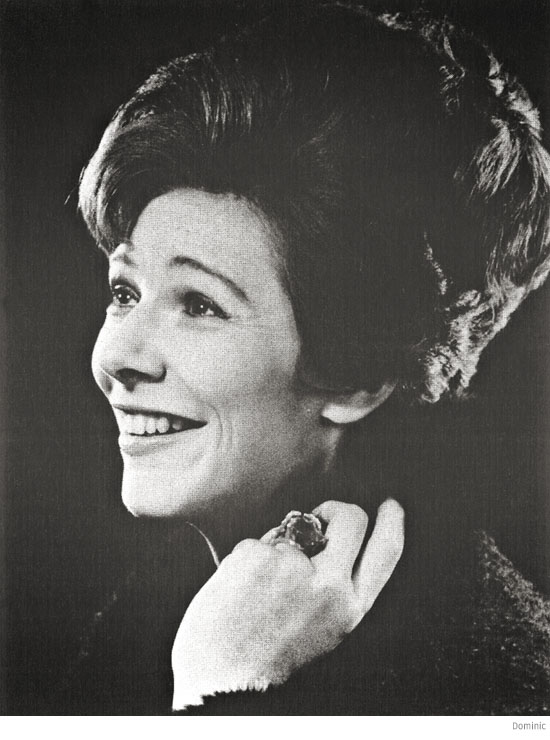
In 1968, New Yorker editor William Shawn decided to start taking the movies seriously. Up to that point, the magazine’s film critics, men like Brendan Gill and John McNulty, had always thought themselves better than their beat; their work evincing amused detachment from the vulgar entertainments that sated the grubby masses. In a 1946 essay called “The Country of the Blind,” New Yorker super-critic Wolcott Gibbs, a man of the theater, asserted that “the cinema resists rational criticism almost as firmly as a six-day bicycle race, or perhaps love.” Shawn, who realized that cinema had long ago gained respectability, thought it now merited the same sort of close attention as theater or fiction—and realized that existing personnel weren’t up to the task.
His first hire was Penelope Gilliatt, a British novelist and playwright who considered film every bit the artistic equal of, well, herself. Though she had been writing about film for The Observer in London, Gilliatt never really considered herself a critic, a reporter, or even a journalist. Instead, she saw her nonfiction output as an extension of her more creative work, and in her 12 years on staff at The New Yorker, she penned a steady stream of keenly drawn profiles and reviews that blurred the line between the two, often abstracting the form altogether. Gilliatt’s prose is allusive, her observations at once breathtaking and unmoored. She cared little for robust analysis, or literal transcription of quotes, or banal factuality. Penelope Gilliatt treated criticism like literature, and if she didn’t always hit her mark, at least she had her reasons.
Today, Gilliatt, if she is known at all, is known for her downfall. Almost from the time she arrived at The New Yorker, Gilliatt was hampered by alcoholism. It affected her work; Shawn covered for her. In 1979, she was disgraced by a plagiarism scandal when she swiped a large chunk of The Nation’s profile of Graham Greene. That marked the end of her time on The New Yorker staff, though Shawn did throw her an assignment now and then. This makes for a sad, even pathetic, biography, at odds with the refinement and hauteur that characterized her writing. Disgraced and increasingly ineffectual, Gilliatt puttered along writing fiction until her drinking killed her in 1993, at age 61.
But her work shines as a model of a lost genre of film writing—the evocative, intelligent personality piece, less concerned with passing judgment on a movie than with understanding its maker. In much of her 1980’s anthology Three-Quarter Face: Reports and Reflections, long out of print, Gilliatt isn’t that interested in great works, but rather with the people behind them; the profiles and reviews contained therein are tools with which to magnify the workings of the creative mind.
The pieces collected in Three-Quarter Face span 1966 to 1979, as America was recovering from revolution and film still processing its own anti-authoritarian upheaval. Gilliatt, mannerly and aloof in the best British tradition, but with a touch of mysticism, preferred foreign fare and exalted genius; she subscribed to auteur theory and then some, as if doubling down against the more anarchic, untoward directions that American film was taking—spurred on, notably, by Pauline Kael, her contemporary at The New Yorker (the two women alternated six-month stints as the magazine’s chief reviewer). More than once, she writes approvingly of directors who edit in their heads while shooting a film; prizing an economy of effort, never shooting more than they need to, because they already know where they’re going with it. Beginning with a profile of Luis Buñuel and ending with a series of reviews of films by Rainer Werner Fassbinder, Three-Quarter Face offers a gallery of artists in full control of their medium depicted by someone who was in full control of hers.
If read unsympathetically, Gilliatt can come off as an especially sophisticated lightweight; an inveterate namedropper and hobnobber, eager to let her accomplished subjects know that she is one of them. (Her screenplay for Sunday, Bloody Sunday was nominated for an Oscar in 1972, and you get the sense that she never let anyone forget it.) Gilliatt was sometimes criticized for getting too close to her subjects, and the showy intimacy of her writing and reporting may grate on those who prefer their journalism impartial or adversarial. But we shouldn’t mistake it for fluff. Nobody understands artists like other artists, and there is art to be made in this mutual understanding.
The book’s title refers to Gilliatt’s journalistic approach, as articulated in her introductory essay. “The face is three-quarter turned to us in leisure and in friendship,” she writes. “But a vital quarter is always inexplicable except through paying attention to a man or woman’s talk, small-talk, gestures, way of living, choice of intimates, professional endeavors.” Gilliatt thought that a mixture of journalistic observation and novelistic reflection could unlock something secret and profound about the nature of creative genius. If James Agee appointed himself cinema’s prophet, Gilliatt volunteered herself as the caretaker of its auteurs. “The point of a profile is to record exact expressions of focused and very particular minds,” she once wrote. She was referring to her subjects, but she might as well have been talking about herself.
Gilliatt was born in London in 1932 and raised in Northumberland, where her father was the director of the BBC in the North East region from 1938 to 1941. At 14, frustrated by her parents’ separation, Gilliatt claims to have run off to America, on a freighter ticket she funded in part by selling scripts to the BBC. Both of her parents thought she was with the other. Gilliatt attended Queen’s College in London and then earned a scholarship to Vermont’s Bennington College. She worked an office job in New York until winning a writing contest conducted by the British edition of Vogue and returning to London, where she eventually became an editor at the magazine. In 1961, Gilliatt began writing about film for The Observer. She published her first novel, One by One, in 1965; the book later served as source material for Sunday, Bloody Sunday.
Following the collapse of her second marriage, to the playwright John Osborne, Gilliatt relocated to New York right as William Shawn was doubling down on the New Yorker’s efforts at cultural criticism. The arrival of Kael soon thereafter—another woman, and another truly idiosyncratic writer—said something about just what radical terrain Shawn felt cinema to be. The two frequently disagreed, and could not have been more different, stylistically and ideologically. Shawn had a nearly adversarial relationship with Kael; he was over-protective, even indulgent, with Gilliatt. Kael sometimes wrote as if she were making up the medium on the fly. Gilliatt was not only a true believer in the European canon, she prized the sort of access and elitism that was completely at odds with Kael’s sensibilities. Kael wanted to convince you of things. Gilliatt took it as a given that certain people, places, and things were worth discussing, and wrote as if the reader ought to share those assumptions.
This assumed consent can make much of her writing feel somehow encoded, insular. Her point of view may be somewhat fussy, and she can seem smug and unbearable at times (“Jean Renoir said something of this sort to me in Paris when we were shopping for gigot of lamb”), but the way she goes about drawing characters—at once stark and impressionistic—makes her profiles read fresh, even today.
You can’t appreciate Gilliatt without understanding the way she worked. For one thing, she thought a writer had to be almost unhealthily obsessed with her subject in order for the profile to be any good. “Impossible to write adequately of anyone who doesn’t haunt the writer’s thought,” she wrote. “It is a joyful affair to report accurately on the inner vernacular of someone whose work and character one cherishes.” And that “inner vernacular” couldn’t always be captured by traditional journalistic means: though Gilliatt would spend great spans of time reporting her stories, she felt strongly that note-taking had limited value and admitted that she took liberties with her subjects’ quotes.
In the introduction to Three-Quarter Face, she describes profiling and reviewing as a “fictional process,” an unfortunate choice of words given her later professional difficulties. Nevertheless, it’s a valuable insight into why good reporting alone doesn’t always make for a compelling story. A reporter’s notebook can be filled with facts and figures; but unless some effort is made to squeeze meaning out of those details, and the author is willing to take an interpretive risk, no amount of research will make the story land. This doesn’t mean interpreting wildly for the sake of effect, or forcing connections where they don’t necessarily exist, but rather taking note of gestures, phrases, and other stray details that, in themselves, say something larger about the subject. The fiction writer creates characters entirely, and this level of control allows the author the fine-grained detail that the journalist can’t always muster.
The collection’s first piece, a 1977 profile of Buñuel, shows Gilliatt’s philosophy at work. It begins abruptly, as if the reader were interrupting a private conversation between the director and Gilliatt. He wants her opinion on aging, but the subject is dropped almost immediately. We then learn that the two of them are in Seville, on set. Buñuel is shooting in his home country for the first time since 1969. He reminisces about history. Gilliatt muses on Buñuel’s archetypal characters. She tells him he looks like he’s dreaming, then tells a funny story about Buñuel and a taxi cab. The piece is sometimes hurried, sometimes extravagantly slow. Later:
He gets up and walks off, and comes back with an orange for me, picked from a tree. “You weren’t lonely?” he says.
“I was thinking.”
“Film is the complement of conversation. As a cat is. I keep a cat in the half-open drawer of my workroom in Mexico. Many a tale we have spun together. Insects are one thing, cats another.”
We go on talking, and then he abruptly gets up and asks me to forgive him if he has a siesta. As he says this, straight-backed, leaning forward from the hips, he looks like a sail in the wind.
Yes, Buñuel is on display, but Gilliatt is, too. Or, to put it another way, Gilliatt isn’t there to translate or provide order. She is part of the creative ferment even as she tries to articulate it for an audience. This technique—this sense of journalist and subject working in tandem—can certainly be abused; one might argue that Gilliatt’s work occasionally strays too far in this direction. But it also gives her best pieces a real sense of presence, whether she’s profiling a director or reviewing a film.
Her first profile of Jean-Luc Godard is like a staring contest between two master aphorists, in their interactions and then in her interpretation of his films. Three-Quarter Face features three pieces on Godard, and they are possibly less helpful than more straightforward stories; you don’t learn anything about the brand of socks Godard wears, or what he thinks about his leading ladies. Rather than presenting her own impression of Godard, Gilliatt seems to try very hard to capture Godard’s impression of himself. This makes for a piece that is at once instinctual and collaborative; a wholly accurate portrait of an elusive subject. Gilliatt doesn’t simply tell us that Godard is mysterious, or show that he is. She creates an air of mystery around him:
[Godard] has a cleft chin, good hands, and a wary look of being about to spring away from dangerous situations. His expression is less implacable than he probably imagines, this peculiarly convivial and questing hermit. His friends (“I have very few friends,” he asserts firmly, in a typical style of testing intimacy by keeping it at bay) tend to say of him fondly that he is impossible. His medium is not violence, and they know it.
Gilliatt may understand Godard, but she has no interest in unpacking his riddles. Instead, she responds in kind, offering up journalism that makes no effort at what she might derisively refer to as “translation.” After being reminded that Gilliatt is profiling one of the day’s most celebrated filmmakers, the piece again retreats:
He seems to despair of himself daily. He presents himself as being severe. But he will make dead-eyed concessions to funny truths, as his friends and allies find. He tries very hard to laugh, but he has a sense of the ludicrous which equals his capacity for being bored. He also owns up to the pressure of feelings which is characteristic of his piercing company.
Gilliatt has pulled from their encounter enough material to masterfully evoke the enigmatic filmmaker. She would argue that the creative world does not reveal itself in an orderly fashion, nor does life unfold this way. Prose like hers, then, is both more alive and truer to life.
The net effect, though, depends on her subject. Vladimir Nabokov is at once insistent and peripatetic, another mood that Gilliatt conveys with ease. When she spends time with Nabokov, the resulting piece is unsettled, a rattling chain of details that complement the author’s cranky, somewhat florid, personality. The on-set moments with Buñuel capture both the director’s meditative air and the flurry of activity around the shoot. She is more neutral when profiling Henri Langlois, the director of the Cinémathèque Française, a figure she admires but whose life’s work—obsessively collecting, preserving, and archiving film—depends on a kind of forthright wonder that Gilliatt can observe but never quite muster herself. Gilliatt worked best with characters whom she might have created on her own; characters who came from the world she inhabited, and thus could sufficiently understand. These are the limits of a journalism based on the author’s imagination.
The 30-some pages devoted to Woody Allen and Diane Keaton show what happens when Gilliatt is miles out of her comfort zone. Gilliatt just doesn’t get Allen. She certainly tries; you can practically feel her working. She lunges, stabs, and, on the whole, ends up with a far more concrete portrait than usual. In “Guilty, with an Explanation: Woody Allen,” the deductive powers that served her so well with Godard yield claptrap, the sort of thing Allen would have spoofed in Love and Death—which, incidentally, she loves for its engagement with Big Questions, rather than realizing the movie is about making a mockery of these questions to begin with. Allen struggles with pigeons, complains about kitchen gadgets, and keeps up his French lessons even though he doesn’t have time for them. Somehow, Gilliatt fails to make these details comes across as true to Allen’s character. Most notably, despite Allen’s quip that he sees himself “as a Jewish uncle at some event,” Gilliatt fails to pick up on this most essential quality of a man who, until fairly recently, based his entire career on reclaiming and subverting Jewish stereotypes. Maybe Gilliatt is just being decorous, but it’s hard not to feel embarrassed for her when she remarks that, “The nose strikes him as a particularly doubtful feature, hovering always on the edge of farce, and possibly more acceptable when flattened out by a steamroller into a large piece of leather, as it is in ‘Sleeper,’” and fails to follow it up with anything about Allen’s self-hating-Jew shtick. A Woody Allen who hates his nose without yielding a punchline is unrecognizable.
What makes the Woody Allen blind spot so remarkable is that “Her Own Best Disputant: Diane Keaton” is perhaps the sharpest read of all. Keaton, along with Jeanne Moreau and Lina Wertmuller, is one of only three women addressed in the collection. Gilliatt’s appreciation for Keaton is genuine and unaffected in a way that little else in Three-Quarter Face is. And even if Gilliatt doesn’t go out of her way to spotlight women, she seems to realize that Keaton, unlike the others, needs her help to be taken seriously: “Her prodigious comic gifts are sometimes hidden. She tends to hoard these gifts, as if she were an impostor guest at a banquet tucking away food for friends under the challenging eyes of a portly butler, or as if her talent might run out in some world energy crisis.” Gilliatt also lets Keaton speak for herself more than almost any other subject in Three-Quarter Face, as if to counteract the Annie Hall-derived idea of her as a ditz. It’s the lone piece in Three-Quarter Face that resembles advocacy, and one wonders if Gilliatt’s foray in American popular cinema is intended as some sort of rescue mission.
Next to her profiles, Gilliatt’s reviews are sketches, kernels for something bigger. And indeed, they offered her far less raw material to work with. Her reviews of Hitchcock’s films seem to grasp at the characterization offered by her profile; the write-up of Peter Davis’s Vietnam documentary Hearts and Minds is almost perfunctory, as if it lacked the necessary spark to bring Gilliatt to life (or maybe shake her out of a stupor). One notable exception is her review of Fellini’s Amacord, which reads rather like a novelist incorporating a screening into her work—perhaps even of an invented film. It’s description and reflection in no particular order, seemingly in search of a context. In the manifesto-like introduction of Three-Quarter Face, she explains that she treats her reviews as “essays about the works that most precisely reflect the creator’s intelligence.” In other words, traditional reviews barely scratch the surface of what matters about films—namely, the people behind them. “Analysis tends to be barren and overweening: it thinks itself the master of the thing criticized, not its servant,” Gilliatt wrote. “Such writing ties the English language into granny-knots. It forbids sentences that seek and anecdotes that expand.”
This somewhat unusual notion—that a critic ought to defer to greatness—is, in its own way, highly personal. It also, even more than the seductiveness of fiction, or the limits of her imagination, captures Gilliatt’s weakness as a writer and journalist. There’s something complacent about a film writer who only wants to engage that which she already knows and is comfortable with. Kael swung wildly at every new film down the pike, sometimes whiffing, sometimes connecting, but always stepping up to bat. Gilliatt was a woman of the canon. She was set in her ways and tastes, and one gets the sense that the crippling loneliness of her later years was part of this same pathology.
In a way, her criticism is a study in limits. Her sentences are fragmentary but polished; her reporting is alternately loose and specific. By its very nature, her journalistic framework—her unbroken focus on that which is concealed, maybe unknowable—prizes the educated guess over the verifiable fact. But to criticize Gilliatt for what she couldn’t do, or the poor example she sets if taken too literally, is to ignore what makes her worth rereading. She is a writer who sees fiction and profile as two sides of the same act, and she appeals directly to the “fugitive insights and heed” of fiction as perhaps the best way to tell an ultimately true story.
Gilliatt wasn’t the first person to make this turn; Tom Wolfe and much of the New Journalism tried to reverse these polarities. Gilliatt stands apart in her refusal to fall back on storytelling. She was concerned solely with evocation, with capturing moods and moments as clearly as possible. “It’s so interesting and thrilling to enter into the temperament of a fine picture,” she once said. “I strive for evocative criticism rather than judgmental criticism: to make one feel ‘Gosh, that’s the way it felt to be at that particular film on that particular day in that particular theater with that particular person.’ And I don’t mean whispering in the dark.” When fully realized, this method opens up the subject in a way that narrative simply never can. In many ways, it is more true to life, with its seemingly random movement and bits of information, than anything written by Wolfe and his cohort.
A form of journalism that captures the world unfolding, that tackles important subjects by means of obscure utterances, seems very much in line with the ways that Twitter or Tumblr can be used as a means of reporting, commentary, or, yes, profile writing. Thousands of opaque, self-serving fragments can be stitched into a resonant, evocative whole. Our finest vagaries can be a valid instrument for recording the truth.
Bethlehem Shoals is a founder of The Classical.