Sign up for the daily CJR newsletter.
Some people are still hauling out the false argument that Fannie and Freddie caused the housing bubble and thus, the crash.
Yes, Fan and Fred contributed (like nearly everyone touching housing), and they need to be seriously reformed or taken out. But they were far from the most-significant players.
Paul Krugman refutes the Fan/Fred/CRA with data:
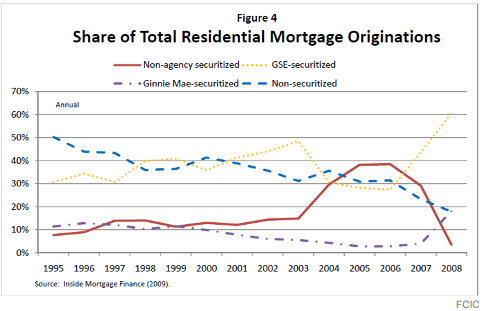
If there’s one line on that chart that looks like a bubble it’s the non-agency securitized one. In other words, non-Fannie and Freddie loans.
Krugman’s right on that and he’s right on this:
Of course, I imagine that this post, like everything else, will fail to penetrate the cone of silence. It’s convenient to believe that somehow, this is all Barney Frank’s fault; and so that belief will continue.
— Give credit to The Wall Street Journal‘s (All Things D’s) Walt Mossberg and Kara Swisher for their interview of Facebook CEO Mark Zuckerberg yesterday.
I think they, and particularly Mossberg, show that a tough interview doesn’t have to be a hostile interview. Mossberg presses Zuckerberg repeatedly on privacy, clarifying his questions to zero in on Zuck’s repeated dodges. Zuckerberg looks like he’s being grilled by some rogue CIA agents, sweating profusely and removing his hoodie. This is good stuff. Watch the whole thing if you can bear listening to Zuckerberg speak. He’s not too impressive.
— Bloomberg has a terrific story on the Foxconn suicides. That’s the Chinese company that makes your Apple and HP products so those two companies can keep up their fat profit margins.
This is a remarkable lede:
Ah Wei has an explanation for Foxconn Technology Group Chairman Terry Gou why some of his workers are committing suicide at the company’s factory near the southern Chinese city of Shenzhen.
“Life is meaningless,” said Ah Wei, his fingernails stained black with the dust from the hundreds of mobile phones he has burnished over the course of a 12-hour overnight shift. “Everyday, I repeat the same thing I did yesterday. We get yelled at all the time. It’s very tough around here.”
Conversation on the production line is forbidden, bathroom breaks are kept to 10 minutes every two hours and constant noise from the factory washes past his ear plugs, damaging his hearing, Ah Wei said. The company has rejected three requests for a transfer and his monthly salary of 900 yuan ($132) is too meager to send money home to his family, said the 21-year-old, who asked that his real name not be used because he is afraid of his managers.
At least 10 employees at Taipei-based Foxconn have taken their lives this year, half of them in May, according to the company, also known as Hon Hai Group.
This is a natural byproduct of free-trade fundamentalism. It’s labor-standards abitrage by our best and brightest American companies.
Has America ever needed a media defender more than now? Help us by joining CJR today.