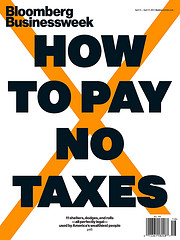
It’s a good look at how billionaires get out of paying taxes. Drucker, an old Wall Street Journal colleague of mine, gives us this excellent context on the richest 400, pointing out that their federal tax burden fell by nearly half from 1995 to 2007:
For the 400 U.S. taxpayers with the highest adjusted gross income, the effective federal income tax rate—what they actually pay—fell from almost 30 percent in 1995 to just under 17 percent in 2007, according to the IRS. And for the approximately 1.4 million people who make up the top 1 percent of taxpayers, the effective federal income tax rate dropped from 29 percent to 23 percent in 2008.
He also points to the McCourt anecdote:
Several of those techniques involve some variation of complicated borrowings that never get repaid, netting the beneficiaries hundreds of millions in tax-free cash. From 2003 to 2008, for example, Los Angeles Dodgers owner and real estate developer Frank H. McCourt Jr. paid no federal or state regular income taxes, as stated in court records dug up by the Los Angeles Times. Developers such as McCourt, according to a declaration in his divorce proceeding, “typically fund their lifestyle through lines of credit and loan proceeds secured by their assets while paying little or no personal income taxes.”
Swell guys. Real estate developers, of all people, depend on taxpayers and government—sometimes through direct subsidies—to make their investments go. Taxpayers usually foot the bill for the infrastructure that makes developers’ projects feasible.
Drucker runs through several different techniques the wealthiest use to avoid taxes, including the “‘No-Sale’ Sale,” the “IRA Monte Carlo,” and the “Estate Tax Eliminator.” It’s an excellent compilation of tax tactics that ought to be scrutinized.
Meantime, Johnston also emphasizes the income inequality that’s run amok in the last thirty years. At the same time taxes on the rich have tumbled, their gross income has skyrocketed. Meantime, median wages have been flat over that time and actually declined in the last decade.
It’s worth remarking that it’s nice to have these two stories out at the same time. Johnston’s piece is running on the covers of alt-weeklies across the country. Drucker’s is on the cover of a major business mag at your nearest mainstream newsstand.
Combined, they hammer the point home that the system is rigged in favor of the wealthiest at everyone else’s expense.

That’s why, say, private-equity and hedge-fund managers’ get to treat their fee earnings as income rather than long-term capital gains.
It's the other way around.
#1 Posted by Abe, CJR on Wed 13 Apr 2011 at 08:30 PM
Thanks for the catch, Abe. Fixed.
#2 Posted by Ryan Chittum, CJR on Thu 14 Apr 2011 at 01:53 AM
This is the same liberal shell game we see all the time - conflating FICA taxes and income taxes..
The FICA taxes go (in theory) to pay benefits from a trust fund - and the REALITY here is that these taxes, when the benefits are entered into the equation (as the liberals conveniently and consistently refuse to do) are highly, highly progressive.
The people who pay the least payroll taxes receive proportionately much more money in benefits than those who pay the most taxes. This is just the way it is. It's called R-E-A-L-I-T-Y... Say it until your lips stop moving and maybe it will sink in...
When it suits the liberal argument to skewer the "rich" (translation "other people who have more stuff than I do") and to argue to snatch their property at gunpoint, then FICA taxes are the same as income taxes... Fungible money to be accounted identically.
However, when it comes to defending the Social Security ponzi scheme, then all of sudden the liberals are tripping themselves to distinguish between FICA contributions and the general income tax. FICA taxes suddenly aren't "taxes" at all - they're merely involuntary insurance premiums that pay benefits while income taxes get spent in the general operating budget.
You'd think any honest, self-proclaimed "watchdog" of "professional journalism" would make this hypocrisy plain, especially when the story hails from a Left Coast "alt-weekly" adorned with a pig caricature....
Apparently, arithmetic isn't the strong suit of the journalism schoolies at Columbia.
#3 Posted by padikiller, CJR on Thu 14 Apr 2011 at 10:21 AM
Padikiller, well said about FICA “taxes” and how the fundamental understanding of them gets changed depending on the nature of the debate. They are fungible funds when arguing for higher taxes and they are "insurance" and a kind of "social solidarity" when people talk about means testing them. You can’t have it both ways.
#4 Posted by Mike H, CJR on Thu 14 Apr 2011 at 10:38 AM
Nice try, guys, but taxes are taxes -- doesn't matter what activity they're used to support. Social Security TAXES may go into a trust fund, but that money pays retirees, rather than being held for the current workers who paid the tax. Other taxes may pay for a bridge, and maybe I drive over it or maybe I don't, but I still get the benefit of having a viable state and national highway system.
If you have to pay it to the govt., it's a tax. FICA isn't an IRA, it's a tax. So it needs to be figured in a person's overall tax burden. So should gas taxes, sales taxes, etc. Put it all together, and it's extremely regressive. If you are going to start computing benefits, how about benefits to the hedge fund sharpies from TARP and the rest of the bailout?
Everyone benefits from tax spending in some way. I may not have kids in public school, but I benefit from an educated work force for the country. I may not own a boat, but I benefit from having the Coast Guard. My house isn't on fire at the moment, but I benefit from having a local fire department. And I may not be 66-1/2 years old, but I benefit from not having a bunch of poor, elderly people who can't support themselves in their old age.
#5 Posted by Brian , CJR on Thu 14 Apr 2011 at 12:17 PM
Brian:
The problem here is that the liberal calculus incorporates the costs of Social Security (FICA taxes paid into the system), but curiously omits the benefits paid out to individual contributors. It's a typical commie shell game. A soviet balance sheet. If all tax dollars are indeed dollars and created equal on their way into the treasury, then so are benefit dollars that are paid in benefits from the treasury.
Any fair analysis of the actual cost to particular classes of taxpayers will prove the plain REALITY in short order... Namely that once cash payouts to individual Social Security recipients are calculated, FICA taxes are in fact highly progressive - the people who pay the most in FICA taxes recoup proportionately far less in benefit payments than the people who pay the least in FICA taxes. I recently provided a detailed example in the forums here that proved that an individual who paid three times less than maximum FICA contribution for 10 years less than another individual who contributed the maximum benefit for 40 years would nonetheless receive more than half the monthly benefit of the maximum contributor.
Once these cash payouts are included in the equation (not to mention SSI, Medicaid, SCHIP, Food Stamps, Section 8, the EIC and the host of other taxpayer funded social benefit programs that dole billions in cash out to poor Americans), it becomes clear in terms of real money that higher income taxpayers shoulder a disproportionately huge part of the tax burden in the U.S.
#6 Posted by padikiller, CJR on Thu 14 Apr 2011 at 02:34 PM
He thoroughly debunks the canard that the rich pay vastly more taxes proportionally than everybody else and he shows how the system has been rigged over the last three decades in favor of the wealthy. The truth is that while the federal income tax is progressive, other significant taxes, like payroll contributions, are regressive.
Ryan, I know guys like David Cay Johnston tell you what you want to hear and all, but a little more of a critical eye should be applied to even the most “fantastic” of pieces.
I did a bit more digging into some of the arguments and assumptions DCJ made in his article and it didn’t turn out so well for him. An example to illustrate.
Take a single mother in Alabama, the most regressive local tax burden according to DCJ and one of the sources he used the . Let’s say she makes $18,700 a year. What is her real total tax burden? Well, on the federal side she isnt going to pay anything in federal income taxes … actually, she qualifies for the EITC, so she will receive a check for $2,686. Assuming she works for someone else, she will have to pay FICA and that is 7.65% or $1,430. So on the federal side her total tax liability is -$1,255 or – 7.1%. Now, as DCJ states, the federal component of tax liability is only one side of the equation, so lets look at the state side. According to ITEP, he state and local tax liability, on average, is about 10.5% or $1,853 per year. So her new total tax liability, state and federal, is $598 or 3.4%. This may or may not be typical but its all based on averages and this particular hypothetical is representative of many many people. It doesn’t end here though … lets not talk about health insurance because her and her child are most likely covered by Medicaid but lets throw in that fat slice of Gub’mint cheese she gets every month from the USDA. Exact numbers were tough to come by, but some reasonable estimates would put this persons qualifying benefit at $140/month or $1,680 a year in direct benefits. You can see where all this is going
Taking DCJ’s example and providing a more complete picture shows his first argument to be a swing and miss of rather epic proportions because while a wealthy Alabamite certainly pays less in local and state taxes as a percentage of their income, their overall tax burden when factors such as the EITC, food stamps, other direct benefits, and their federal marginal rate is many times higher.
This is a pretty classic bait and switch on DCJ’s part where he frames the arguments from a state and federal tax POV, quotes critics who are only referring to federal income taxes and doesn’t bother to do the rest of the work to see how the two balance each other out on the whole. I think because it didn’t give him the answer he was looking for and it was better left to ignore it for the sake of his argument.
So to DCJ’s first point, no poor Americans don’t have a net tax liability.
Is there some break even point where the more money you make your combined state and federal tax liability goes down? I think there might be but that point is much closer to the mid to high six figures than it is to the low five figures in income. But with no empirical evidence provided supporting this, we just have to take it on faith that its true.
DCJ also mentioned the 2004 American Jobs Creation Act and implies its breaks for companies repatriating offshore profits was behind Pfizer’s mass layoffs over the past several years. The argument seems a little “underwear gnomish”.
1. Pfizer repatriates $37 billion and saves $11 billion from the American Jobs Creation Act
2. ……………
3. PROFIT! Err, I mean, Pfizer lays off 40,000 people.
#7 Posted by Mike H, CJR on Thu 14 Apr 2011 at 02:46 PM
The article is very clearly about total tax burdens and not just income taxes, there is no dishonesty inherent in including FICA taxes in that. The dishonesty is in saying that "poor people pay no taxes", which you hear all the time.
The article is also not just about poor vs. rich people's taxes, it's about the middle class, too. My family income is above the median US household income, but below the median for 2 FT earner families. We paid 9% of our gross income in federal income taxes, not including fica. (Nor did we receive any government payments/insurance/food stamps, etc.) John Paulson paid no federal income taxes. Is that acceptable, or not?
Lastly, if you're going to subtract food stamps from taxes, shouldn't you also subtract benefits like TARP or TALF?
#8 Posted by Julie, CJR on Fri 15 Apr 2011 at 09:34 PM
@Julie:
OK, for the sake of argument, forget about the SS benefits paid from FICA taxes... Why doesn't this typical liberal hit piece mention the tax credits poor Americans receive? If we're going to examine the taxes, we have to look at the credits as well as the debits, right?
Even if one chooses to ignore the benefits paid from FICA taxes, the REALITY is that the poorest Americans pay no net taxes. Indeed they end up making money from the government.
In order to pay FICA taxes... The "poor" must earn wages... And in doing do they recapture MORE than they pay in earned income credits.
For example, a single mother of two who makes $15000 a year receives an earned income tax credit of $5030, yet pays payroll taxes of only $847.50.
Thus, this women receives net income from the Treasury of more than $4000 - equivalent to two dollars an hour or more than 25% of her gross income.
This story is nothing but a typical, slanted commie screed.
#9 Posted by padikiller, CJR on Sat 16 Apr 2011 at 08:29 AM
No doubt, there are so, so many things wrong with the current U.S. tax system. It is long overdue for reform and modernization, especially to remain globally competitive. Doubt it? Read political thriller author Steve Martini's screed in "Shadow of Power" and see if you disagree.
http://soquelbythecreek.blogspot.com/2010/04/hidden-gem-even-authors-get-it.html
As for the Top 400, I've generally found it to be bad policy to base broad decision on just 0.00035% of a population. You can read more about the Top 400 and how their taxes compare here.
http://soquelbythecreek.blogspot.com/2010/02/rich-dont-pay-taxes-lie-purposely.html
#10 Posted by Soquel by the Creek, CJR on Wed 20 Apr 2011 at 11:24 AM