

WSJ cuts muscle
A Debit to The Wall Street Journal—and we mean to the institution itself, not the reporter—for a “Heard on the Street” piece describing how some arcane accounting rules allowed Citigroup and Merrill Lynch to keep billions of dollars in write-downs off their income statements.
This piece should have been a Credit, but the Journal seriously underplayed it and cut it far too far. The paper’s bread-and-butter “Heard on the Street” column has unfortunately been dwindling for years. It once had dedicated space of 1,200 words or so and sometimes got more. Now under new ownership it seems to be wilting further. Credit-worthy reporter David Reilly needed more than a measly 621 words to tell this story, and too many questions remain unasked and unanswered.
The story says Citigroup took $15 billion in write-downs the first quarter, but legally hid $2.3 billion more. Merrill took $6.6 billion in write-downs, but legally hid at least another $3.1 billion—compared to the company’s acknowledged loss of $1.9 billion. That’s not exactly spare change, even on Wall Street.
Where are these extra write-downs lurking? Reporter Reilly writes that they’re in
a special bucket in shareholders’ equity called ‘other comprehensive income.’ The beauty of this bucket is the charges land on the balance sheet, but don’t dent the companies’ bottom line.
The theory behind the bucket is that it’s a place for companies to put losses until they deem them to be non-temporary. If a firm says its going to hold a security till maturity, it doesn’t have to mark it to market (reprice it). It’s accounting limbo, makes little sense, and seems made for abuse.
And Citigroup and Merrill aren’t alone in using this loophole, we are told in a graphic. (post updated with graphic at 1:52 p.m.)
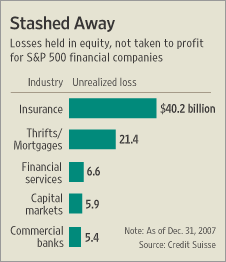
We wonder: What accounting rule permits this evasion? What do accounting rulemakers say? Securities regulators? If this loophole is so important and bad, is there any move to change it? Will anyone speak in favor of it?
Readers are supposed to evaluate this phenomenon based on 621 words? Ridiculous. Anyone who says that’s what readers want has a low opinion of readers.
More stenography from the FT
A Debit to the Financial Times for a front-page interview with John Dugan, comptroller of the currency, about his fear of a wave of bank failures.
Dugan’s office, as the FT tells us, oversees 1,700 national banks. So, it’s one of the institutions that bear responsibility for the current credit crisis. But the paper presents Dugan as a mere observer, allowing him to distance himself from the problem.
‘We’re going to have some more bank failures that will come back more to historical norms and may go above with time,’ [Dugan] said. ‘That is a natural consequence of the economy going from historically exceptionally benign credit conditions to something that is more normal to something you would get in a downturn.”
Well, la-di-da. Except that there’s nothing “natural” about this credit crisis, and if regulators had been regulating, we wouldn’t be in such a bad spot right now. The role of Dugan’s office in this meltdown has been well-documented, finally, and yet the FT does not provide readers any of this vital context.
Some critical distance is needed from the FT with its exclusive interviews. This is becoming a common theme.
NYT takes on sub-rate raters
A Credit to The New York Times Magazine for a piece yesterday describing the crucial role credit-rating firms played in the inflation of the housing bubble.
Roger Lowenstein tells this critical story clearly and with authority through the tale of a single, subprime mortagage-backed security pool. We’re not going to say it’s beach reading by any means—this is complicated stuff; so complicated that the bankers creating them didn’t know what they were doing—but if you want to learn how the conflicted interplay between government-sanctioned ratings firms and their Wall Street paymasters created this financial crisis, this is a great place to start.
And further props for getting a Wall Street CEO, in this case the current Hero of Wall Street Jamie Dimon of JPMorgan Chase, to admit that his firm has “a large failure of common sense.”
The story is a damning picture of a system in which “the government outsourced its regulatory function” to companies, and it ought to be a roadmap for new oversight by regulators attempting to prevent this from recurring.
Not so Smart
A Debit to Smart Money for a column that tries to usher in an economic recovery that doesn’t actually exist.
Donald Luskin, chief investment officer for an economic consulting firm, sounds like warmed-over Larry Kudlow.
Everyone was already saying that the U.S. economy had fallen into recession. The Bear catastrophe could only make matters far worse.
And yet now, a month later, the economy has not gotten worse. Compared to the bleak expectations then, even just hanging in there would have been an upside surprise. But it’s more than that. Things actually are getting better.
Luskin begins with earnings. Sure, he admits, GE had a bit of a disaster this quarter. But besides that little hiccup, “the news has been terrific.”
Tell that to Capital One. Or Ambac Financial , or any of the airlines .
Better than expected, maybe. Terrific? Hardly.
Luskin goes on to tell us:
The worst is over. It’s more than over.
Apparently The New York Times, and just about everyone else, didn’t get the memo. In a Tuesday piece on the scramble for capital, the paper says:
The pain is far from over. Even the most optimistic forecasters say banks will suffer billions of dollars in additional write-downs on mortgage investments and other debt in the months ahead.
If the pain isn’t over at the banks, then it isn’t over in a lot of other places, either.
And how about those out-of-control home foreclosures and falling-off-the-chart home sales? Skyrocketing energy prices? Out-of-control food costs here and everywhere? Rising unemployment? Believe us, the list could go on. Architectural billings, anyone?
So what if there was some excess home building and home buying? So what if some stupid banks made some stupid loans, and some stupid home buyers took those stupid loans and now can’t pay them back? It’s a problem, I suppose. But in the end it’s a side show.
We understand the value of the contrarian argument, but this one is poorly supported.
Strong work from Sidel
A Credit to the WSJ for a page-one piece that shows the paper, at least for now, gives space to some stories.
Robin Sidel reported last Monday that small and midsize banks are starting to feel the impact of their imprudent lending, an under-examined side of the credit crisis.
Why are many smaller banks in a bind?
Some, feeling squeezed by competition from mortgage companies or brokerage firms, expanded into new lines of business or tried to undercut big banks’ rates. Others were seduced to expand across state lines after interstate-banking restrictions were lifted a decade ago. Credit unions revved up real-estate lending, in part as some states relaxed laws that limited their operations to a single community or employee group.
A clear, concise explanation, including both misguided strategies and weaker regulations.
Where’s Robert?
Credit to The New York Times for its smart story on Robert Rubin’s ambiguous role at Citigroup. He was chairman of the executive committee, whatever that means, and held enormous sway at the bank even as it led the economy into the credit crisis. Still, he apparently believes he was in charge of, and responsible for, nothing. His attempts to shore up his reputation remind us of Alan Greenspan’s.
“I don’t feel responsible, in light of the facts as I knew them in my role,” he adds.
Got it. Thanks.
The piece includes a devastating anecdote showing how Rubin, as treasury secretary, killed a measure to shore up derivatives regulation that could have averted the worst of the current crisis. The anecdote, in which Rubin dresses down the head of the Commodities Futures Trading Commission, is based on a first-hand account by Michael Greenberger, then the commission’s director of trading and markets, who was there:
At an April 21, 1998, meeting with Brooksley Born, the chairwoman of the commodities commission, Mr. Rubin made no secret of his feelings about her proposal. “It was controlled anger. He was very tough,” Mr. Greenberger recalls. “I was at several meetings with him, and I’ve never seen him like that before or after.” Ms. Born didn’t return calls for comment.
We wish there were more on Rubin’s role in the repeal of Glass-Steagall. The law that replaced it was formulated under Rubin, signed under his successor and essentially ratified the 1998 merger that created Citigroup, the source of many of our woes.
Good look at statistics vs. reality
A Credit to Harper’s for Kevin P. Phillips’s piece “Why the Economy Is Worse Than You Know,” (subscription required) about how government statistics have given us a falsely positive view of the economy over the past few decades.
Definitions of key stats, like the consumer-price index and gross domestic product, have gradually departed from reality, writes Phillips.
…the use of deceptive statistics has played its own vital role in convincing many Americans that the U.S. economy is stronger, fairer, more productive, more dominant, and richer with opportunity that it actually is.
Phillips doesn’t see any conspiracies behind this statistical debasement, but sees a series of “accumulating opportunisms” and blames both Republicans and Democrats.
This lack of paranoia or partisanship gives Phillips credibility when he looks at who benefits from the rosy numbers:
We might ponder as well who profits from a low-growth U.S. economy hidden under statistical camouflage. Might it be Washington politicians and affluent elites, anxious to mislead voters, coddle the financial markets, and tamp down expensive cost-of-living increases for wages and pensions?
We’re pretty sure the question is rhetorical.
Fortune-ately, we have Sloan
A Credit to Fortune for Allan Sloan’s column “A Gift from the Beltway,” which announces:
High-income folks like me don’t qualify for rebate checks. But we’re getting so much more.
Sloan explains:
Thanks to a relatively little noticed portion of the stimulus package, we’ll be able to refinance our house more cheaply than we otherwise could, or presumably sell it for more.
We like this piece because Sloan both illuminates important but obscure changes in mortgage rules, and candidly reveals his own position to us: we find out that he and his wife make enough money (more than $174,000) to benefit from these changes.
Not that self-interest leads Sloan to support the new rules:
The one thing I liked about the stimulus package was that the government had enough sense to not send money [an economic-stimulus tax rebate] to people like me. But then it turns around and hands me a housing subsidy. I’ll gratefully accept the gift. But that’s no way to run a country.
Ahead of its Time
Finally, a Credit to Time.com for breaking the big story that the Wall Street Journal’s top editor, Marcus Brauchli, is “resigning.”
It’s a great scoop for a newsweekly, showing Time can scrap with the dailies via its Web site.
Elinore Longobardi is a Fellow and staff writer of The Audit, the business-press section of Columbia Journalism Review.