

Nicholas Carr has a fascinating book excerpt in this month’s Wired looking at what the Internet does to how we think. He’s critical, as you can tell from his title: The Shallows.
Carr points out—uncontroversially, I thought, when I first read it last week—the downside of embedded links.
Research continues to show that people who read linear text comprehend more, remember more, and learn more than those who read text peppered with links…
A 2007 scholarly review of hypertext experiments concluded that jumping between digital documents impedes understanding. And if links are bad for concentration and comprehension, it shouldn’t be surprising that more recent research suggests that links surrounded by images, videos, and advertisements could be even worse.
In a blog post yesterday, he expands on the downside of linkage:
Sometimes, they’re big distractions – we click on a link, then another, then another, and pretty soon we’ve forgotten what we’d started out to do or to read. Other times, they’re tiny distractions, little textual gnats buzzing around your head. Even if you don’t click on a link, your eyes notice it, and your frontal cortex has to fire up a bunch of neurons to decide whether to click or not.
There can be no doubt that this is true, and the fact that Carr is getting hammered for bringing it up is bizarre.
Here’s Matthew Mathew Ingram, in what’s either an exercise in snarky point-missing or an unfair distortion of Carr’s argument:
As I mentioned to a number of other people who were discussing Nick’s piece, including Chris Anderson and Vadim Lavrusik, I think not including links (which a surprising number of web writers still don’t) is in many cases a sign of intellectual cowardice. What it says is that the writer is unprepared to have his or her ideas tested by comparing them to anyone else’s, and is hoping that no one will notice. In other cases, it’s a sign of intellectual arrogance — a sign that the writer believes these ideas sprang fully formed from his or her brain, like Athena from Zeus’s forehead, and have no link to anything that another person might have thought or written. Either way, getting rid of links is a failure on the writer’s part.
As I said in a comment on Nick’s post, I fully expect his next move will be to remove links of any kind — and then to ban comments as well, as “thinkers” such as Seth Godin have, since they just get in the way of all that pure thought. And then, perhaps, Nick will finally decide that the internet itself is rather over-rated, and will retreat to his books, where no one can argue with him. And that would be a shame, because arguing with him is such fun.
That’s like saying anybody who thinks drilling for oil in a mile of water is a bad idea really just wants to ban drilling for oil, period.
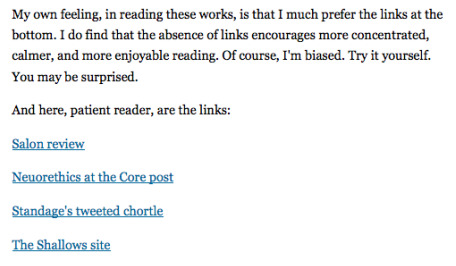
The whole point Carr is making is that embedding links in the text distracts from reading and understanding the text. It’s a reader advocacy thing, not a writerly cover-your-ass gambit. That’s very clear from the fact that Carr posts links at the bottom of the piece:
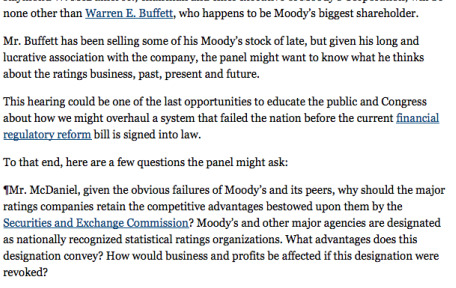
The distracted-by-links thing has long been an annoyance for me—particularly when they’re not specifically selected links. For instance, here are a few paragraphs from a New York Times column today:
Think about reading a newspaper pre-Web that decided it wanted to turn a few words blue here and there. Isn’t that in itself distracting? Now think about how many times you jump in and out of a story to follow some link. It can’t not be distracting.
It’s not a trivial question to ask what the Internet is doing to our attention spans. I know mine, for one, is shot to hell. And my suspicion (totally unproven and based only on personal observation!) is that you scan more than you read on the Internet. With a printed publication, you read more than you do on the Web. Why is that? Well, you’re not distracted by hypertext for one.
Reading on the Web takes more self-discipline than it does offline. How many browser tabs do you have open right now? How many are from links embedded in another piece your were reading and how many of them will you end up closing without reading since you don’t have the time to read Everything On the Internets? The analog parallel would be your New Yorker pile, but even that—now matter how backed up—has an endpoint.
Links add another dimension to a story when used well for context, sourcing, and reference. They’re extremely valuable and a critical part of the value that the Internet brings. But some people are better linkers than others. Look at that New York Times screen capture above. Every one of those links takes you to a topic page rather than something specifically relevant to the point in the text. That’s not worth the distraction of the links.
Here’s a Times story with editorially selected links in the story:

And here’s how it looks on the iPad:
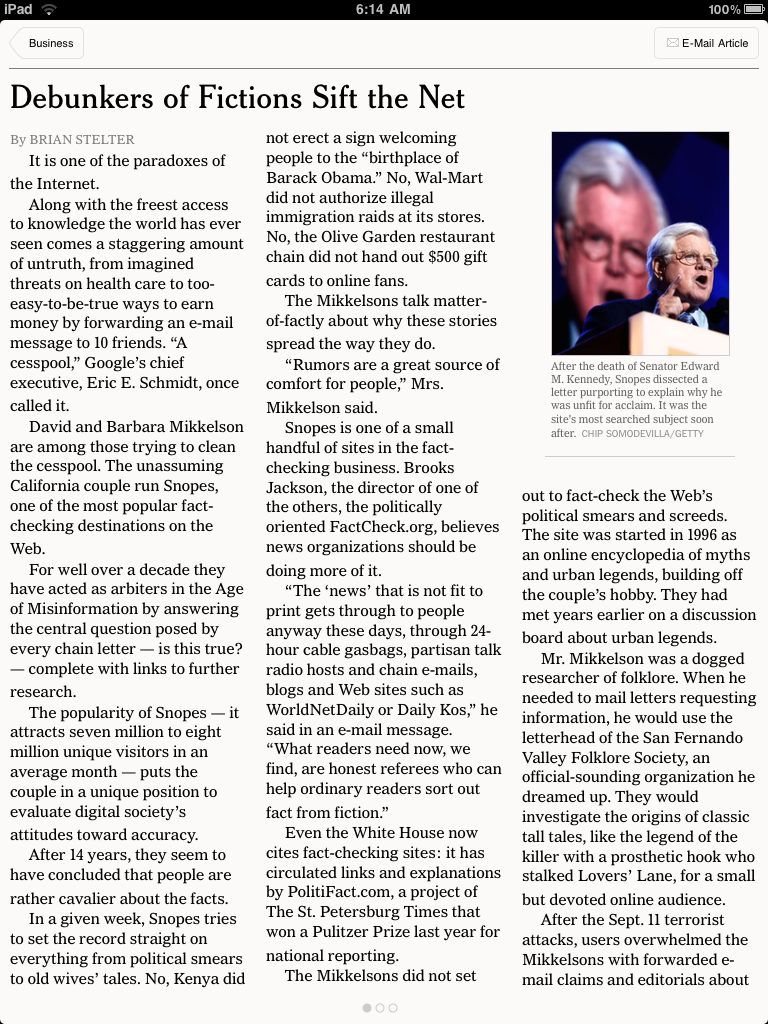
Which is more readable? It’s not even close. Does that mean we ought to do without those links? No!
So what do you do about it? Probably nothing, of course. Footnotes are distracting in their own way. But what about a button to turn off in-text links?
Dismissing the question of what links do to attention and readability as some anti-link nonsense does nobody any good.
Ryan Chittum is a former Wall Street Journal reporter, and deputy editor of The Audit, CJR’s business section. If you see notable business journalism, give him a heads-up at rc2538@columbia.edu. Follow him on Twitter at @ryanchittum.