

Washington Post ombudsman Patrick B. Pexton has a flawed analysis on the logic of a possible paywall there and on the performance of the one that already exists at The New York Times.
How much revenue could charging digital readers really add to the bottom line? To find out, let’s look at the Times’ and Post’s annual reports — publicly available data.
The New York Times Media Group — the division that includes the New York Times and the International Herald Tribune — increased its circulation revenue (revenue from people buying newsstand copies, print subscriptions and digital subscriptions) from 2010 to 2011 by $21 million, or about 3 percent. It saw no growth in circulation revenue the year before. Let’s assume that most or all of that increase was from new digital subscriptions. It didn’t even cover the decline in Times advertising revenue in 2011, which was $24 million.
These numbers are bad (Adding: though technically accurate) in a couple of different ways. First, Pexton is comparing apples to oranges. The NYT‘s paywall was only in place for nine months of last year, not all year, as Pexton implies. You can’t compare nine months of circulation-revenue changes to twelve months of ad-revenue changes and then say the former “didn’t even cover the decline in” the latter.” That’s like giving somebody a 100 meter headstart in the 400 meters and then talking about how the laggard couldn’t even compete, even though they ran faster than the rest of the field.
If you make this an apples-to-apples comparison by taking out first-quarter NYT ad revenue declines, which accounted for $3.5 million of that $24 million 2011 ad drop, then circulation revenue increases actually covered ad declines, by about a half a million dollars. That’s a lot different than Pexton’s “it didn’t even cover the decline,” which if fairly calculated should have been “it more than covered the decline.”
Moreover, Pexton doesn’t take the rapid growth of the NYT‘s digital subscriptions into account. Advertising is a 160-year-old business at the paper, but the paywall was brand new last March. Digital subs got off to a quick start, yes, but there were many more of them at the end of the fourth quarter than there were in, say, May.
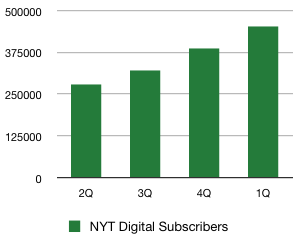
A fairer comparison would take the run rate of the fourth quarter numbers of a new business when comparing them to an old business.
When you do that, you find that circulation revenues, if they had been at a fourth-quarter level all year (and note that circ revenues aren’t cyclical like ads), would have been more than $50 million above 2010 levels. They grew faster as the year went on, and the Times projects they’ll continue to grow at a high rate in the current quarter:
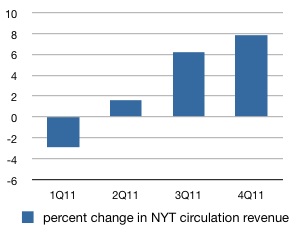
This brings us to another flaw in Pexton’s analysis: He doesn’t consider what print circulation declines were doing to overall circulation-revenue numbers before the paywall went up. The NYT doesn’t break those numbers out, but you can bet that print circulation revenue was declining in the low-to-mid single digits before the paywall went up. Times circulation revenues declined an average 3.6 percent a quarter from July 2010 to March 2011 (the second quarter of 2010 benefited from favorable comps due to a price increase three quarters earlier).
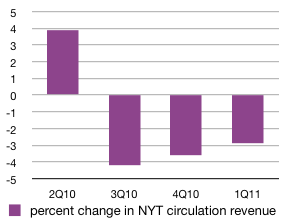
The paywall changed that trajectory sharply, as you can see by combining the last two charts:
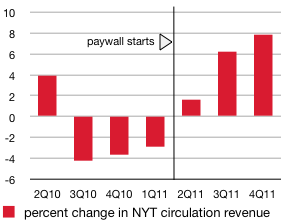
Assuming a 3 percent decline in 2011, circulation revenues would have declined roughly $21 million in 2011 without a paywall. Add that to my $50 million figure above and you’re talking about a swing of more than $70 million a year due directly to the paywall. Not all of that is directly due to digital subscriptions. Some of it comes from discouraging people from quitting the print paper to read free online. The Times‘s print circulation on Sunday—far and away the most important day—actually increased for the first time in half a decade in the wake of the paywall.
Meanwhile, there’s another critical piece of information missing from Pexton’s column: A paywall doesn’t have to be an all-or-nothing affair, and the Times‘s isn’t. He says this:
The other thing to consider is that if everyone else is putting up paywalls, and The Post doesn’t, it has a huge opportunity. It could be the only quality news site that remains free.
That depends on what you mean by free. If you mean free to read all you want without paying anything, sure. But for 95 percent or more of visitors to nytimes.com, the site is free. The NYT let casual readers read twenty stories a month for free last year before asking them to pay (it has since lowered that to ten a month). That means its stories continue to get blogged and tweeted and emailed and it sells ads to the casual readers who wouldn’t pay $16 a month for a subscription. Even if you’ve already hit the limit for the month, you can still read NYT stories linked by blogs and the like.
Because of this strategy, the Times has preserved and added all that circulation revenue done while growing digital advertising revenue at a double-digit clip (in the News Media Group, which is dominated by the NYT and the much smaller but also paywalled Boston Globe).
How did Pexton’s paywall-free Washington Post do in digital ad revenue in 2011? The Post Company doesn’t break the Post‘s results out from Slate’s, but the two declined 8 percent last year, a $9 million loss.
But hey, somewhere down the line the Post might figure out how to make beaucoup money online:
And ponder this: What if The Post, through its innovative uses of technology and social media — witness its Facebook app Social Reader; more than 15 million people downloaded it in just over five months — cracks the code for how to make money with digital content. Then The Post would be formidable. Post executives just met in California with the powerhouses of Silicon Valley. This is not coincidence.
I’ve been hearing this logic from the free crowd for more than a decade and it still hasn’t happened. It’s not going to either, regardless of how many powwows Post brass has with the folks who are smarter than they are and who make their money on other people’s content.
Pexton:
So a paywall is not a solution; it would help over time, but it would not bring a revolution in profitability.
Nobody suggests that leaky paywalls are going to bring about a revolution in profitability. The point is to stop or slow the bleeding and to help make the transition to an all-digital future five or ten years down the line—one that includes more than one flimsy revenue stream based on volatile and not-very-lucrative digital ads.
With every passing year, there’s less and less of the Post to save.
Ryan Chittum is a former Wall Street Journal reporter, and deputy editor of The Audit, CJR’s business section. If you see notable business journalism, give him a heads-up at rc2538@columbia.edu. Follow him on Twitter at @ryanchittum.