

CAIRO—In all the excitement over emerging digital technologies, our increasing physical contact with people from other parts of the world is sometimes overlooked. Today I find it less remarkable that a lower middle class shopkeeper in Istanbul or Casablanca has a smartphone affixed to their belt than, say, the fact that they bought it on one of their frequent trips to Barcelona.
Just as we’re becoming ever more connected in a digital sense, we’re also more likely to have visited other parts of the world, or to have loved ones or friends scattered in other countries—trends that are generating increased global outrage when human rights abuses occur in other parts of the world. If you’ve ever traveled to, say, Bangkok or Jerusalem or Athens, and later received news about protests or violence there, such information likely affected you more deeply because you have memories from such places, and your information-seeking urge to follow developments there is stronger.
We develop a kind of camaraderie of curiosity when we visit a place, and people are much more likely to be urged to action—perhaps in the simple sense of a Facebook post or a five-dollar donation to the Committee to Protect Journalists—when injustice is slapped on newsmakers or news consumers in a place that they’ve been.
Why does injustice in Zimbabwe, Eritrea, or Myanmar generate less global indignation than that in Iran, Venezuela, or even Libya? Well, lots of reasons, and among them is the fact that more outsiders have visited these latter places for work or wonder. Sincere digital activism—indeed, activism of any kind—is usually not without a physical antecedent.
This is something Malcolm Gladwell argued in a 2010 New Yorker essay. Social networks are “terrific [for] the diffusion of innovation, interdisciplinary collaboration… and the logistical functions of the dating world. But weak ties seldom lead to high-risk [or sustained] activism,” he wrote. Personal and physical connections drive higher involvement in human rights advocacy.
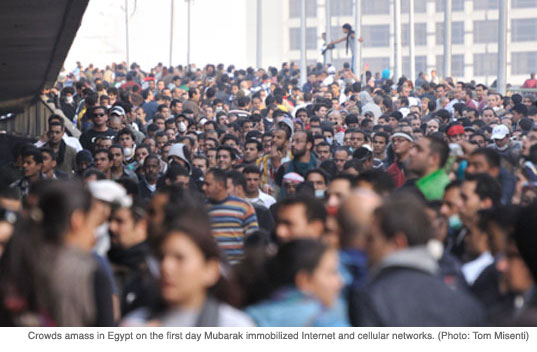
The world is becoming smaller, and an attack on human rights in any given location is an attack on a greater condensation of global interests. When the Egyptian government cracked down on communication networks in 2011 by disabling Internet and cell phone networks, hundreds of my and my wife’s relatives and friends (actual, flesh-and-bone friends, unlike some of our phantom Facebook contacts) had a greater interest in information suppression in Egypt than they otherwise would, whether they had visited the country or not, because we were there. Because of our physical presence in Egypt, our loved ones were more likely to e-mail, Tweet, post on Facebook, and discuss with others news about media repression in Egypt.
Indeed, when Mubarak’s techno-thugs shut down Internet and cell phone networks across Egypt, there were tens of thousands of American citizens living, visiting, conducting business, and reporting news in the country, most of whom suddenly lost essential contact with the outside world. There were thousands of EU citizens and Arabs from other parts of the Middle East in Egypt. A government’s attack on its press or another information system is, in fact, a multinational offense, affecting interests and individuals from many other parts of the world.
Global mobility continues to grow, and just as peoples around the world are more digitally connected, we’re also more physically connected, as even working class citizens in emerging economies often find the resources to visit other countries. During a recent trip to Turkey, my wife and I were shopping for jewelry and spices in Istanbul’s Grand Bazaar, and we stopped and had a chat with a merchant tempting amblers with silver earrings and bracelets. When I told him I grew up in Florida, he gushed into details about two trips to South Beach he’d taken in recent years, right down to the particulars of shops and bars along Collins Avenue.
I’ve argued in previous writings that lay people everywhere should be incensed by attacks on free speech anywhere, but nothing makes this case like a brick-and-mortar experience of a news consumer who happens to have visited—or has a loved one in—a country in which an assault on the press takes place.
Twain said “[t]ravel is fatal to prejudice.” It’s also fatal to indifference. As the world becomes more physically, not just digitally, connected, the Mubaraks, Chavezes, and Qaddafis of the world will find it harder to control conversations about their actions. A dictator may shut down the Internet in a certain country, but they can’t mute the outrage of outside observers who feel they have a stake in ending the silence.
Justin D. Martin is a journalism professor at Northwestern University in Qatar. Follow him on Twitter: @Justin_D_Martin