Sign up for the daily CJR newsletter.
CAIRO—If my sense is correct, e-readers will soon replace printed books as the dominant form of literary distribution. There are already plenty of groups who have good reason to go digital: the environmentally conscious, penny-pinching school boards, bookish families, citizens in dictatorships that ban various paper books, elderly individuals who can’t lug around heavy books, graveyard shifters with substantial downtime. But the group with perhaps the most reasons to use e-readers is travelers, particularly globetrotters.
My wife and I were early adopters of Amazon’s Kindle. We live and work in Cairo, and in 2009-2010 she or I have visited or will visit the U.S., Singapore, Israel, Cyprus, Jordan, Kuwait, and possibly Tunisia. We’d be nuts to carry paper books to all of those locations since we now don’t have to.
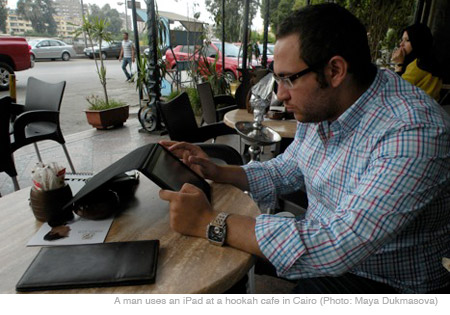
Also, as a journalist who reports from many of these countries, being able to carry around a small library is invaluable. In Singapore, I wanted to quote Fareed Zakaria’s book The Post-American World for a piece in CJR. I had what I needed from my Kindle literally in seconds, and didn’t need Internet service to get it.
Ours is an isolated story, but think of the other roughly 5.3 million Americans living outside the U.S., a figure that doesn’t even include military personnel. Or consider the tens of millions of German readers—those living in Germany are much more likely to travel internationally than Americans—who now have access to digital books in their language on the Kindle. With airlines charging passengers for even thinking about luggage, paper weights are even less attractive cargo.
Also consider that hundreds of thousands of American students study abroad every year. Taking a class in economic history at the London School of Economics? You can shell out good British sterling for the print version of Adam Smith’s An Inquiry into the Nature and Causes of the Wealth of Nations, a 600-page anvil, or you can get the book absolutely free on a Kindle, as the volume has long been in the public domain and free of copyright limitations.
E-readers are money-saving devices, and the savings margin is often the greatest for individuals purchasing books outside of the United States, where international shipping costs are much higher and there are often fewer options to purchase used books.
My graduate journalism students are required to read Best Newspaper Writing, 2008-2009, published by the Poynter Institute. The paperback book is available new from Amazon for $27.78. For my students to buy the same book from our university bookstore, they pay 70 percent more: around $47.00. The book, not yet available for the Kindle, might cost $15 on an e-reader.
Perhaps the only folks aching to see paper books remain the dominant form of literary provision, aside from companies that process wood pulp, are readers sentimental about the “feel of curling up” with a paper book. But this group of traditional bibliophiles is dwindling, which will only continue. People have the tendency not to want to “curl up” with unnecessary expenditures. I was committed to the paper book before I tried an e-reader. Now I’ll never buy another paper book unless it’s a must-have item that isn’t yet digitally available.
In the late 1990s, plenty of letter writers were committed to handwritten notes over e-mail, but just ask the U.S. Postal Service how revenue has been over the last decade. (The Postal Service as we know it now will not survive, a fate that, interestingly enough, will be partly tied to the death of the paper book and the non-shipping thereof).
The setbacks of e-readers are frequently discussed and legitimate. Scores of books are not yet available on e-readers. To lend a book to a friend you usually have to lend them the entire device. And you don’t want to use it in the bath, poolside while kids do cannonballs, or in a sauna (although I don’t at all doubt that waterproof e-readers are in our future).
E-readers won’t kill old-guard newspapers, which are dying for other reasons. (Nor are e-readers likely to save many of them; at $144 a year, a Kindle subscription to the moribund Washington Post is a fantastic rip-off, especially since the paper is still free online. The WaPo subscription costs more than the Kindle itself!).
But, I tell you, e-readers will kill the paper book, and travelers will be highly complicit in the act.
Has America ever needed a media defender more than now? Help us by joining CJR today.