

Juan William’s abrupt firing from NPR and hiring by Fox News seems to have kicked up an old debate over whether public radio should still receive federal funding. The Corporation for Public Broadcasting has funded public radio since its creation through an act of Congress over forty years ago. In the past week, Sarah Palin, Mike Huckabee and Newt Gingrich have all said that this policy should be re-examined.
This morning, MediaBistro alerts readers to a new poll by Poll Position, showing how divided Americans are on this issue:
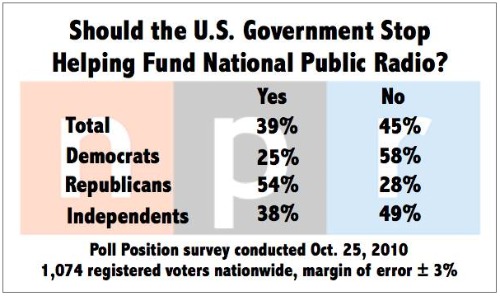
It’s important to keep in mind, when writing about this issue, that NPR actually receives a lot less money than people might think it does (a fact drummed into listeners’ heads every time a membership drive comes along). The NPR website is quite clear about the organization’s sources of funding, and the past few years’ financial reports are available for download there.
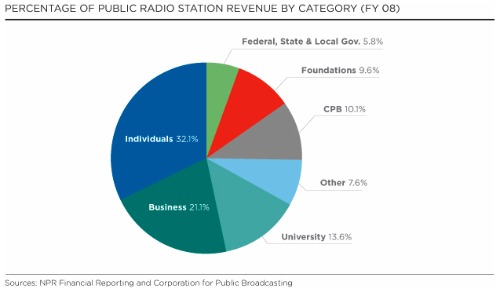
Here’s the chart for NPR’s individual member stations: see that direct funding from Federal, State & Local governments made up only 5.8 percent of the stations’ revenue in FY 2008. The Corporation for Public Broadcasting (CPB) contributed another 10.1 percent, but even if you add those up, that’s still only about 16 percent of the stations’ funding coming directly or indirectly from government sources.
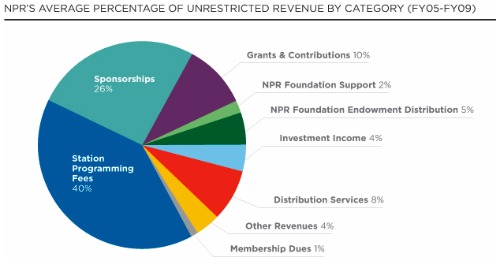
And here’s the breakdown for NPR itself, for FY 2005-2009. NPR is funded in large part by the fees that the member stations pay it for the right to play NPR programs (like Morning Edition, All Things Considered, etc.) and by corporate sponsorships. NPR actually does not receive any government funding for its operations costs.
As with any hot topic, it’s easy to get swept up in the hysteria, so it’s that much more important to anchor the discussion with the raw facts. Opinions are controversial; facts are not.

If tax monies are so insignificant in funding NPR, Lauren, why does NPR persist in accepting these - leaving itself wide open to charges of using public funds to subsidize the political preferences of the members of its staff? Or am I being 'hysterical' by asking skeptical questions?
#1 Posted by Mark Richard, CJR on Thu 28 Oct 2010 at 11:58 AM
I love NPR, but if it is pulling fees from member stations, where are the member stations getting their money? Probably the govt.
#2 Posted by Darius, CJR on Thu 28 Oct 2010 at 12:22 PM
@Mark,
NPR accepts the money b/c they need it. Its not like NPR is flush with cash. As for your question, it signifies to me that you don't listen to NPR all that much. NPR is one of the few places still available for factual information and international coverage. They criticize Democrats and Republicans and often do a better job of explaining policies than of the network or cable "news" shows.
As for the Juan Williams firing, I'm fine with it, but i see why people are upset. However, I'm more dismayed by the fact that Williams, himself, doesn't see it as a bigoted statement. Just b/c you believe it's true, doesn't make it any less racist.
#3 Posted by Neil, CJR on Thu 28 Oct 2010 at 12:30 PM
They seem flush enough to manage to keep their taxpayer funding to very low percentages. Seems they could replace this revenue with short advertising periods, much like Sirius XM does. NPR is popular and if they were to drop the taxpayer subsidies they'd survive. Since they're a non-profit they're not supposed to be flush with cash.
#4 Posted by Steve, CJR on Thu 28 Oct 2010 at 01:09 PM
Darius - that's what the first chart shows, the breakdown of funding sources for the member stations. The second chart is for NPR overall.
Also, I forgot to mention in my post that CEO Vivian Schiller has since explained the firing in a memo to NPR member stations, apologizing for how she handled it. She said Williams wasn't exactly fired "for" the comment he made on O'Reilly; it was kind of a last straw sort of a thing. You can read it here: http://politi.co/bK3L9m In any case, I'm not really arguing one way or the other about the firing; just saying that some people arguing about gov't funding (and the people writing about the arguing) don't seem to be aware of the actual #'s in question, or are ignoring the real #'s because they would make the story seem less exciting.
#5 Posted by Lauren Kirchner, CJR on Thu 28 Oct 2010 at 01:17 PM
Thanks for the clarification on funding sources; much different than I would have expected.
I remain unconvinced that we should be using taxpayer money for broadcasting news and opinions, and dislike having a corporation whose Board is appointed by the Federal Government. It is not possible that a right-wing or left-wing majority might succeed in putting its "puppets" in place, and then use increased government funding (if contributions fall off), with the result of having a propaganda channel?
It's not really a hot button for me, but rather a gnawing concern that I never have been able to put to rest.
#6 Posted by Terry Ott, CJR on Thu 28 Oct 2010 at 01:43 PM
My bad. Though it's interesting that universities represent such a large portion.
#7 Posted by Darius, CJR on Thu 28 Oct 2010 at 01:45 PM
In response to Darius statement:
Local “member” stations receive their funding in the same way that NPR receives funding. It is member driven, if local stations/affiliates cannot meet there monetary goals via public, local corporation donations & grants from universities or foundations, then they have to strip programming. The local stations receive very little, if any, funding from the US government, federal or local. If you "Love" NPR and have listened for any amount of time, then you should know this by the quarterly 2 week or longer "pledge drives" that completely disrupt regular programming for up to 1/4 of a broadcasting day.
There should be no question or political debate about funding for NPR, Juan Williams was completely in the wrong, he went on a publicly viewed, corporate owned network as a representative of NPR (this was stated by Bill O'Reilly several times during the broadcast) and gave a very non-neutral, bias opinions.
I understand that as American, we all have freedom to express our points of view, but there is something called journalistic integrity. Mr. William’s by expressing his personal feeling in public lost the ability to give neutral, non-bias commentary and lost creditability as a journalist. From the night of his appearance on Bill O'Reilly's show forward, persons that would normally listen to Mr. William’s reports will now question his ability to accuracy report on a story.
The sad part of this is that the American public has fallen victim to right wing political squawk boxes such as Bill O'Reilly, Glenn Beck & even Alaska’s beloved moose hunting, hockey mom Sarah Palin (now a paid commentator of the Fox New Organization along with Newt Gingrich) which foul the airwaves with half truths, scare tactics, and fear mongering under the guise that they are journalists.
#8 Posted by Hattrick, CJR on Thu 28 Oct 2010 at 05:26 PM
@Neil, I expect I listen to NPR a lot more than some people on these threads watch Fox. BTW, I listen to it from our local public radio station - which is sponsored by the local state university - which in turn is, of course, heavily subsidized by public funds in spite of all those fund-raising appeals.
Kirchner's account does not include 'universities' in her percentage of NPR funding, but these are almost always, I believe public universities, with public monies supporting them. So there is good reason to believe the 'public' resources drawn upon by NPR, when all is said and done, are greater than the 16.1% figure. And the foundation money in the pie chart is tax-exempt.
NPR has excellent resources and many virtues, which is why I listen to it. But it is tainted (like the BBC) by a sort of rigid urban/bourgeois vocabulary, framing, and story selection conventional to the mainstream media.
This result in poor predictive journalism as a general rule.
#9 Posted by Mark Richard, CJR on Fri 29 Oct 2010 at 12:48 PM
Removing the tax funding from NPR removes the "Public" from its name. Just because some old curmudgeons have been griping since the New Deal about publicly funding our culture, doesn't give them any more credibility than they had back during the Depression. If you think that the government has no place in public forums, well, I disagree with you. Since we both disagree, this boils down to a power struggle--and might does not make right.
As a matter of fact by lobbying to remove public funding from NPR, it shows your weakness: you are weak in your ability to tolerate dissenting views; you are weak in your integrity to preserve objectivity in journalism; you are weak to go after smaller institutions (e.g., can't privatize Social Security? Go after NPR!)
#10 Posted by Tony MacFarlane, CJR on Fri 29 Oct 2010 at 02:08 PM
Sorry guys, but the second pie chart for NPR only covers "unrestricted revenue" and for 5 fiscal years (2005 to 2009). What about restricted revenue?
More interesting is that NONE of the NPR funds came from the Federals.
Look again.
However 7% came from the NPR Foundation, which got it where?
And since various government agencies give grants (NTIA for one), how much of that 10% category is hiding tax money?
As to the first pie chart for all Public Radio stations (NPR or not), 16% came from Federal, State and local governments, plus CPB. And there's a undefined "other" category for another 7.6 %.
Some forensic accounting is called for. Where's Mike Taibbi?
#11 Posted by MattS, CJR on Fri 29 Oct 2010 at 02:09 PM
Killing NPR funding is just part of the teabagger jihad against rational thinking.
Although NPR is run on a shoestring compared with the FOX News GOPstapo, it may be better for NPR to become independent, then they can fight back with more force against the immigrant-bashing, gay-hating Teabag Party scum who are dragging this country back to the dark ages.
#12 Posted by Glenn Brownshirt, CJR on Sat 30 Oct 2010 at 12:58 AM
This NPR founding Report and this Ratio Graph statement is very useful part of this NPR system.A couple month ago, We didn't fount out like this changes..Great improvement.. Leanspa
#13 Posted by Leanspa, CJR on Sat 30 Oct 2010 at 04:44 AM
Thanks to Glenn for confirming a stereotype of NPR's defenders. I'm sure NPR itself isn't wincing at such sophisticated refutation of the conservative-right criticism of the network. In the meantime, my local public radio station was running as fast as it could away from the upper management of NPR, inserting disclaimers that it was independent of that management.
You are correct, however, that by operating independently of tax funds, NPR would then be able to liberate its inner Pacifica Radio or Air America. Shouldn't the left therefore join the right in defunding it?
#14 Posted by Mark Richard, CJR on Sat 30 Oct 2010 at 07:31 PM
BTW, Hattrick, NPR is part of a corporate entity, too, whose employees do not work for free. It's called the Corporation for Public Broadcasting. Unlike Fox, it is subsidized by public funds, so Fox is not taking any of your money, whereas NPR is taking money through taxes on people who disagree with its politics.
#15 Posted by Mark Richard, CJR on Sat 30 Oct 2010 at 07:35 PM
I'm trying to remember.. Did the liberals raise this much of a stink over the vastly less legitimate termination of Bill Moyer's Now program?
http://en.wikipedia.org/wiki/Kenneth_Tomlinson
http://www.democracynow.org/2005/5/16/bill_moyers_responds_to_cpbs_tomlinson
Right wingers object to politicization when, and only when, it's their own who are affected.
#16 Posted by Thimbles, CJR on Sun 31 Oct 2010 at 03:26 PM
Juan Williams was released from his contract because his employer didnt agree with his actions. Welcome to America Juan. This happens uncountable times every day. Guess what Juan, youre not entitled to your job.
If NPR was trying to silence him, releasing him from his contract would leave them unable to do so. If he thought he had a legal leg to stand on he'd excersize that option. As it turns out he signed a 2 million dollar contract a few dozen hours after his comments were made? Could he have been trying to provoke NPR into releasing him so that he could sign with FOX? Contracts of that magnitude arent standard forms that you buy at the office supply store. They generally take weeks to negotiate and solidify.
Hmmm... I may have been born at night, but it wasnt last night !!
#17 Posted by Common Sense, CJR on Wed 3 Nov 2010 at 01:18 AM
NPR does indeed -- as its defenders have noted here -- have every right to release Juan Williams from his contract if he doesn't meet the conditions of his contract. The problem is that NPR officials have said that Williams violated his contract by expressing his opinions as an analyst, yet NPR has a long list of analysts who have expressed strong, even vitriolic, opinions without so much as a reprimand. They include Nina Totenberg, Cokie Roberts, and the late Daniel Schorr. Americans who have followed this issue are aware of the double standard, and so they know that the reason given for Williams' dismissal is bogus. The resulting damage to NPR's credibility could be a major factor when Congress takes up federal funding for public radio.
#18 Posted by frank, CJR on Wed 3 Nov 2010 at 12:27 PM
CJR should do a piece on what may be the biggest overlooked story on "public" radio — the lack of transparency on how stations spend taxpayer (and donor) money. More than 60% of public stations are affiliated with universities, and many of these hide behind state laws that allow them to avoid financial disclosure (e.g., KUT in Austin, TX). Fifty million dollars of CPB money has been spent installing "HD" radio transmitters, a moribund technology that has gone nowhere — force-fed to the locals solely to provide a market for canned NPR product. The mission of public radio has gone awry, and there's no check on the money spent.
#19 Posted by outraged, CJR on Tue 9 Nov 2010 at 07:32 AM
I always thought of NPR as a true journalistic operation. I no longer trust the network.
#20 Posted by CRAIG, CJR on Sun 6 Feb 2011 at 07:45 AM
Posted by Mark Richard: "...leaving itself (NPR –Brian) wide open to charges of using public funds to subsidize the political preferences of the members of its staff? Or am I being 'hysterical' by asking skeptical questions?"
Yes, you are being hysterical and you clearly do not listen to NPR. National Public Radio identifies its guests -and is frequently vilified for having a disproportionate number of conservative to liberal commentators on it’s programs.
The canard you state is a common, albeit inaccurate, talking point of those who oppose NPR, Mark. Most conservatives I know consider anything liberal if it is not clearly conservative; a hollow metric allowing no middle ground.
I was a Republican for some thirty years; I have been an NPR listener for even longer. I was a combatant in the first Gulf War (Desert Storm) where I frequently found myself explaining why we were there (thank you, NPR). I even worked at an affiliate for a brief time after I finished my degree. While taking calls during a pledge drive I started talking to the guy next to me. He mentioned that he was a retired FBI field agent who now worked as a private investigator. I asked if he would mind me asking his political preference, he said:
“Republican.”
I asked if he ever got any grief from his friends for supporting ‘National Pinko Radio’ and he laughed, replying:
“NPR is the best un-biased news you can get in this country, many people who actually work in government (he seemed to be implying ‘not’ politicians) listen for that reason."
#21 Posted by Brian, CJR on Thu 17 Feb 2011 at 02:43 PM
NPR’s listenership is comprised of about 30% conservative (self-identifying). I would also like to state for the benefit of the redoubtable Mr. Mark Richards that much as “…NPR is taking money through taxes on people who disagree with its politics.”
I find the government taking my money through taxes to fund things I disagree with like aircraft carriers, ‘spare engines’ for much over-budgeted interceptors… et al.
#22 Posted by Brian, CJR on Thu 17 Feb 2011 at 02:52 PM
If all federal funding for NPR stopped today, NPR would not go away. At least not in the major markets. The only stations that would be impacted would be the stations in rural or economically depressed areas. Those areas where the local population can not afford to give donations to NPR. Granted, the larger markets would probably pitch in to help keep the smaller markets running but at what cost. More fundraisers or fewer services. The quality of NPR would have to drop, which is exactly what the far right seem to want. Less competition for the commentary they pass off as news. Is NPR far right? Well I guess it depends upon your point of view. I listen to NPR all the time. Some articles I find right of me and some left of me. The reason I listen is so I get a view of what is happening in the world and my local area, new ideas in science and comedy. I hear things the I won't hear on the networks. NPR doesn't have to worry about ratings or corporate sponsors. The benefit of public broadcasting far exceeds the cost to the government. One day of funding the wars in Iraq and Afghanistan at their height cost more than NPR gets for a year from the federal government. The right wing's attempt to defund NPR has little to to with fiscal responsibility and a lot to do with ideology.
#23 Posted by Adversary, CJR on Thu 11 Oct 2012 at 01:18 PM
