

For a quarterly coupon magazine—even “Southern California’s best coupon, calendar & news magazine”—Reader Magazine would appear to have landed some major exclusives.
This summer, the magazine, which is distributed by mail to 150,000 households in San Bernadino county, caught up with the Dalai Lama.
And in 2008, it asked questions of Thomas L. Friedman, John McCain, and Stephen Colbert.
From the February/March/April 2008 “Reader Magazine interview of Senator, John McCain, 2008 Presidential candidate” (Reader does not make it easy to link directly to their articles, but back issues are available in PDF format on their website):
Reader Magazine: As you look at yourself, was your courage there before you were taken prisoner or did it develop?
McCain: I think it developed in this respect. I had believed that all glory was self glory and that I didn’t need anybody else and I could do everything on my own and I was brave and tough and I was just like Robert Jordan, my hero, the protagonist in “For Whom the Bell Tolls.”
The thing is, Reader’s interview is an awfully lot like—almost word for word, in fact—an interview CNN’s Larry King did with John McCain in 2005.
KING: As you look at yourself was your character there before you were taken prisoner or did it develop there?
MCCAIN: I think it developed in this respect and I believe that all glory was self glory and that I didn’t need anybody else and I could do everything on my own and I was brave and tough and I was just like Robert Jordan, my hero, the protagonist in “For Whom the Bell Tolls.”
Similarly, Reader’s interview with the Dalai Lama, published earlier this year, was originally published in 2006, in The Progressive. Thomas L. Friedman’s interview (November/December/January 2008-09) was taken from Time. And the exchange in which Reader “sat with” Stephen Colbert (May/June/July 2008) appears to be a combined work of fiction and bits from the comedian’s appearance at Harvard and his bio on the Australian Broadcasting Corporation website.
RM: Your background is in entertainment.
SC: And my foreground. What is The Reader anyway? Who has time to read today?
Indeed. What is the Reader anyway? Though Reader founder Chris Theodore says his magazine is ten years old, only issues from 2008 on are available on its website. From a search of the magazine’s back issues, Reader appears to be a usually 32-page publication of advertisements—tailored to four neighborhoods in San Bernardino County—and content it seems to take from almost anywhere and then claims as its own.
In each of the above cases, Reader represented the interview as its work; Reader Magazine is substituted for the name of the original interviewer in all but the Q&A with the Dalai Lama, in which Amitabh Pal is given a byline, but neither The Progressive nor the original 2006 publication date is mentioned. In some cases, the interviews were shortened or lightly edited. Good thing, too, since the material was lifted from publications that were several years out-of-date; in Pal’s interview, Reader omitted a reference to the Iraq War and changed the Dalai Lama’s age from 70 to 76, for example.
“This is definitely unethical, and, at some level, troubling. Unfortunately, in this day and age, it is fairly common, certainly online but also in print,” said Pal when I informed him of his work’s second run. “The practices by the Reader are, sadly, part of a broader trend.”
Perhaps. Plagiarism certainly happens today. The digital age has brought new ease for writers to cut and copy, as well as a vaster universe for them to cut and copy from. These developments have coincided with an era charged with the spirit of aggregation and the collaborative wiki-, while also squeezed by time and budgets and the constant call to do more with less. None of this excuses plagiarism, but helps to explain why it continues.
Yet Reader, the oddly-titled, quarterly coupon magazine of Southern California, is a completely different beast. As evidenced by its tendency to raid journalism’s grave circa 2006, Reader is not on this frantic publishing hamster wheel. Its plagiarism is not isolated to a few sentences or a choice turn of phrase. It’s not the work of a rogue reporter trying to get ahead, or an overwhelmed reporter trying to keep up. It is the whole scale ripping off of others’ work.
Reader is a mailed advertiser—its website boasts it “now has a larger circulation than the paid circulation of nearly every newspaper in California”—that was founded on the principle “keep the price as low as possible, and the quality as high as possible.” Its website is clearly geared towards its advertisers. That’s fitting: the Reader’s advertisers do not sustain its journalism; its “journalism” is a strategy to sustain its advertisers. Plagiarism is its bold, bald business model—and it has been this way since at least 2008.
Besides a smattering of local content, a quick sampling of the last three years’ of issues would suggest all other content is taken from somewhere else. The Reader has drawn its content from many varied sources—some fair, most not—and failed to credit nearly all of them, including Newsweek, National Geographic Adventure, the 9/11 Report, Huffington Post, the Diet Channel, author Guy Kawasaki’s blog, RT, Mumbai-based CNBC TV 18, Guideposts, and Jonathan Calloway, a recent college graduate and winner of the Elie Wiesel Prize in Ethics Essay Contest (Calloway was given a byline). The Reader does not limit itself to the text of other publications; it also recycles art and photos.
CJR contacted a number of these outlets, and in each case was told by the original author or publication that they had been unaware of the republication of their work, and often times that Reader had gotten basic things wrong. Samantha Carlin, of the Elie Wiesel Foundation for Humanity, for example, said that not only had Reader not requested or received permission to run their contest’s prize-winning essay, it had “misrepresented the prize in its table of contents” by getting the name wrong.
A June 2010 Newsweek story, “Healthy at any Age,” by Mary Carmichael, was published as Reader’s July/August/September 2010 cover story.
Carmichael, now a higher education reporter with The Boston Globe, was dismayed to discover Reader’s treatment of her article, which included some stylistic edits (using ellipses for dramatic effect, for example) and drastic abridgement. She was relieved only that they had neglected to run her byline. “They edited it in a way that makes it sound airheaded,” she said.
But the bigger problem according to Carmichael was that what Reader published was merely the introduction she had written to a much larger package, and it didn’t make any sense on its own. “You just kind of wonder did they even read the thing that they copied and edited?”
Carmichael, who has seen her work reprinted without permission before, was surprised by the audacity involved in this case and, though not personally hurt by it, was bothered by the fact that Reader “may be making money on something that they should not have.”
“It seems like something you should A: never do, and B: never do in the age of the Internet,” says Carmichael. “I don’t often see my work or other peoples’ work presented wholly in the guise of being someone else’s the way this happened. I would be horrified if that’s the new normal.”
Yet far more egregious than these instances in which Reader lifted a single article, is its latest issue in which it borrowed almost all of its content from the Seattle-based Yes! magazine.
Doug Pibel, Yes!’s managing editor, says that Reader lifted at least 11 pieces—including the “Purple America” cover art and feature—from multiple issues of Yes! and its online content. He notes that all Yes! branding was stripped and replaced by the Reader equivalent— “a Yes! magazine take on what Americans want” became “a Reader Magazine take on what Americans want.”
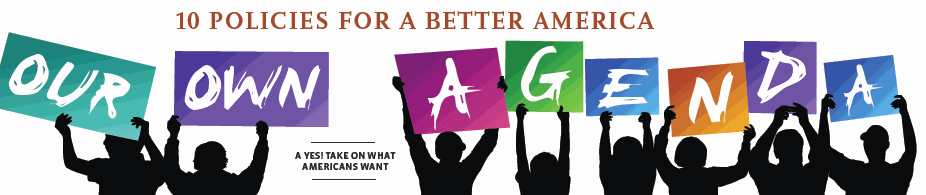
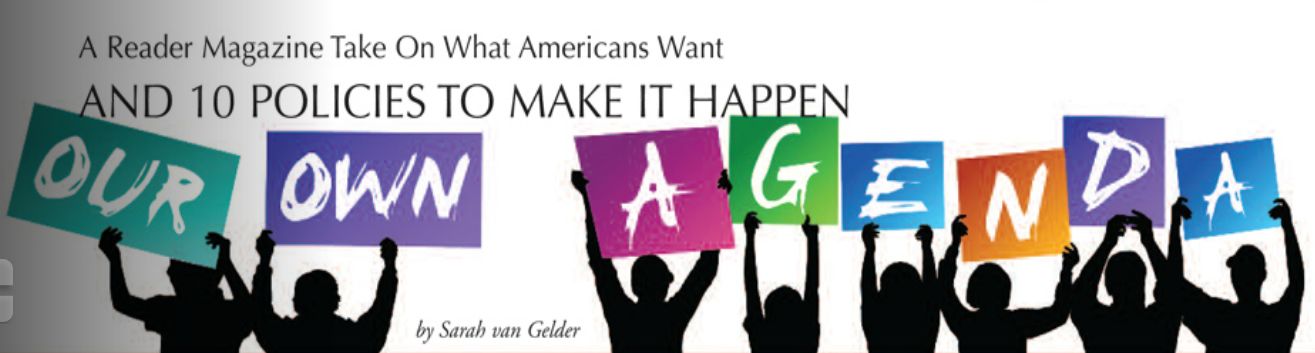
There were minor differences: in editing an introduction to Yes!’s interview with Richard Wilkinson, Reader misspelled the researcher’s last name; it also changed the title of Yes!’s feature, “Tools for a popular uprising,” to the less bellicose, “Tools for a more perfect union.”
Pibel learned of “this amazing product” when he received an email and link from an “alert subscriber…who picked up on the fact that this was an unlikely spot for our material to appear and asked ‘Did you actually give permission to this magazine to reproduce this?’”
Following his tipster’s link, Pibel discovered that Reader not only looked and read a lot like Yes!, but that four of his contributors—executive editor Sarah van Gelder and a chairman of the board among them—had been added to Reader’s masthead. Pibel was further surprised to learn that his magazine had entered into a “special collaboration” with Reader.
Per Theodore, in the issue’s Publisher’s Note:
We’ve chosen the theme of this Reader Magazine to be Purple America, to remind us of the common hopes and ideals we share as a nation. We first heard the term “Purple America” in Yes!, a national, nonprofit media organization that fuses powerful ideas with practical actions. Because we believe many of the ideas espoused by Yes! deserve to be heard in the broader marketplace of ideas, we’ve given our voice to republish some ideas through a special collaboration.
Except, says Yes!’s Pibel, “this is a collaboration that did not involve any communication with Yes! magazine. There was no collaboration—‘special’ or otherwise.” (Even so, this one-sided collaboration appears to be the only instance in which Reader’s founder, Theodore, has sort of credited a source publication.)
“It’s particularly egregious for us because it’s really a placement that is contrary to our brand,” says Pibel. “We’re all about sustainability, economic justice and ramping down consumerism. And being used in support of shopping coupons is not usually where we prefer to show up.”
Pibel has found an attorney to represent the magazine pro bono and draw up a cease and desist letter. “We want people to reprint our stuff, we just want to have credit for it and maybe a link to our website when they do,” he says.
But more than anything, Pibel was stunned by the “chutzpah” involved in Reader’s stunt. “In today’s Internet world, I think people are getting real confused about what’s appropriate use and what’s not,” he says. “But I think it goes far beyond that to take an interview and substitute your name as interviewer. The level of audacity involved there—I don’t even know how you would even think of doing that.”
Chris Theodore, founder and publisher of Reader, wasn’t up for explaining. When contacted by CJR, Theodore refused to grant a phone interview or respond to e-mailed questions, and instead sent an e-mail threatening a lawsuit if we pursued the story. He also accused of this reporter of conspiring in a “smear campaign” with an individual “who seeks to speciously discredit our much loved publication, and is using your institution for this purpose.”
Despite the perils that the Internet would seem to present for plagiarizers of our time—it can take but a simple Google search to undress the Emperor these days—Theodore does not shy away from promoting Reader on its many platforms. Perhaps he even offers a clue about his editorial practices at his Tumblr and Facebook pages, in a post titled, “Massive Collaboration Changes Everything,” where he hints at the substance of a new social network, Wikitny, he is building and which he imagines will become the “place to add your mark to the destiny of the world.”
Perhaps also telling is this language at the Reader Magazine legal page:
The information presented here has been compiled by Noble Media, Inc. from internal and external sources. However, no representation is made or warranty given as to the completeness or accuracy of such information. In particular, you should be aware that this information may be incomplete, may contain errors or may have become out of date.
Yet, if Theodore’s philosophy is that unsourced compilation is the same thing as collaboration, it hasn’t stopped him from displaying the standard legal—copyright and trademark—protections for Reader’s content as well. You will be prosecuted for plagiarizing the plagiarizer, apparently.
“It’d be nice if there were some recourse,” says Vincent Zandri, a freelance journalist and author of fiction whose feature, “One Man’s Victory Against All Odds” by RT in May 2009— was republished in Reader’s November/December/January 2010-11 issue. “If one of your stories is being reprinted and you’re not paid for it, that’s plagiarism and money out of your pocket—especially for me; I’m a freelancer.”
Zandri says his work has been pirated numerous times, and he was not terribly surprised to learn he had been plagiarized and republished in a Southern California direct mailer:
As great as the digital world has been as a journalist and fiction writer—especially with lucrative ebook sales—it has been just as troubling because people are pirating me left and right…. But as a journalist, I’m on to the next story and I’m working. I just don’t have the time or the resources. I don’t know what I could do—I’m powerless and as long as it is out there digitally, it can be hacked.
Zandri promotes a lot of his work on his website, a strategy he says he is beginning to question as a result of his continuing battle against piracy and plagiarism.
And so, what to make of this all? Reader Magazine is just a coupon magazine, mailed to 150,000 homes in Southern California—and promoted, with mixed success (thirteen Twitter followers, but 8,516 likes on Facebook) on the Internet. It’s design and layout are crummy and crowded; the product of someone that has gone crazy—color! fonts!—with newly affordable and accessible home publishing programs. It’s quite likely more people toss Reader out than actually read it. And when they do, they’re reading stories that are sometimes years old—what is that really worth?
Yet before waving away Reader’s editorial misdeeds, with a ‘Why bother?,’ it’s important not to forget the principle of it, nor the fact that while Reader rips off other print media—an industry we’ve heard isn’t doing so well these days—Reader’s operations hum along on the backs of others with ad revenues that appear to be growing and are celebrated on the Reader’s Facebook page:
From humble origins, The Reader Magazine has grown to become today one of the largest circulation publications in Southern California, reaching a readership that earns $8 billion.
The Reader is also getting fatter. Its latest Redlands edition was 40 pages, up from the its usual thirty-two.
Erika Fry is a former assistant editor at CJR.