

CAIRO—Isolation begets trouble. Myanmar and North Korea are isolated failures. Unvisited shut-ins die earlier than those with frequent human contact. Rumor mills grind their finest work when politicians hide out. You get it.
This is true with news organizations, too—yet in 2010, many news outlets still seem determined to close themselves off from their audiences. Most of the 6.8 billion people alive have never used the Internet, and roughly another 2 billion people will coinhabit the planet by 2050. That’s a lot of unique visitors, but plenty of today’s news organizations won’t be around to court them.
In 2006, the International Center for Media and the Public Agenda at The University of Maryland published a study examining twenty-five news websites for transparency and openness based on five criteria: 1) Willingness to openly correct mistakes; 2) Openness about corporate ownership; 3) Openness about conflicts of interest; 4) Openness about editorial guidelines; 5) Openness to reader comments and criticism.
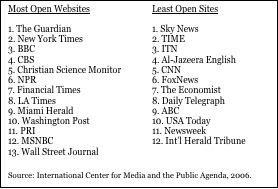
The list of most transparent news organizations contained many of the the most powerful global names in the business, and ones most likely to survive in some form. We can’t demonstrate through this categorization scheme, of course, whether the relationship between openness and longevity is directional. Newspapers with ombuds are typically more transparent than those without, for example, but news sites flush with more cash are the kinds of outfits that can afford ombuds in the first place. It makes sense that solvency would increase openness, as more resources are devoted to personalizing connections with audiences. But transparency and openness draw traffic, too, and plenty of news organizations aren’t paying attention.
Consider GlobalPost, an exciting, yet unopen, online news group scouring stories in dozens of countries. (Disclosure: I’ve contributed commentary to GlobalPost.) Their site’s contact page is a lonely little e-mail form, with no personalized contact information for editors, news desks, management, or anyone else. I’ve tossed unanswered messages into this digital darkness. The site contains no central corrections page, no contact information for correspondents, no guidelines for freelancers, and no free-trial period for their for-pay package.
For more than a year and a half following GlobalPost’s launch, readers wishing to comment on stories had to register, comment, and then often wait hours, sometimes longer, for editors to vet every assertion (commenting has since been made much easier). I highly value the work that GlobalPost is doing, and I’m grateful that they’ve published some of my work, but I have to give them a cold “F” on openness to dialog.
Compare GlobalPost’s contact page to that of Mother Jones or Politico, the latter of which has e-mail routes for everyone but the night cleaners.
We are in the “Listenomics Age,” wrote NPR’s On the Media co-host Bob Garfield in his book The Chaos Scenario. “Its defining characteristic: the herd will be heard. If you do not listen [to audiences], you are a fool because your crowd is your greatest resource.”
It is common in online publishing to hear newsmakers lament how many dragons are lined up against them: devilishly low CPMs, noncommittal advertisers, audiences with attention spans shorter than their eyelashes. But an unimproving online draw also has something to do with shutting audiences out. Online news organizations that don’t publish e-mail contacts of their correspondents and editors, don’t have a clear corrections policy, and insist on creepily vetting every audience comment are partly to blame for any online loneliness they endure.
The vigor of online news organizations will ultimately depend on their ability to erect lasting paywalls, and a bellwether event is coming in 2011 when The New York Times raises one. But the volume of commerce within online paywalls will at least partly depend on an organization’s openness and transparency; paying subscribers demand far more openness and responsiveness than Willy the unique visitor. Additionally, even sites with paywalled news grounds, like The Wall Street Journal and, soon, The Times, will still court casual, non-paying visitors to generate ad revenue on the free portions of their sites, and they’ll need to make these visitors feel in the loop, too.
Regarding whether to give audiences e-mail contacts for reporters and editors, editorial guidelines, and visible corrections, that old axiom of academe still resounds: publish or perish.

Here are the best ways to help news sites survive:
-- Telling the truth, even if doing so could jeopardize your White House press credentials.
-- Referencing the U.S. Constitution in stories relating to the federal govt.
-- Employing honest historical perspective. (What has history shown to be the fate of empires, fiat money systems, heavy-handed central-planning, standing armies versus patriotic militias, and so on.)
-- Being skeptical of the "official line."
-- Not lying for govt. or anyone.
-- Not shilling for pro-govt or govt-connected groups and individuals.
-- Referring to the U.S. military and diplomatic footprint as "empire."
-- Not using scare quotes and popular-yet-disingenuous modifiers (moderate, extreme, liberal, fringe, etc.) to distinguish U.S.-govt entities from their skeptics and adversaries. (Readers are more nuanced than editors may assume.)
-- Citing source outside the beltway, such as Austrian School economists and anti-war advocates, no matter their perceived left-right leanings.
-- Not automatically giving benefit of the doubt to govt officials and their stated intentions.
-- Not referring to the United States of America as a "democracy" (it's a constitutional republic, or at least it was meant to be).
-- Remembering that this country was founded on the principles of individual liberty and fueled by the DIStrust of govt. Let your coverage reflect the true political battle: the individual vs. the state, and not the left v right, etc.
-- Did I mention NOT LYING FOR GOVT OR ANYONE?
#1 Posted by Dan A., CJR on Mon 13 Dec 2010 at 05:06 PM
I'm pretty sure lying for the government is actually crucial to becoming a mainstream news website.
#2 Posted by Avery, CJR on Mon 13 Dec 2010 at 10:54 PM
Justin,
I read with interest your post about the openness of news organizations. We appreciate your analysis, and there is no way to disagree with your assertion that our contact page contains “no personalized contact information.” But, the contact form loads into an email box that generates an auto responder to every inquiry, which includes this language and email address, among some others:
For comments about our stories, to suggest story ideas, or report
breaking global news contact:
editors@globalpost.com
The contact form email box is checked every morning by our communications coordinator, who responds to, or forwards emails to other staffers for a response. We don’t respond to every email, but if a person has an issue, or a question, we make a point to respond directly.
You are right about our comment system, it was cumbersome for some time, but it proved difficult to fix. We moved to using Facebook commenting and now we have a system, which we believe works well and makes it effortless for people to comment and the comments are posted immediately after submission. We also get a lot of feedback on our Facebook fan page, which now has more than 110,000 members.
We love the idea of transparency here at GlobalPost, but I do wish you had spent a little more time on our site in preparation for your article. If you did, you might have noticed our feedback page (linked from the bottom of very page on our site), http://www.globalpost.com/feedback, which contains the email address for our “editors,” which is collected from 6AM until 11PM, 7 days a week, by the news desk editor on duty. That page also includes an email address for inquiries related to our GlobalBloggers, for Jobs, for membership, my name, phone number and email (which is also in the Press Releases section), the name phone number and email for our VP of Sales and our Sales Manager, GlobalPost’s mailing address and our main number. If you had clicked on our Mission section (in the top nav on every page), or the About link (in the footer on every page), you would have found the email address of our President and CEO Phil Balboni at the bottom of a letter from him (the main body copy on the page), and our mailing address, phone and fax on every page.
By way of explanation, not excuse, we don’t display the email addresses of our correspondents because they are all freelancers. As a small organization with limited resources, we thought it was best to funnel inquiries through one desk to keep the flow of communication manageable and also to be aware of any issues a reader may point out in our reporting, so we can respond to it quickly. We do pass emails along to our correspondents and to the editorial team immediately upon receipt of the form.
We are in favor of more ways for our readers to contact us. What we have now is not a perfect system, but it does seem to work, as evidenced by my response to your inquiry today, which came into our editors@globalpost.com email address and was forwarded to me. You’ll find a personal email address added to our contact form before the end of the week.
Best,
Rick Byrne, Vice President
Director of Communications & Marketing
GlobalPost
The Pilot House/Lewis Wharf
Boston, MA 02110
rbyrne@globalpost.com
617-854-3184
#3 Posted by Rick Byrne, CJR on Thu 16 Dec 2010 at 04:06 PM
Thanks, Rick, I'm familiar with your feedback page, but even that section is sparse (it doesn't even contain contact information for CM Sennott, your editor-in-chief).
Also, you declined to address one of GlobalPost's more indefensible omissions: its lack of a corrections page. I really value what GP is doing, and I hope you make it, but your site is lacking some very basic essentials.
#4 Posted by Justin Martin, CJR on Fri 17 Dec 2010 at 05:11 AM
