

As the world knows by now, the photographers Chris Hondros and Tim Hetherington were killed on April 20 in Misurata, Libya. Hetherington was the better known of the two for his documentary, Restrepo. But we have a special feeling for Hondros, whom we got to meet when he took part in a CJR panel discussion. In late 2006, for our forty-fifth anniversary issue, the magazine ran an extended oral history, which later became a book, Reporting Iraq, an oral history of the war by the journalists who covered it. It included photos, and every time we laid our potential choices out we were drawn to Hondros’s work. They had a recognizable humanity and an almost-beautiful light, even when they depicted the worst. One photo we chose was taken moments after a family car had been accidently shot up at a checkpoint. We see a soldier and a blood-covered little girl who had just lost her parents, not an image you can quickly get out of your head. When Judith Matloff interviewed Hondros for our history, we found the backstory of that photo so compelling that we used it to end the book. Here is the result of that interview, Chris Hondros on how he got that picture:
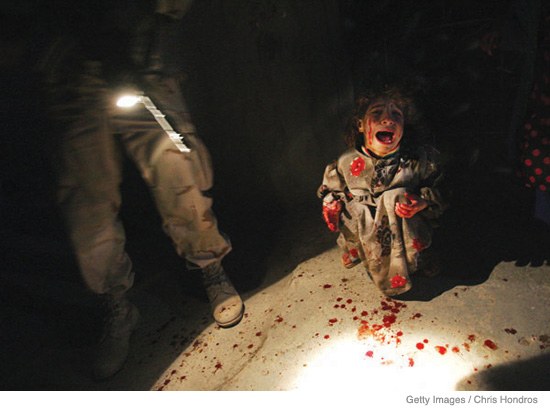
There was a particular incident that happened on January 18, 2005, up in Tal Afar in the north of Iraq. I got out there on Saturday, and they wanted me to go out [on an embed] on this mission they had going out on Sunday. The next day, we went on a routine patrol. I got with one unit that seemed to be pretty good: the Apache company. They were pretty press-friendly, these guys, and we went on a walking patrol in downtown Tal Afar, just in the middle of the afternoon, handing out flyers supporting the upcoming election and all that. And sure enough, in the middle of the afternoon we got into a firefight. They got ambushed a little bit — a few shots were fired, and before they knew it they were surrounded, and they were firing out, they were firing in — dramatic, hourlong gun-battle in downtown Tal Afar. And because none of their guys were injured, and they basically came back, they were all exhilarated, and I had all these dramatic pictures, and they liked them. Then Monday I just hung around the base. The mortar guys, the guys who fire the long-range mortars, they were just firing a few mortars — I took some pictures of that, nothing special.
And then finally on Tuesday, the same guys — the Apache guys who were in the firefight — were going out on a late afternoon patrol. So I said, “All right, I’ll go on that.” But they got delayed. So finally at six we went out, and it was the same kind of thing, a little smaller, like a small group of twenty men or so, patrolling. And it was also dark by this point. So they’re out on the streets, and it’s after the curfew, which is about six o’clock. And as we were patrolling on a darkened boulevard, in the distance, a car, maybe a hundred yards down at least, turned onto the boulevard and started coming toward us. And I already had a bad feeling, you know? Because these are camouflaged [soldiers]; they don’t patrol regularly, and they don’t call much attention to themselves, because if they have lights and sirens and things like that they’d be seen or easily attacked. So here’s a bunch of testy men with guns running around and a car coming towards them, and they don’t let cars come toward them.
I had a feeling the situation was going to end up badly. So I moved over to the side, because I feared at least some warning shots would be fired. The car kept coming. It was dark. Sure enough, somebody fired some warning shots, the car kept coming. And then they fired into the car. And it limped into the intersection, clearly no longer under its own power, just on momentum, and gently came to rest on a curb. I was kind of paralyzed, and then slowly walked to the car and, sure enough, I hear children’s voices inside the car, and I knew it was a family. The doors opened; the back doors opened, and kids just tumble out of the car, one after one after one — six in all. One was shot to the abdomen, though we didn’t realize he was shot at the time, though he was bleeding profusely and as soon as he dropped, there was blood in the street. The soldiers realized it was a civilian car. They ran and grabbed all the kids and ran them to the sidewalk. In the front seat, what ended up being the parents were killed, riddled with bullets, instantly dead. The children in the back were, incredibly enough, okay, except for the one kid who was winged in the abdomen.
I photographed the car coming in, and even the tail end of it getting shot up and it resting on the curb, the children coming out, the soldiers carrying them over to the side, treating them, looking them over, trying to figure out who was shot, who was not. And the father — the mother’s body was collapsed, you could hardly see her, but the father was still sitting up on the seat, riddled with bullets, his skull had almost collapsed because it had been shot so many times.
What happened was — and we found out from the boy who was shot, he ended up being flown to Boston for treatment — they were out visiting with family or something and they knew that their curfew was in the evening, so they were trying to get home. It was a little bit after the curfew, but time is never a precise thing to Iraqis — it’s not like this German, iron-clad, six-o-one curfew. It’s more like, all right, you’re not supposed to be driving around at night. Generally speaking, you could be out on the roads after six o’clock and nothing would happen to you. They were just trying to hustle and get home, and they’re driving along, and all of a sudden they hear shots. They don’t see — it’s dark — they don’t see camouflaged soldiers in the dark in front of them. They just hear shots. Now, when you’re in a car driving around Iraq and you hear shots, your first instinct is to speed up, because either someone’s shooting at you for some reason or somebody’s about to get into a battle nearby. Either way, you don’t want to be around there; you want to get out of there. And then, the headlight range — by the time they actually get into the region of your headlights, forget it, that’s way too close, they’re already engaging you by that point, shooting you up by that point. So that’s why they didn’t stop.
So I photographed this thing, and again [the military] didn’t try to obstruct me or stop me from photographing — and they could have — and it’s kind of remarkable that they didn’t; it’s kind of a human reaction and so on. But they didn’t, and that has happened before: sketchy things have happened on embeds. Almost every soldier in Iraq has been involved in some sort of incident like that or another, I would say. Their attitude about it was grim, but it wasn’t the end of their world. It was, “Well, kind of wished they’d stopped. We fired warning shots. Damn, I don’t know why the hell they didn’t stop. What’re you doing later, you want to play Nintendo? Okay.” Just a day’s work for them. That stuff happens in Iraq a lot. That’s why it’s such a damn mess, because almost everybody’s had something like that happen to them at the hands of U.S. soldiers. They hate them.
But I realize, as much as that happens in Iraq, it almost never gets photographed, and so I did realize I was onto an important set of pictures. I was also technically worried if I had anything at all because it was completely pitch dark, almost to the limits of what can be photographed, and I had the camera set in a way that lets in the maximum amount of light but often blurs photos, so I was worried that it would be a bunch of mush. So I played along with their casual attitude, because I didn’t want them to realize what I suspected: that this would be an important set of pictures that would go out a lot. I wasn’t saying, “What’s your name? What’s his name? What happened here?” I was just trying to photograph, and I was just trying to stay in the background — click-click quietly, didn’t say anything, didn’t offer up any opinion or anything. And then it’s, “We’re going now.” “All right, ready to go?” “Okay.”
They radioed ahead to the base about what had happened, and I met up with the major there on the base, an officer who ran it, and who probably knew a little better than these guys that what had happened out there could get out, that a journalist was along. So he calls me to his office as soon as I get back, and he says, “Pretty unfortunate what happened out there, Chris. We’re going to investigate, see what happened. We’d appreciate it if you held off on sending those photos for a couple of days, because we’re going to investigate, try to see if we can get to the bottom of what happened out there.” I want to get these photos out. Whether we send them on the news wire or not, that can be negotiated, but I need to get these back to New York before something happens. I mean, they have the capability to jam all communications from base, including my personal sat phone, but they don’t want me to send these photos out. Their base, one hundred percent their property, they’re the Army, they have no reason whatsoever not to confiscate my sat phone or jam communications to prevent me from sending the pictures. So I said, “Well, I have to talk to my boss, but yeah, I think we want to work with you there, Major. So I think we can probably do something like that, let me check but I think we’ll be okay.” And then I stepped out of the major’s office, ran back to my trailer, and flipped open my sat phone, got all the pictures and looked at them, and whoa, I couldn’t believe how much information was there. The pictures did come out. And I said, “Okay, send, send! Tone them up, tone them up, quickly, quickly, send, send, send!”
And I put on the captions: “Don’t send these out until you hear from me, until you hear from my boss” — Pancho Bernasconi is my boss. So I sent twenty pictures, and I got my Thuraya phone. I talked to Bernasconi and I said you better talk to this guy about what to do, and he said, “I’ll talk to him.” So I walked back over to the major’s office, but the major had gone to bed. And then there was a captain who I’d also talked to earlier, still up, and I said, “I have my boss on the phone, can you guys talk about . . .” and the captain, young sport, he said, “Yeah, okay, sure.” So they talked, and I heard them talking, and I heard his side. He said, “Well, we’d like to hold onto these photos. We’re asking you not to send them out for a few days so we can investigate . . . Uh-huh, uh-huh, uh-huh. Yeah, well, we wanted a little bit of time for us to get the investigation, uh-huh.” And I think what my boss was saying was, “Well, we’re a wire service, by the time we put them on our wire — but they won’t actually be in papers till a day or two, [or] maybe not — people use them or not, it just depends.” I heard that back and forth, and the captain said, “All right, well, I think we’ve come to an agreement” or something, and gave the phone back to me. So I went to bed.
Six a.m. next morning — [makes knocking sounds] — “The major wants to see you right away!” Oh boy, here we go. The major’s up bright and early. The major had already received an e-mail from Baghdad, the army office in Baghdad, because the photos were distributed right away by my office and immediately went out all over the world right away. Meanwhile, Baghdad Central Command had not been informed. If there’s something controversial, they’re supposed to report that to Baghdad and say, “Hey, by the way, there’s going to be some bad press coming out of here because we had a friendly-fire incident.” Then the Baghdad press office is always able to kind of prepare for it. They had no warning whatsoever. They just looked on the Web sites in the morning and they see these series of horrible pictures of U.S. soldiers shooting up an Iraqi family.
So the major comes up to me. “What happened, Chris? I thought we had an agreement. I thought you said you were going to hold onto those photos.” I said, “Well, major, I came back and you were in bed. I talked to the captain.” And the captain was right there and [the major] said, “What! Captain? Did he come back here last night?” and [the captain] said, “Well, yes, sir, but I talked to his boss and he . . .” and [the major] said, “Chris, excuse me for a second.” And the poor captain’s watching his career evaporate. The captain was saying, “Well, I thought — my impression was that the boss in New York said they were going to hold them.”
And you know, it was a confusing thing.
The Editors are the staffers of the Columbia Journalism Review.