Sign up for the daily CJR newsletter.
It seemed too strange to be true—and, in the end, it was. A story posted to The Huffington Post yesterday announced rather shocking news: “Scalia on Brown v. Board of Education: I Would Have Dissented.” On the site’s homepage–where the story spent much of the day–the headline was even more provocative:
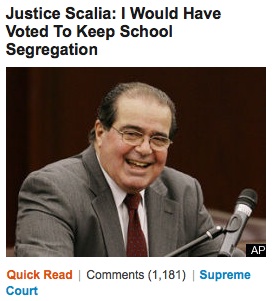
The story, it turns out, was aggregated from Taegan Goddard’s Political Wire—which was aggregated, in turn, from a piece posted to Arizona’s East Valley Tribune newspaper Web site Monday evening. The dispatch in question, provided by the Capitol News Service, detailed the appearance made by Scalia and fellow Supreme Court justice Stephen Breyer in Tucson on Monday, at a talk (subject: “Principles of Constitutional and Statutory Interpretation”) sponsored by the University of Arizona’s law school.
Per the story:
Using his “originalist” philosophy, Scalia said he likely would have dissented from the historic 1954 Brown v. Board of Education decision that declared school segregation illegal and struck down the system of “separate but equal” public schools. He said that decision, which overturned earlier precedent, was designed to provide an approach the majority liked better.
“I will stipulate that it will,” Scalia said. But he said that doesn’t make it right. “Kings can do some stuff, some good stuff, that a democratic society could never do,” he continued.
“Hitler developed a wonderful automobile,” Scalia said. “What does that prove?”
But, hmm. Constitutional originalism is one thing; using that approach to defend, even theoretically, the myriad injustices of ‘separate but equal’ is quite another. And even in a media landscape populated by Balloon Boys and Real-Life Pirates and Porcine Viruses and Sarah Palin…some things are still, yes, simply too bizarre to be true. And ‘Sitting Supreme Court Justice Offhandedly Advocating Segregation’ is, indeed, one of those things.
What Scalia actually said–albeit in a roundabout way–was that “I would’ve been with” “Justice Harlan” in a text-based interpretation of the equal protection clause. That would be John Marshall Harlan, who dissented in the case not of Brown, but of…Plessy v. Ferguson.
Yes. The Tribune story, essentially and unfortunately—by way of whitewashing the subtler point Scalia was making about the tense relationship between an originalist approach to the Constitution (which requires the deciphering, the Justice noted, of what such “generalized provisions” as equal protection meant at the time of the Constitution’s writing) and a so-called “evolutionary” approach—confused two landmark Court cases: Brown, whose decision is the subject today of near universal acclaim…and Plessy, that of segregational infamy, whose decision is—and properly so—the subject today of near universal disgust. Of course Scalia would dissent from Plessy. One assumes that all the current Justices, regardless of their particular jurisprudencial proclivities, would do the same.
Which means, then: nothing to see here, folks. Scalia was not, in fact, advocating segregation yesterday. No incendiary affronts to common decency were afoot. (Unless, that is, one counts sloppy reporting.)
What’s notable about the Scalia narrative, though, is not merely the egregiousness of the words put in the mouth of the Justice. More interesting is the context in which the error grew—and the manner in which the erroneous story went viral. The story was picked up not only by the HuffPo and Political Wire, but also by TPM and New York magazine and the law blog Balkinization. It went from zero to zeitgeist in less than a day.
While that is unsurprising, it is also…worrisome. The Tribune story, after all, was riddled with red flags on the accuracy front. Not only was there the bizarre and inflammatory nature of Scalia’s supposed comment itself; there was also the choppy and occasionally verging-on-incoherent wording of the report—suggestive, in general, of some kind of context lost. But as the erroneous story made its way from Tucson to the explosive ether of the World Wide Web, those paving its path either missed those flags, or actively ignored them. As Salon’s Alex Koppleman notes:
Everyone gets a story wrong sometimes, there’s no avoiding that. But in this instance, the bloggers who picked up the article could and should have avoided the situation. Scalia was never directly quoted saying something like, “I think Brown v. Board of Education was wrongly decided. The article, or at least this part of it, relied on paraphrasing. On a big story like this one, the lack of a direct quote demands, even more than usual, some stringent fact-checking. Before posting, it’s just good practice to look for a primary source — video, audio or a transcript from the event — not to mention to check against Scalia’s previous statements and even call the court for comment. It may mean you have to wait a few minutes, even a few hours, before posting what others already have, but it’s better to be right than to be fast.
That’s true. And yet it’s also true, as Yale law professor and prolific blogger Jack Balkin—the person who actually realized that the Brown v. Board of Education reference was, indeed, a misquote—points out, that the blogs that linked the Scalia story were “relying on the fact that this was supposed to have been a fact-checked story by a reputable mainstream news organization.” They made a fair assumption that the information they were repeating for their readers was accurate. Though Balkin from the outset had (and expressed) doubts about the accuracy of the Brown quote in his post of the story–“Justice Scalia has always associated himself with Justice Harlan’s colorblindness language in Plessy,” he told me in an e-mail, explaining his initial skepticism about the quote—in this case, he writes, “the original duty was that of the mainstream media organization that published the piece in the first place.”
But that duty, I’d add, applies not merely to the original reporting of a story—getting it right—but also to the correction of reporting that turns out to be erroneous: getting it right for the long term. Accuracy—and, therefore, trust—are not mere matters of checking one’s facts before one posts a piece. Precision must be an ongoing process—and media outlets, be they staffed by one person or 100, must own up to their mistakes in an obvious, record-correcting, and generally transparent way. “Everyone gets a story wrong sometimes, there’s no avoiding that.” The test—and the trust—is in how outlets behave in the aftermath of error.
In the Scalia story—though one hesitates to revisit the tired old case of Bloggers v. MSM, which was decided (if, perhaps, by a split court) long ago—it’s striking, the disconnect between the correction strategies of the bloggers and of their MSM counterpart. When Balkin confirmed, through watching the video footage of the Scalia talk, that the Justice had indeed been misrepresented, he added the following lines to the top of his post:
UPDATE:
As I suspected, Justice Scalia did not say he would have dissented in Brown v. Board of Education in 1954. The newspaper account is incorrect and took his remarks out of context. The author of the article, Howard Fischer of Capitol Media Services, owes Justice Scalia an apology.
And I apologize for quoting this incorrect article in my original post.
The HuffPo provided a similar update at the top of its report: “CORRECTION: An item posted here — reporting that Supreme Court Justice Antonin Scalia said that if he were on the court in 1954, he would have dissented in the landmark Brown vs. Board of Education decision that ended school segregation based on race — was incorrect.” The HuffPo piece has helpfully maintained the text of “our original, incorrect report”; at the same time, in tacit recognition of the fact that many of its readers are more accurately ‘headline skimmers,’ it has changed its headline to reflect the error of the original post: “Scalia Misquoted on Brown v. Board of Education (CORRECTED).”
Meanwhile…the newspaper—the originator of the flawed reporting, and the only member, in this crowd, of that increasingly nebulous group known as the MSM—initially simply scrubbed the offending passage from its Scalia story, without a note of explanation. Then, late in the day yesterday, it replaced the initial story with a new one. “Capitol Media Services sent an updated and corrected version of the story, which we have posted,” East Valley Tribune editor Chris Coppola told me in an e-mail yesterday evening. “It also notes the correction.”
The story now begins with an editor’s note referencing the initial ‘Scalia would dissent from Brown’ claim: “This is an updated version of a story that was originally posted Oct. 26. It removes an incorrect reference to Brown v. Board of Education in the initial version.” But the only records of the story’s original claims, on the story’s page on the Tribune sites, are phantom references to them in the article’s comments section. If one wanted to find the original claims…one would have to go to the HuffPo piece.
All of which has, to step back from Scalia for a moment, a full-circle quality to it: the bloggers exhibiting responsibility to their audience, the students becoming the masters, the circle of life, etc. In the teeming world of the Web—one defined not merely by seemingly endless variety on the part of news outlets, but also by, consequently, seemingly endless choice on the part of news consumers—one of the rarest and therefore most valuable commodities is trust.
That tenuous good—a function of authority, accuracy, and audience attention—is a limited resource largely because one of its key components—attention—is itself finite. Each audience member has only a limited amount of attention he or she can give to news stories. And that limited resource, in turn, leads to a tension between plenty—the variety and redundancy of news outlets available to audiences—and scarcity. With the end result being, among other things, that no longer is reader loyalty something that can be safely assumed, in the old ‘well, where else are they going to go for their news?’ model. In our world of media plenty, no longer is the cultivation of trust one component of the journalistic equation; it is a key component. It is, in many ways, the component: If people doubt the accuracy of the journalism you produce—or, worse, if they don’t pay attention to it in the first place—then what, really, is the point?
For bloggers, whose journalism evolved with the Web, the visceral instinct toward trust—the implicit recognition of its primacy—is coded, so to speak, into their journalistic DNA. Mainstream outlets, on the other hand—outlets which, up to now, have been able to take their readership largely for granted—don’t generally share that instinct. They’ve always been interested in cultivating trust, of course—trust builds audiences, which builds both revenue and journalistic impact—but their relationship with trust has been more detached. They’ve generally understood trust as something to be ‘earned’…but not as something that is implicitly, and existentially, necessary. While they’ve had to work to maintain reader trust…they haven’t had to work too hard at it. Because, again: where else are the readers going to go?
That disparate attitude toward trust is something we see play out often—and certainly in the case of the Scalia story, in which the bloggers went out of their way to correct the record, flagrantly and loudly, while the mainstream outlet did so more quietly. HuffPo readers, if they look at the outlet’s Scalia piece, come away with a much fuller picture—of the broader Scalia story, its movement through a kind of group-moderated fact-checking process—than the Tribune readers do.
Though the preferred stereotype of the blogosphere, as portrayed by external viewers, is of a kind of ethical Wild West in which there are few rules and even fewer outlets interested in following them (“freewheeling” is one of the kinder descriptors)…their reaction to the Scalia story is only the latest bit of evidence of blogs’ development of mechanisms by which to cultivate trust. These mechanisms have been organic, to be sure—they’ve sprung up individually, rather than by professional fiat, and they have often been the results of coevolution. But they have quickly taken on a universality suggestive of external mandate. They’ve taken on, in other words, the guise of professionalization—even as they’ve been defined precisely by their lack thereof.
Indeed, in the same way that professionalization—and codes of ethics along with it—was an evolutionary adaptation that helped newspapers to thrive in the media environment of the early twentieth century… today, in the blogosphere, shared norms of behavior—voluntary adopted, as before—are helping online outlets to thrive. The Scalia story is yet another piece of evidence that the “freewheeling” blogosphere is, in its own way, professionalizing: it’s developing shared standards that are aimed, as similar standards were for the MSM, at cultivating trust. “CORRECTION:”—updating stories in real time, in a can’t-miss-it manner—is one of those standards. Mistakes, particularly as the speed of our news cycle shifts into ‘warp,’ will happen. The distinction—and the trust—comes in how outlets choose to fix them.
Has America ever needed a media defender more than now? Help us by joining CJR today.