Sign up for the daily CJR newsletter.
Here’s what some working editorial cartoonists (and other illustration insiders) think about the brouhaha over this week’s New Yorker cover.
Mike Luckovich
editorial cartoonist at the Atlanta Journal-Constitution since 1989
“I’m an editorial cartoonist and I’m used to edgy, hard-hitting cartoons, and it made me cringe. And for a while I didn’t understand why I cringed.
“I think the illustration misfired. The way it turned out it looked like [the cartoonist] was poking fun at the Obamas, and I don’t think that was the artist’s intention: I think he was trying to poke fun at the outrageous lies about the Obamas.
“I love [Barry Blitt’s] style. He has a beautiful style and a very unique of caricaturing people in a cartoony, intelligent way, but he’s still able to capture their likeness. I think, aesthetically, it’s a beautiful cover. I just think it doesn’t work.
“This is a fairly common thing with editorial cartoons: your symbolism overwhelms the satire, and that is when people react the strongest. As cartoonists, we have to be careful that we’re saying the correct thing. It’s like Dick Cheney shooting his buddy in the face: when the gun goes in the wrong direction, it can really cause some pain.”
culture editor of Jyllands-Posten, the Danish newspaper that, in 2005, published a series of cartoons depicting the prophet Mohammed, leading to riots and outcry across the Muslim world
“I would say to David Remnick that I can feel his pain. I read a comment by him that he’s kind of surprised and shocked by this reaction. I’ve been thinking a lot about people’s reactions to cartoons for a few years. Part of the power of images is that they are open to different kind of interpretations—even if you share the same values and operate in the same cultural context. That is something that is an inherent quality of an image. It is never one-dimensional. People will always read it in different ways. That’s what art is about.
“I find funny the reaction by the Obama people that they’re offended by someone who is making fun of those who offend them. There’s a big irony in that.
“Satirical cartoons are usually offensive if they’re good cartoons. In Danish, we have a saying, ‘You laugh at humor and you smile at irony, but there’s nothing to smile about with satire.’
“There’s a very big difference between these cartoons and with the cartoons I published. It has a lot to do with culture differences, but they do not add up to what happened during the cartoon crisis, where you had very different readings of the cartoons. “
Ruben Bolling
author/illustrator of the weekly comic strip “Tom the Dancing Bug”
“I didn’t like when I saw it. I thought it was failed satire, just because he was unable to—in the space that he had, in the wordless panel—to communicate the satire. He just presented the right-wing nightmare, without twisting or exaggerating the premise in any way.
“Good satire has got to take the premise further comedically, and it has to make clear what the target of the satire is. The target of the satire is not how radical Obama is, but, rather, how ridiculous the right wing apprehensions are. Because that was unclear, the satire didn’t work.
“It’s often hard to guess what kinds of misinterpretations people will have on our work. And there’s an element of willful misinterpretation that’s going on here. It’s part of the problem: people are deliberately misinterpreting it because they want to get riled up. It’s something that all editorial cartoons go through.”
Derf
creator of the weekly comic strip “The City”
“I thought it was hilarious. I’ve been working on stuff similar to that, so I’m pissed off that, with one cover, they’ve cornered the market. Now every time you comment on [the issue], it’s going to get related to The New Yorker.
“So many people are misinformed, and you can’t draw to the morons of America. If you don’t know that Obama isn’t a Muslim, we can’t help you.
“I don’t think we have to be clear. It’s not up to us to hold people’s hands. There’s a tendency in political cartooning to really hammer down on people’s heads. I want people to be confused and pissed off.
“At the same time, would it be as successful without the New Yorker logo across the top?”
Jim Morin
editorial cartoonist at the Miami Herald for thirty years
“If you have people who don’t know what the reality is, then it’s very difficult to have them understand satire. You have to be aware of what the facts are. If you’re unaware of the fact that Obama has had these accusations made against him that are untrue, then you’re not going to get it.
“It offended some people because it might inspire some to confuse what is real with what is not. They’re going to think it’s a real portrayal of what Obama and his wife are about, as opposed to being a gross exaggeration.
“It could have been a painting on a canvas on an easel, and it could have a donkey painting it, because this is how Republicans are trying to get people to see Obama.”
Matt Bors
creator of the nationally syndicated comic strip“Idiot Box”
“The outrage is out of proportion. I didn’t find it particularly clever or funny, or clumsy; it was just a typical New Yorker cover that elicited a little smirk.
“Obama is a smart guy: he got the cover. He could’ve made a joke, but instead he decided to go after a magazine that’s publishing long stories about him and his wife.
“It makes it seem that this kind of commentary is off limits, that satirizing the right wing view is offensive.
“Everyone is saying that it lacked context, that there should’ve been a caption or text, but I think the point came across pretty clear. What level would you have to take it to, to make it clear that it was satire?
“It seems that more people are worrying about people not getting it, than people actually not getting it.”
Josh Fruhlinger
editor of The Comics Curmudgeon and cartoon columnist at Wonkette
“I think it’s a funny cover, but unfortunately, because of the insanity that is modern political discourse, I heard about the controversy before I saw the cover.
“I think it’s a truism in comedy that if you have to keep explaining the joke, then the joke hasn’t worked. The cover assumes a set of shared assumptions, and if you don’t share those assumptions, you might react different.
“I always bitch about those cartoons where every single item has a label on it—’oh, this horse represents the Fed’—but I look at several dozen political cartoons a week. If you’re someone who doesn’t do that, it might be hard to find your bearings on that.
“It makes me sad, because all controversy just makes everything blander.
“From a technical standpoint, I think it’s very clever. It’s not just talking about a specific thing, it’s extending already ridiculous interpretations of other people’s view points.
“In the current time, you have to realize, when you create an image, that it will be seen out of context. It works in the set of expectations that people bring to what’s on the cover of The New Yorker.
“I’m very against making things dumb or bland, but if you’re only assuming that everyone who reads this is exactly like me, then there’s the problem of everything becoming an in-joke.”
Keith Knight
author/illustrator of The K Chronicles
“There was a time that i didn’t know what The New Yorker was, and if i had looked at the cover and didn’t know what The New Yorker was, i could see how it could be construed differently. The satire isn’t obvious. It’s really subtle.
“As a good cartoonist you want to be good, funny, make a point, be sharp. And most of the time, you’re more of one, and less of the other. This is a case of that; the point isn’t as sharp as it needs to be.
“Personally, I’m not into being totally outrageous just to be outrageous, but it would be really great to make a point and be funny and be outrageous.
“I didn’t even get a chance to see it without it being couched in ‘shocking revelations and controversy.'”
Bill Bramhall
editorial cartoonist, New York Daily News
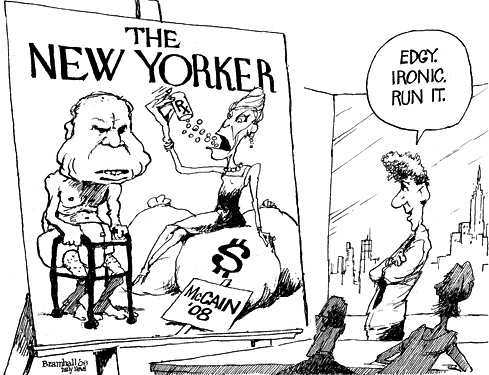
“My response is my cartoon in today’s paper.”
Has America ever needed a media defender more than now? Help us by joining CJR today.