

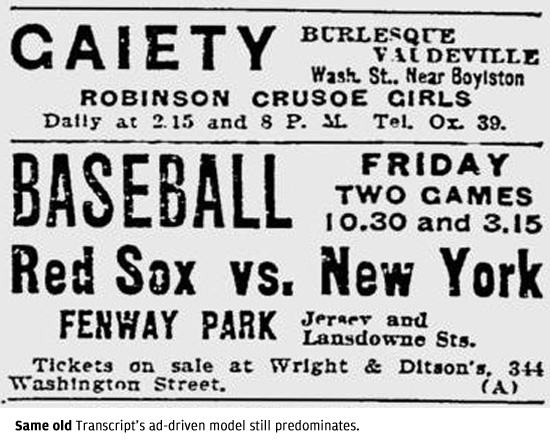
In 1830, a publisher named Lynde Walter launched a Boston paper called The Boston Evening Transcript. Transcript’s most important feature wasn’t its content or format, but its business model. A subscription cost only $4 a year, barely more than a penny a day. Walter could sell so cheaply because industrial production and middle-class consumption created a newly robust advertising market; slashing the price of the paper let him increase his audience so dramatically, he could more than recoup in ad revenue what he gave up in subscription fees.
Imagine giving Walter a tour of The Boston Globe today. He would not recognize the computers on reporters’ desks, or their phones. He would not recognize cameras, or delivery trucks, or even light bulbs. He would, however, recognize his business model, still at work. Transcript helped usher in modern news economics: The publisher gives the audience access to the news. The audience gives the publisher access to the advertisers. The advertisers pay the publisher for access to the audience. The publisher gets to keep providing the news.
The magazines and newspapers built mainly on advertising subsidy instead of reader support became collectively known as the penny press. The broadcasting industries of the 20th century—radio and then TV—followed this logic as well, with ad revenues providing virtually all the income. Though parts the news ecosystem don’t use this model—NPR, Voice of America, Ms. magazine—the subsidy of news via the triangle trade between publishers, audiences, and advertisers has been at the center of the American news industry for most of the last two centuries.
Every formerly stable leg of that triangle is buckling.
The problem for American journalism isn’t just that revenues are collapsing; the entire context in which traditional institutions operated is being altered. This leaves three options for American newspapers today (and for magazines and broadcast news in the near future): They can try to preserve their existing structure while shrinking their operations; they can restructure, changing not just size but organizational pattern; or they can collapse, simply extracting the revenues they can get before they vanish.
The most talked-about change in the old triangle is the relationship between newspapers and their audiences. The proliferation of the Web means that every publicly available source is now available to every member of the public. Even if digital distribution changed nothing else, that thousand-fold increase in competition would forever alter the news ecosystem.
Digital media also erodes audience habits. Publishers and salespeople often sold advertisers on the loyalty of their readers, but we readers have never actually been loyal. We’re just lazy. Prior to the Web, when options were scarcer, lazy meant continuity: We got the same paper we got yesterday; we read another article in that paper rather than searching out alternatives. Today, lazy means serendipity. We read what our friends send us, from wherever they got it. (Their friends, probably.)
We don’t select publications anymore, we select links. Even as the Web grew, publishers assured one another that the need for a trusted news source would preserve newspapers’ relevance, but it turned out that the trust we have in our friends is, for most of us, an adequate substitute for deciding what to read, watch, or listen to.
The relationship between advertisers and customers has also exploded. Some of this has been driven by new publishers—Gawker and HuffPo, Talking Points and BoingBoing—but far more radical is the rise of advertising as a stand-alone service, no editorial trappings anywhere in sight: Amazon, Google, Craigslist, Monster, Match, Backpages, Groupon, Freecycle, and on and on.
The last leg of the triangle, between advertisers and news outlets, hasn’t changed in any fundamental way, but it has changed enormously in practical ones. News organizations used to be able to overcharge and under-deliver in their deals with advertisers; the pizza place and the car dealership had nowhere else to go, and no one knew how many people saw, or acted on, a given ad anyway.
We now know exactly how valuable any given ad is, and the answer turns out to be: not much. Web ads provide almost perfect measurability for advertisers—someone did or did not click on your ad, then did or did not buy your product. As a result, the old saw about advertisers knowing that half their advertising dollars were wasted, but not which half, no longer holds true. An efficient ad business is a less profitable one for traditional media outlets.
The threat to ad-subsidized news was hidden in part by the fact that print revenues rose through 2005, even as the Web was spreading like an oil slick. After 15 years of trying to adapt to the commercial Web, no one has figured out a way to replace print revenue with digital. This makes significant reduction in cost a forced move for every traditional news outlet, leaving only three broad options over the next few years: shrinking, restructuring, or collapse.
We’re already in the shrinking phase, where organizations conserve their structure while dramatically reducing headcount. As has been pointed out by everybody who thinks about this strategy for five minutes, holding prices constant while reducing quality has never been much of a dangle. (Similar logic will probably hold true as TV ad revenues continue to fall in the next few years.)
The open question for shrinking is simple: Is there a smaller newsroom that can still create a worthwhile product? Can a 300-person newsroom shrink enough to operate on lower revenues, while still earning ad revenue that supports that smaller staff? Can they do it with 200 people? 150? Newsrooms have fired, on average, something like a third of their newsroom staff since the highwater mark of newsroom employment, and it has not yet been enough.
The best that can be said about shrinking to some small but stable state is that it beats going out of business. There’s another possibility, though, and that’s restructuring, which is shrinking plus dramatic organizational change. “Doing more with less” is the mantra of every publisher who’s just sacked a dozen reporters, because the “with less” part is a forced move. The “doing more” part, though, requires reinvention of method, not just reduction of employees.
News startups large and small—MAPLight, Smoking Gun, Homicide Watch, ProPublica—are all experimenting with new sources of informational value—amateurs, crowds, databases—and with new possibilities for producing news in partnerships and consortia. These organizations all punch above their weight, given their staff costs. In the same way the Industrial Revolution made an hour of a weaver’s time far more valuable, by increasing the cloth he could produce, an hour of a journalist’s time can similarly become more valuable, provided that journalist knows how to work with their readers, or to explore newly available data, and provided her institution supports that kind of work.
Working the way MAPlight or Smoking Gun do would seem to be options available to any journalistic outfit that is interested, but in practice, few large media organizations are yet willing to substantially transform the way their employees do their jobs. This isn’t just about individual job descriptions, but about rethinking the layers of accountability and control that characterize all large organizations. One advantage Talking Points Memo has over its larger competitors is that there are simply not enough employees to have a complex management structure, enabling tpm to try new things and stop doing old things at a faster rate. Presence of process turns out to be a bigger obstacle to change than lack of resources.
Then there’s collapse, the fate of the Rocky Mountain News, The Albuquerque Tribune, The Cincinnati Post, inter alia, requiescat in pace. Collapse is what happens when an organization can’t shrink or restructure to stability, or when it decides to extract the cash it can as it vanishes. Not much needs to be said about collapse except that more is coming.
Steve Coll once suggested that newspapers, heading into a world where their profits were going away anyway, might look at reconstituting themselves as nonprofits. The most common reaction to this proposal was that newspapers couldn’t possibly live on subsidy, for God’s sake. But of course they can, because they have done for the better part of two centuries.
What used to subsidize the news was the local merchant, handing over money to the publisher of the Transcript or the Globe, who then gave a bit of it to the Nosy Parkers on the City Desk. This didn’t look like subsidy to the outside world—the profitable advertising circular and the subsidized spying operation were housed in the same building—but it was one, nevertheless. We the public have never paid full freight for the newsgathering done in our name—not since the 1830s, anyway.
The enormity of the change in the relationship of publisher, reader, and advertiser means that we’d better pray for—and work for—the restructuring of journalism’s existing institutions. We should take advantage of new models of news production, not because it’s some kind of ideal, but because the two other options—doing less with less in the case of shrinking, and doing nothing with nothing in the case of collapse—are worse.
Clay Shirky has a joint appointment at New York University, as a Distinguished Writer in Residence at the Arthur L. Carter Journalism Institute and as an assistant arts professor in the Interactive Telecommunications Program. He blogs at shirky.com/weblog.