Sign up for the daily CJR newsletter.
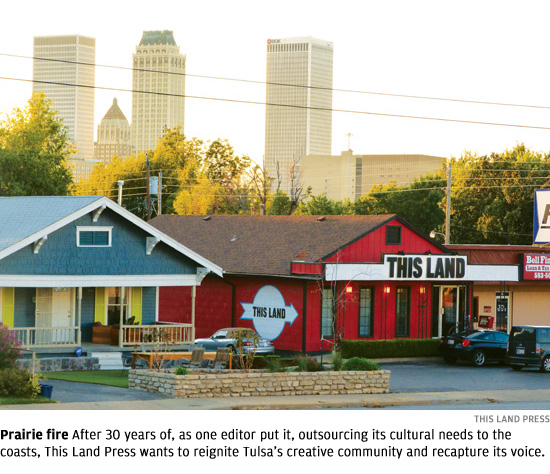
Across the street from a Fastenal hardware store in the shadow of Tulsa’s aging art-deco skyline, the staff of what is perhaps the best for-profit local journalism startup in the country has yet to reinvent the craft. Eleven full-time editorial employees sit at desks scattered across the rooms of a bright red house with Astroturf carpeting, telling stories about their community. As This Land Press founder and editor Michael Mason would argue, if this sounds unremarkable, it’s because journalism’s vision of its own future has become overly complicated.
In its short existence—one year as a passion project and another 18 months as a venture-capital-backed multimedia company—This Land has consistently produced the kinds of in-depth features and investigations that much of the industry is looking to nonprofit models to sustain. While still in its pre-investment days, it published a groundbreaking, internationally cited profile of Oklahoma native Bradley Manning, the army private accused of funneling thousands of pages of classified documents to WikiLeaks. Last September, it took an historical approach to investigative journalism, revealing that a founding father of Tulsa was a member of the Ku Klux Klan and an architect of the city’s notorious race riot in 1921. More recently, it published an investigation into sexual abuse of students at a school run by a local megachurch.
This Land is on pace to become cash-flow-positive next spring—which means that, in two years as a fully functioning business, it will have found a way to earn more money than it spends. If it stays on track thereafter, it will continue to expand its newsroom while earning a profit for its owners. It’s far too early to tell whether that will happen, but the trajectory is promising. No equivalent organization (and, granted, there aren’t many) has come so close to financial self-sufficiency so quickly. Most noteworthy is the fact that if This Land becomes profitable, it will have done so not in spite of its investment in locally focused, literary journalism, but because of it. Rather than hoping that the market might one day find a way to support great journalism—as the current discussion about the future of news suggests—This Land is betting that it can do so now.
To an outsider, Tulsa’s media market does not seem in desperate need of renewal. In terms of maintaining their numbers, at least, the city’s journalists have fared better than many of their counterparts in other cities. The afternoon Tulsa Tribune went out of business right on schedule in 1992, but the morning paper, the Tulsa World, remains relatively stable and family-owned. There’s an alt-weekly, Urban Tulsa, also independently owned, that may be unique among alt-weeklies as a conservative counterpoint to a conservative daily. Tulsa can also claim TV stations, radio news, a business journal, a glossy lifestyle magazine, and all the rest. In other words, the media scene is exactly what any reader who finds himself in a red state oil town of one million people might expect: It’s perfectly adequate. It just wasn’t good enough for Michael Mason.
In spring 2010, Mason was 38 and working as a brain-injury case manager at Tulsa’s Brookhaven Hospital. An odd mix of media insider and outsider, he had spent decades agonizing over the lack of opportunities for writers in his hometown, even as he slowly managed to work his way into some of the most elite corners of the profession—without ever leaving Tulsa. After spending his twenties as an advertising copywriter and aspiring novelist, he decided that a writer needed a career worth writing about, took the case-manager job, and eventually published a well-reviewed nonfiction book about traumatic brain injury called Head Cases (Farrar, Straus and Giroux, 2008). This launched his career as a science writer and earned him another book deal, but while the prospects for his own writing had brightened, the local media that so frustrated him hadn’t changed at all.
So Mason secured a $5,000 contribution from a local businessman and set about producing the kind of paper he felt Tulsa should have. He foreshadowed the inaugural issue by writing a manifesto for This Land’s still-idle website. The piece called for local writers across the country to rise up against inept local newspapers and reclaim the stories of their communities. Of the Tulsa World in particular, Mason wrote:
At several points the in the last decade, you could see the World completely losing its grip on the story of our community. Most of the so-called stories that appear in the “Most Popular” section of its website are thin, encyclopedia-like recountings of the most banal sort: “School Board Proposal May Pass, “ “Crowd’s Behavior Denounced,” and “35 Officers Back on the Job.” Few articles breach the thousand-word mark, and rare among those are the ones that extend over various issues. Other than a standard design, nothing connects the content from last month’s stories to this month’s. Continuity—a fundamental element of narrative—no longer exists. Under the stewardship of the World, the story of Tulsa’s community reads like a book in which one chapter has virtually no relation to the next.
In other words, Mason didn’t so much have a vision for a newspaper as he had a sense of what was missing from newspapers: long-form, contextual writing; a highly refined product designed to provide insight into a community rather than merely deliver a daily supply of information—a job the Internet was already ably doing, anyway.
The first issue arrived in May 2010, followed five months later by a second issue, which included the Bradley Manning piece that This Land’s website would send around the globe. By October, Mason had built up enough momentum to publish on a monthly basis. He tried some smart business maneuvers as well, including auctioning off online advertising slots, but nothing that could create the kind of revenue that would allow a married father of three to devote himself to the experiment full-time. It might have ended there—a fondly regarded anomaly destined to collapse once Mason’s friends grew tired of being asked for contributions—were it not for a Tulsa venture capitalist named Vincent LoVoi.
I first interviewed Mason in March 2011, and at the time I thought of him as an intriguing media theorist and proven editor who was certainly worthy of financial backing, but I had no idea how he might turn what he called “Oklahoma’s first new-media company” into a profitable enterprise. I assumed his plan was to produce great content across multiple platforms and then try like hell to convince local businesses to advertise. On the surface, I wasn’t that far off. It’s just that, like the rest of the industry, I failed to understand the extent to which that decaying old model could be reimagined.
Mason, a genial Midwesterner who has the air of someone constantly mediating between a deep inner monologue and the demands of the outside world, likes to joke that This Land was “born of frustration.” A more accurate description of its genesis involves a meeting of two minds—one editorial, one financial, and both afflicted with a complicated love for their hometown.
LoVoi, who is 55, with a close-cropped gray beard and a politician’s gift for conveying profound interest in anyone he meets, grew up in Tulsa but left at the beginning of his professional life to become a congressional staffer and later managing partner for the Brussels practice of the law firm Akin Gump. While still in Brussels, he partnered with a childhood friend and Tulsa investment adviser named Joel Kantor to buy two failing aerospace companies. They bundled them together, turned them around, and eventually sold them. In 2004, while still working on the aerospace project, LoVoi moved back to Tulsa to raise his four kids and continue his venture-capital efforts in the US and Europe.
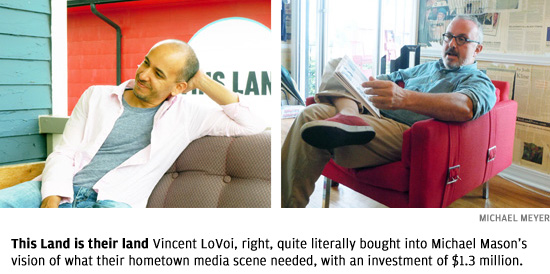

In 2007, LoVoi was diagnosed with an aggressive prostate cancer, for which he would undergo surgery at New York’s Memorial Sloan Kettering in 2008. While balancing his recovery with parenting duties, he and his business partner decided to focus their venture-capital business on the Tulsa community. Instead of investing in biomedical firms and aerospace companies, they began putting their money and expertise into Tulsa-based tech companies, restaurant groups, and other projects that had received little attention in a local economy built on oil and natural gas. Their company, Mimosa Tree Capital Partners, mentions “social good” in its mission statement, but LoVoi very much counts himself a capitalist. “We’re not donors,” he told me. “We’re investors.”
In the months leading up to LoVoi’s decision to invest in This Land and become its publisher, he and Mason held a series of meetings during which they would eat pork belly at a local Japanese restaurant and talk about media. LoVoi encouraged Mason to draw up three different plans to develop This Land into a profitable business, one small, one medium, and one large. They ultimately decided to go large, which meant simultaneously launching and staffing a biweekly broadsheet, hiring a videography crew, redesigning and staffing a website, hiring a sales and support staff, hiring an audio producer, and, in three years’ time, distributing in the Oklahoma City market. “We made the judgment that Michael’s vision had the greatest potential when you had the greatest number of synergies,” LoVoi told me. “It just made sense to do it all at once. You could not do it incrementally. It didn’t work.”
They estimated that it might take up to $2 million to launch This Land and give it enough of a runway to build revenue streams. As of July, the investment was $1.3 million, a number that does not include a pending purchase of real estate. LoVoi says that there is room for further investment if necessary. The original plan, which This Land is currently on pace to fulfill, allowed for two years to attain a positive cash flow, and a full return on the initial investment within four years.
In order to achieve this growth, they developed a highly fluid business model, with varying goals and timelines for monetizing content based on the relative maturity of the market for each platform. They assumed the majority of their revenue would come from print advertising, a market that was still relatively stable in Tulsa. Their revenue estimates for other mediums—Web, video, and audio—were far more conservative. A key part of the large plan, however, was to fully commit to each medium even without a clear vision for exactly how it would eventually contribute to the bottom line. Making each platform profitable was the goal, but in the short term they were comfortable with the idea of simply gaining an audience and other, more intangible, benefits.
Coupled with this multiplatform approach was a more philosophical idea that traced its roots back to Mason’s rant against the Tulsa World in 2010. This Land would focus on narrative and context rather than information, and by doing so would change news from a disposable commodity into something of enduring interest to its audience. Put another way, the value of most traditional news expires quickly, and the window during which an organization can get people to pay for that content is incredibly narrow. By breaking free of the news cycle and focusing on a more timeless, apropos-of-nothing-but-the fact-that-it-happened-in-Oklahoma brand of reportage, This Land could sell a story once—in the broadsheet, say—and then find a way to sell it a second time, with a delayed migration to the website, or an anthology. Or, more important for the mediums that had a less-clear path to profitability—such as video—they could fail to sell a story once but still have other chances to sell it. Well-crafted stories that speak to a community’s sense of identity have a long shelf-life; This Land saw that it could have a virtual monopoly on this type of work in a part of the country Mason and his contributors felt was desperate to rediscover its own voice.
Tulsa, and Oklahoma generally, once occupied a prominent place in the American imagination—even if, as evoked by Steinbeck in the early chapters of The Grapes of Wrath, it wasn’t always a positive one. Leon Russell and others pioneered “the Tulsa Sound” in the ’50s and ’60s, a style that mixed country, rockabilly, rock & roll, and blues, and heavily influenced musicians including Eric Clapton and Mark Knopfler. S. E. Hinton published her groundbreaking young-adult novel The Outsiders not long thereafter, while she was a freshman at The University of Tulsa; Larry Clark followed close behind with Tulsa, a book of disturbing photographs that chronicled teen drug use, sex, and violence in his hometown. But during the 1980s, if you believe This Land managing editor Mark Brown’s theory, everyone locked themselves indoors to watch cable TV, and middle America outsourced its cultural needs to the coasts. The 30-year lag that ensued, during which Tulsa’s downtown withered and its creative community dispersed, left This Land with a wide-open field. “There’s an unknown quantity to this place that has a marketing aspect about it,” Brown says. “In America, what else is there to discover?”
Every facet of the This Land organization comes back to a bet that quality content can succeed in this market—or in any market. “A lot of businesses do a market analysis of what sells and then they create a product to fit that analysis,” LoVoi says. “Here, that’s reversed. Let’s create a quality product. It will work in some way. We’re creating something that we know in and of itself is good. The market follows the quality as opposed to the quality following the market.”
It’s been only 18 months since LoVoi’s investment, but many of the ideas it set in motion are already starting to pan out. Shortly after LoVoi got involved, local filmmakers Matt Leach and Sterlin Harjo hired on full-time to produce short documentaries for This Land (Harjo has had two feature films premiere at Sundance). They spent a year creating powerful video portraits of Tulsans, as well as quirkier fare, such as a restaurant segment called “What the Fork.” The work is beautifully shot and edited, with a tightly controlled aesthetic that blows away the video offerings of most national magazines—let alone local newspapers.
This Land initially struggled to monetize Leach and Harjo’s videos, despite their high quality. Platforms like YouTube and Vimeo greatly increase a video’s potential traffic, but don’t allow third parties to post their own advertisements. Streaming the videos on This Land’s website allowed it to sell ads but decreased traffic. Eighty videos later, Mason and company hit upon the idea of weaving this backlog of great content together, interspersing it with new content, and creating a weekly half-hour cable TV show that now draws 80,000 viewers a month across the state—a number that doesn’t include the viewers who watch the episode the following week when it appears on This Land’s website, or when the videos are cut back into individual shorts and sprinkled throughout This Land’s iPad edition.
Now, according to Mason, This Land is on the brink of securing video sponsors, similar to the blanket sponsorships that nonprofits pursue. “We’re not constrained by one ad model or the other,” Mason explained. “So we can sort of morph to the demands of the market.”
This fluidity, a principle that animates the entire operation, is key to This Land’s advertising model across every platform. By functioning as a for-profit but producing nothing but the kind of inefficient literary and investigative work more associated with nonprofits, This Land has created a niche that could allow local news organizations to create a sustainable base of local advertisers—and offer a possible solution to a key problem facing journalism.
It’s hard to imagine a business ever advertising in its local newspaper for the benefit of being associated with the newspaper; the ad model is based on market share—number of potential customers reached—not brand and exclusivity. With This Land’s model, businesses pay to be affiliated with a high-quality product that exists, in large part, for the good of Oklahoma—and in the case of a limited commodity, like a video sponsorship, compete with one another to do so. At a time when local businesses are increasingly empowered by digital platforms to reach customers on their own, publications with a stellar brand have a huge advantage in the local ad market.
This Land is building a multimedia brand that is at once unified and multichannel. Mason and LoVoi are comfortable with the fact that a portion of their audience experiences This Land only as a TV program, while others know it as part of a Friday-morning program on Oklahoma public radio station KOSU—a weekly hourlong This Land radio show will launch on the same station later this fall. Fifty-five thousand unique viewers each month know This Land as a website; 34,000 know it as a Facebook community. (There’s surely overlap among these audience numbers, though it’s not measured.) Only a fraction of the total audience (16,000 per month) subscribes to the premium print product, or buys it for $2 a copy at local retailers. The broadsheet, which will continue to provide the bulk of This Land’s revenues, is full of large-format photography, and the ads for local bars and bike shops are so polished that they become a part of the overall aesthetic; the bulk are designed in-house for a flat $75-per-piece fee by the same design team that handles the print layout, the website, four forthcoming This Land book projects, and the iPad app. The focus is less on total audience and more on building a brand and a lasting institution that both advertisers and the rest of the community can get behind.
This Land launched its Oklahoma City print edition in June. Despite a low-level rivalry between Tulsa and the larger market 88 miles southwest, it was an obvious move. A separate print run accommodates advertisers who only want to appear in one city, but the content remains the same across both editions. This Land had always thought of itself as telling the story of the entire state—not just the story of Tulsa—and its TV show, website, and radio program have given the print edition a running start at the statewide market.
In the coming years, as This Land grows and newspapers across the country continue to shrink, the Oklahoma startup will help to answer a crucial question facing journalism: Just how big a market is necessary to sustain a for-profit operation delivering this level of quality? Can This Land continue to expand its reporting capabilities as just the voice of Oklahoma? Or will it need to reach beyond the state borders, and become a regional publication for the Great Plains?
Mason and LoVoi are open to the idea of a more regional presence, but they also are confident that other cities and states can cultivate their own operations to do what This Land does in Oklahoma. They made the rather counterintuitive bet that a place like Oklahoma, largely ignored or otherwise covered as if it’s a foreign land by the national media, was the ideal place to plant an operation whose work most resembles that of a national magazine. A list of cities and regions that are similarly marginalized would consume huge swaths of the country.
It’s important to note that This Land hasn’t solved the problem of how to sustain daily journalism. In fact, its work can be read as a bet against daily journalism. Perhaps people will never again pay for up-to-the-minute coverage of city council meetings and crime reports, the kind of stuff that is the bread-and-butter of most local TV news operations and daily newspapers. This Land does its share of civic watchdogging, but this work is ancillary to the true heart of its mission. “What we tend to think of as journalism is more this kind of civic custodian who is helping to rectify neglect and enhance the community through responsible reporting,” Mason told me. “That’s all well and good, but more ancient, more profound than that is the ability to tell stories. And that is something that I think is far broader than just a journalistic mindset.”
In other words, This Land is betting that the key to sustaining local journalism is not to give readers more information more quickly and efficiently, but instead to slow down. Rather than try to beat the Internet at its own game, the idea is to take the tools that technology provides and use them in the service of something more substantial—and hopefully more lasting—than the pursuit of click-throughs and pageviews.
“All indications right now are that we are figuring it out,” Mason said when I asked him about This Land’s future. “But it’s the community that will make it succeed. It has to step forward and support it. It has to embrace it and say, ‘This is what we want for our city and our people.’ That’s the real dilemma of the future of journalism: Will cities and communities take up the responsibility of cultivating similar operations? Do people believe in the story of their community deeply enough to support it? Frankly, I think it depends on the community. Some communities will support it, and some won’t.”
Has America ever needed a media defender more than now? Help us by joining CJR today.