

You Are What You Speak: Grammar Grouches, Language Laws, and the Politics of Identity | by Robert Lane Greene | Random House | 336 pages, $25.00
There’s a certain outspoken portion of the English-speaking population that’s really, really into grammar. Much like those who are sticklers for, say, etiquette or Robert’s Rules of Order, grammar people think of themselves as principled people of substance, convinced that declines in grammar standards indicate corresponding declines in morality. Grammar and punctuation just aren’t taught in schools anymore. This is why people can’t write. This is why the world is going to hell.
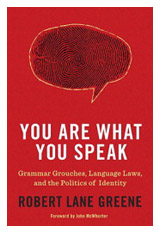 Then again, some would say the world is going to hell because of the language sticklers. In his new book, You Are What You Speak: Grammar Grouches, Language Laws, and the Politics of Identity, Robert Lane Greene, a correspondent for The Economist, writes that proclaiming the superiority of one way of writing and speaking over another isn’t just an annoying habit—it’s a serious political matter. Language is a tool used to foster identity and nationalism. Insisting on one “correct” way of using a particular language is often rather like insisting on the superiority of one’s own culture. Furthermore, argues Greene, “errors” are only the evolution of language, anyway. As people speak, they develop new rules and new standards. No rules are fixed, and attempts to resist linguistic evolution are not only wrong, they’re ineffective.
As he writes:
The long arm of the modern government has been tempted to fiddle with the language rule book itself: governments have banned words and phrases, coined new ones from thin air, fiddled with the writing system, and otherwise used the power of the state to influence the natural growth of languages. The rougher governments of the world threaten harsh penalties when their linguistic laws are not observed: using banned “impure” words or a writing system that has fallen out of favor, for example. This kind of linguistic activism by politicians has rarely been successful. Yet still they try.
Language evolves, Greene explains, and his discussion of that evolution is probably the strongest part of the book. The language we speak today is radically different from that spoken by our linguistic ancestors, who enjoyed no widely accepted standards for language usage. This is why Beowulf is unreadable to modern English-speakers and Shakespeare is only barely decipherable.
The truth is that industrialization led to language standardization. The West created public schools, standardized textbooks, and commonly understood language rules at more or less the same time the first factories opened. If everyone needed to learn how to perform the same interchangeable tasks, then everyone needed to speak and understand the same interchangeable language.
After characterizing language standardization as a tool of capitalistic crowd control, Greene argues that today’s sticklers who stand athwart the vernacular yelling “Stop!” aren’t just pedantic—they’re anti-democratic. Greene denounces those grammar gurus who preach cultish reverence to things like capitalization and the serial comma, reserving a special abhorrence for Lynn Truss’s Eats, Shoots and Leaves, a book with, he explains, “nary a sentence failing to scream bloody murder or whip of a linguistic lynch mob.” He also has problems with William Strunk and E. B. White’s The Elements of Style, finding their arbitrary, unexplained rules (possessive apostrophes after s-words, etc.) confusing and their lofty commands (“Use the active voice”) oppressive.
Or maybe he just finds the people who are really into Strunk and White troublesome. Greene’s general rule seems to be that there are a lot of people who get really wound up about correct English usage, and that these people are pathetic, controlling jerks. He’s probably right, but do these people really pose much of a threat to democracy? Even the sort of people we think of as sticklers—say, your ninth-grade English teacher—probably didn’t think the English language was ordained by God with perfect rules for all time. No, Mrs. Stevens just wanted you to learn how to clearly communicate your ideas so that people could understand what you were saying.
Greene seems to argue that the language sticklers are working to retard the progress of the language; but there’s a big difference between insisting on correct language usage and insisting upon the superiority of one language. Greene’s book consistently conflates these two things. He seems to accuse the people who do the one of also concurrently doing the other. As he writes:
Virtually since we have had written records, and no doubt before, language has distinguished Us from Them. But the connection between language and politics has become ever more explicit with the rise of modern nationalism. …While sticklerism has been with us for a long time, it has been wedding to a particular kind of conservative nationalism in the modern era. Not all stickers are political conservatives or nationalists. But the rigid thinking behind sticklerism—“you must speak and write this way, and only this way”—dovetails with a rigid thinking about group belonging.
There’s a fascinating section in here about the recent history of South Africa. Part of what triggered the end of apartheid, apparently, was the way in the 1970s certain elements of the white government insisted that the country’s black majority learn to speak Afrikaans, a language used only by a minority of the white population. Black South Africans had no need to learn the language, because educated people all spoke English. Blacks who wanted education and good jobs needed to speak English. When the government forced the whole country to learn Afrikaans, blacks revolted and protested in the streets. This, according to Greene, was the beginning of the end of apartheid.
Well, interesting, but we’re getting pretty far away here from Lynn Truss and her semi-colons, aren’t we? Sure, both racial politics and punctuation have implications for language, but Greene doesn’t really demonstrate that the road to cultural intolerance is paved by copyeditors. Discussing both aspects of language in the same book, or investing both aspects with equal importance, seems odd.
The connection between punctuation and politics is important to note, for sure. It’s also important to explain that language apparently evolves through a lot of grammar “mistakes.” And yet the central facts of the book seem a little vague. Sure, language evolves, but grammar rules don’t just exist to thwart evolution. Does language evolve from bad writing, or just from good—if nonstandard—writing?
Consider, for instance, something like this. Barack Obama recently wrote on Twitter: “I want every child to head to school knowing their education is America’s priority. Let’s seize this moment and fix No Child Left Behind.”
Now this, technically, is wrong. “Every child” is singular. “Their education” should reference a plural noun. The phrases are not in agreement. But this is an example of the evolution of the English language. People frequently pair “their” with “everyone.” Obama (or, rather, the White House staffer in charge of the president’s Twitter account) surely knows the difference and uses this phrasing because every single person means, after all, multiple people. Now it’s wrong, but it’s becoming less wrong because it works—it would be rather awkward to use the correct “I want every child to head to school knowing HIS OR HER education is America’s priority”—and people use it frequently. In time the usage will change.
At the same time, however, we have something like this:
Although its status as a “movement” and “classical” has been questioned by some scholars and historians, notably those outside Germany, its growing, immediate importance has precipitated greater awareness of it within academia and within German scholarship. Since Goethe and Schiller’s particular views on the “classical” were seldom adopted by contemporaries, it has been remarked these were possibly “premature” in development; it is, notwithstanding, plain that their efforts made profound and lasting contributions in such areas as philosophy, science, literature, and aesthetics.
This body of text, from the Wikipedia entry on “Weimar Classicism,” doesn’t really contain any grammatical errors, but surely it’s a rather crappy paragraph. This language is bad because it just doesn’t really say much. That’s the problem with something like the passive voice—it inhibits understanding. It’s common enough in writing, but its popularity isn’t indicative of the evolution of language—at least I hope not.
Objection to this sort of thing doesn’t make you some jingoistic philistine; it just means you’re paying attention. Greene aims to defend the “diversity of language,” but there’s a difference between the evolution of language and people just writing unintelligibly.
Part of the problem here is that the diversity of styles of language is not the same thing as diversity of language itself. They’re related but they’re not the same. Sure, insisting on the superiority of one language system over another is a matter of “nationality and identity politics.” But there’s a huge difference between the implications of one culture thinking the language of another is inferior and one culture thinking a poorly rendered version of its own language is inferior.
Merely knowing, and insisting upon, the clearest possible usage of one’s language in printed form doesn’t mean that one is engaged in a futile struggle against progress itself. What really appears to be the most salient point in this book is that there’s language, and then there are grammar rules. It’s important to respect the former and value, though not worship, the latter. Readers and writers would do well to resist unnatural attempts to force a language and a set of rules on a resistant people.
That’s not only obnoxious, it’s futile. Because it turns out that people end up speaking the language they want, no matter what their politicians—or their teachers and copyeditors—prefer.
Click here for a complete Page Views archive.
Daniel Luzer is web editor of the Washington Monthly.