

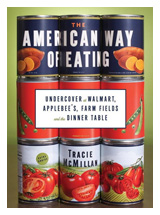
The American Way of Eating: Undercover at Walmart, Applebee’s, Farm Fields and the Dinner Table | By Tracie McMillan | Scribner | 336 pages, $25.00
Irritating. That’s the word that comes to mind when reflecting on Tracie McMillan’s The American Way of Eating: Undercover at Walmart, Applebee’s, Farm Fields and the Dinner Table.
Irritating because McMillan goes undercover in order to determine why Americans as a whole—especially the poor—eat so badly. Except we’ve viewed or read parts of this story before in Morgan Spurlock’s series 30 Days, Eric Schlosser’s Fast Food Nation, and Robert Kenner’s Food, Inc., to name three examples. Throw in Michael Pollan’s The Omnivore’s Dilemma and it’s increasingly unclear what else could be said about food that merits such continued attention.
 Irritating because McMillan is a middle-class white woman who delves into the lives of the poor and because so many pious, holier-than-thou narratives use the poor to teach us life lessons. (Mercifully, she avoids preaching, and her secondary characters are largely engaging and well rounded, but the poverty tourism nonetheless is irksome.)
Finally, it’s irritating because despite its flaws, the book works. Its shortcomings make it easy to want to hate, but the story is captivating enough to engross and sway. But if the trade-off is reading again, for example, about Walmart’s competition-killing practices while learning the reasons fresh produce is harder to come by in Detroit, or how Applebee’s doesn’t cook its food so much as assemble it, the trade-off—suffering through some oft-told tales—seems fair.
While covering the poverty beat for a magazine, McMillan had a minor revelation when a teenaged interview subject with bad eating habits let her in on a secret: She eats poorly because it’s cheap. Vanessa, the young interviewee, loves fresh vegetables but can rarely afford them, and asks McMillan, “If you want people to eat healthy, why make it so expensive?” McMillan acknowledges Vanessa hasn’t said anything groundbreaking, but she’s hit on a truth: “Eating poorly is easier than eating well.”
It’s irritating—even disheartening—that, for many Americans, eating fast food or prepackaged food is a simpler, less headache-inducing (though possibly more artery clogging) alternative to searching out, purchasing, and then preparing fresh food. Why shouldn’t the poor have easy, affordable access to the same foods the affluent have? Everyone has to eat, and eating fast food each day may kill you (just ask Morgan Spurlock).
So McMillan goes undercover as a member of the working poor to determine why eating poorly is the standard and whether it’s possible to eat, for example, fresh produce while living off the wages earned by picking grapes in a field. She also picks peaches and garlic at California farms where she’s the only white person in the fields. (Her standard cover story is that she has lots of problems and doesn’t want to work at a job where she has to deal with customers.) She moves onto working at Walmart supercenters—the stores with groceries—in Michigan. Finally, she works the line at an Applebee’s restaurant in Brooklyn.
“What would it take for us to all eat well?” McMillan asks herself at her journey’s beginning. The low-paying jobs—she sets aside some startup cash in each location to find an apartment, but that’s about it—make it easier for her to live and spend as an actual farm worker, grocery clerk, or food runner would. In each location, McMillan charts her take-home pay and expenses, including her food budget. She does some meticulous planning to keep from going hungry in each spot. Not surprisingly, she hits some stumbling blocks.
Shortly after starting a stint cutting garlic, McMillan feels pain in her arm. “The pain is actually so great I cannot cut a single garlic stalk,” she writes. “This is all it took? Two weeks in the field and I’m debilitated.” She receives medical care—she has tennis elbow—but leaves farming. “It comes down to my arm or the fields,” she writes.
When McMillan moves on to Walmart, she makes the mistake of eating out too often. She lives near family. “I socialized with my sisters,” she writes. After some quick calculations, she finds the money she’s short on rent and gas is about the same she spent while out. She brings home around $220 a week and has to take out a cash advance on her credit card.
She eventually pays off the advance and gets help from her landlord, who lets McMillan pay weekly instead of monthly, thereby making budgeting easier. The landlord also makes a deal with her: do the grocery shopping and we’ll share meals from my part of the list. Over the course of reporting, McMillan finds similar generosity in her co-workers and landlords. “[A]s families eking out a living on very little, they understood the very basic role of food in their, and my, survival,” she writes.
It’s at McMillan’s final stop, a Brooklyn Applebee’s, that she has the most fun working, but experiences the worst personal affront; she’s sexually assaulted by a co-worker’s friend at her going away party. After talking to the police and several witnesses, she lets the matter drop (partly because she was drugged and has little memory of the attack), writing, “I could do something that, for most women in my situation, would be unthinkable. I could just walk away.”
That the perpetrator gets away with it is beyond irritating; it’s maddening. The assault—in the fields there’s something similar she calls “sexual quid pro quo,” and one survey she cites reports 80 percent of farmworking women have experienced some kind of sexual harassment—is one of the things McMillan brings to light, in addition to her difficulties eating well as a lower-middle-class worker. With no purpose for her work other than reporting—no kids to support or “real” bills to pay,” she can split.
McMillan rounds out each section of the book with histories of each type of work she performs, deftly weaving them into her personal narrative. At turns, she chronicles crappy farmhand wages and the rise of machine farming; Walmart’s ascent to the top of the grocery food chain; Applebee’s history from solo restaurant to an enormous chain with 2,000-plus restaurants worldwide; and the ways each of these histories impact the food choices in our lives.
As time wears on, she also becomes borderline apathetic about her own eating habits, preferring to consume Applebee’s food for lunch because she gets a credit that covers what she eats. She eats just one other meal a day while working at the restaurant.
Throughout the book, the prose is crisp, with a to-the-point simplicity that’s graceful and swift. Each section is well researched and the reporting is appropriately deep. And all the problems with the American way of eating—from a lack of food education for many in the populace, to a corporate-dominated farm system that underpays workers, to grocery chains with poor sanitation systems, to name just several—are covered by McMillan to varying degrees.
Food politics stories can be annoying; we hear about the obesity pandemic repeatedly; the first lady’s program to change kids’ eating habits is under attack from the right; and we all have at least one self-proclaimed foodie friend we want to smack. In other words, we’re bombarded with food. But McMillan’s story is one we can’t hear too often, even if there’s an occasional sense of deja vu. When she suggests a political solution akin to Henry Ford’s model of making his own cars affordable for his workers (which is an economic solution that would likely need political backing today) is the ultimate fix for changing the American way of eating, one wonders: Will any politician successfully take up the cause? Or will it end up another casualty of partisan bickering?
Probably. And that’s not just irritating. It’s a shame.
Click here for a complete Page Views archive.
David Riedel was managing editor of the New Haven Advocate. He’s currently a Boston reporter and film critic. Follow him on Twitter @ThaRid.