

‘What the Heck Are You Up To, Mr. President?’: Jimmy Carter, America’s ‘Malaise,’ and the Speech that Should Have Changed the Country
By Kevin Mattson | Bloomsbury USA | 272 pages, $25
If there is such thing as a national mood, then 1979 found the United States engaged in a prolonged national gloom. Vietnam had crushed our belief in our collective destiny; Watergate had crushed our trust in our leaders to help us rebuild it. The energy crisis—which led politicians of the era to bemoan our, yes, “dependence on foreign oil” in one breath and to extol the urgent need for, yes, “alternative fuels” in the next—manifested itself in rampant inflation, deep recession, and quasi-Darwinian scenes at the gas pump. The Cold War trudged on. The accident at Three Mile Island in the spring of that year solidified the fear that we were, at every moment, one poorly torqued rivet away from nuclear disaster. Indeed, when Apocalypse Now was put into wide release a few months later, the film resonated not just as an agonized depiction of a war whose wounds remained raw, but as an expansive allegory of America itself. Apocalypse was in the air. Or as the historian Kevin Mattson puts it in his latest book: 1979 was “a good year to pronounce the American century dead.”
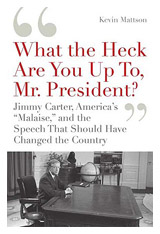 ‘What the Heck Are You Up To, Mr. President?’—the title comes from a headline printed in the New York Post during the heady summer of ’79—is a chronicle of pessimism, a cultural history of the tumultuous twelve months that capped what Tom Wolfe dubbed the “Me Decade.” This was the year in which Looking Out for Number One was a national bestseller; in which a magazine called Self first hit newsstands; in which Charlie’s Angels and hot tubs and mood rings and the self-proclaimed “Modern Day Gomorrah” that was Studio 54 captivated the national imagination; in which the country’s political anxieties broadly manifested themselves, as such anxieties are wont to do, in a queasy blend of arrogance and apathy. A generation earlier, Americans were heeding a president’s call to ask what they could do for their country. By 1979, Mattson suggests, they had gone beyond asking what their country could do for them–they had stopped assuming their country could do much of anything at all.
Among those who looked upon all the excess and ennui with a sense of alarm was the naval-engineer-turned-peanut-farmer-turned-Sunday-school-teacher-turned-politician who had the responsibility (and, it seems, the misfortune) of piloting the nation through the turbulence. Jimmy Carter was in many ways a perfect storm unto himself. And that summer, Mattson suggests, was a time when the moment met the man—when a president whose mind mingled the moralizing nature of a Baptist minister with the steely optimism of a mechanical engineer surveyed the national state of affairs and concluded two things. First: America was broken. And second: he would fix it.
‘What the Heck’ is, finally, the story of Carter’s pragmatic and prismatic (and ultimately quixotic) attempt at salvation: the address he delivered just over thirty years ago, on the evening of Sunday, July 15, 1979. The one we now know, to the extent that we know it at all, as his “malaise” speech.
The most telling aspect of that speech is that it never used the word “malaise.” To be sure, Carter’s address referred to a “crisis of confidence” among the American people. It alluded to a “growing doubt about the meaning of our own lives.” It suggested that the Americans of the late ’70s—a historical moment that Carter advisor Stuart Eizenstat had recently described, with a telling lack of irony, as “the worst of times”—were losing sight of the country’s founding values, devolving instead into a languor of hedonism, materialism, narcissism. Our psychic state, Carter declared, amounted to “a fundamental threat to American democracy.”
“This is not a message of happiness or reassurance,” the president intoned, “but it is the truth, and it is a warning.”
The address Carter delivered was one whose “depth and sophistication,” Mattson notes, “reflect the seriousness of its intellectual inquiry into the nation’s values.” Its rhetoric was vigorous, its ambitions lofty (the speech was penned primarily by Carter’s chief speechwriter at the time, a young dynamo named Hendrick Hertzberg). “Malaise” came only later. Indeed, as Mattson demonstrates, the gloomy term was retroactively fused to Carter’s speech, quickly transforming itself from a phantom limb into an appendage of a rather more parasitic variety. One that quickly began, as all parasites will, to attack its host.
“Our memory of the speech comes from those who reworked it,” Mattson declares—those “who twisted its words into a blunt instrument that helped them depose a president.”
His book, Mattson states in a moment of melodrama, is thus not merely a work of history, but also a “presidential murder mystery.” It is an attempt to discover how Carter, whom Hunter Thompson called “one of the most intelligent politicians I’ve ever met,” could end his first and only term in the White House as a political punch line. (And a cruelly enduring one: in a recent episode of The Simpsons, Mattson notes, the citizens of Springfield unveil a statue of a four-fingered President Carter. The words emblazoned upon his likeness? “Malaise Forever.”)
Considering the many parallels Mattson posits between the political realities of 1979 and the political realities of 2009, it will perhaps come as little surprise that chief among the persons of interest the author’s investigation singles out for censure are the members of the national press corps. Sure, Mattson notes, Carter himself shares culpability for the speech’s final failure. Mere days after delivering it, the president asked his entire Cabinet to resign—”the purge,” this was dubbed—causing both economic panic and questions about his mental health. And sure, Republicans and their allies were waiting to pounce on and amplify the president’s every weakness. (Ronald Reagan: “I find no national malaise. I find nothing wrong with the American people.”) But in Mattson’s view, “malaise” owes most of its stubborn stickiness to the press, whose hasty packaging of the political present guides, in turn, the political future.
Summarizing the speech on July 16, the Los Angeles Times declared that Carter had outlined “the moral malaise into which the country had descended.” The über-columnists Evans and Novak suggested that the speech was a “warning of ‘malaise’ in the land.” In The Washington Post, David Broder predicted that the president would continue to address “what he sees as malaise in the country.” All this in light of the fact that, immediately following the speech, White House switchboard operators found themselves overwhelmed by thousands of incoming calls—some 84 percent of them praising the speech, Mattson notes. And that, immediately following the speech, Carter’s approval ratings shot up 11 percent.
While the evidence in Mattson’s “murder mystery” is clear, less so are its means and motive. And perhaps that’s inevitable. Perhaps the conclusions here are obvious, neither requiring nor deserving the dignity of detail. They filter, after all, back to the familiar press pathologies–groupthink, cynicism, a sweet tooth for spectacle–that journalists are accused of so often we risk numbness to their deeper causes through the anesthetic of cliché itself.
About these pathologies, Mattson has little to say beyond the usual bromides. He diagnoses a “lens of cynicism and jadedness” and leaves the matter at that. Still, his book does suggest the danger presented by a press corps that fails to fulfill the pact it makes with history–a failure which amounts to its own “fundamental threat to American democracy.” We are, after all, a nation of words. From Winthrop’s sermons to the Declaration’s summons, from “I Have a Dream” to “Yes, We Can,” we have defined who we are not just according to what we do, but according to what we say. We have known each other—which is to say, we have known ourselves—through language.
There is pathos, then, in the failure of a speech. There is pathos when a president’s rhetoric proves unable, by its own standards, to take us somewhere better than we were before. And that pathos extends to the press—who in this case, Mattson suggests, served not merely as first-draft historians, but also, in their failure to see beyond the vagaries of the political moment, as agents of stagnation.
In that regard, ‘What the Heck’ is haunted by the specter of its own conditionality. It is the story of a speech that, to downgrade the moralism of Mattson’s title to mere realism, could have changed the country. “Are we so certain that the turn taken was the right one?” Mattson asks. “To remember Jimmy Carter’s speech today allows us to ask that question with the sort of moral import it deserves.”
Indeed, it is that moral space—the space not only between promise and reality, but between the inspiring and obstructive capacity of words themselves–that the press must navigate every day. Journalists must have split loyalties if they are to discharge their duties fairly and well. They must answer both to the present moment and to history–and to both at the same time. ‘What the Heck’ is, in the end, a sober reminder of all that is at stake in that paradox, and of what can go wrong when the press surrenders itself to the caprice of the instant. Mattson’s is not a message of happiness or reassurance. But it is the truth, and it is a warning.
Megan Garber is an assistant editor at the Nieman Journalism Lab at Harvard University. She was formerly a CJR staff writer.