Sign up for the daily CJR newsletter.
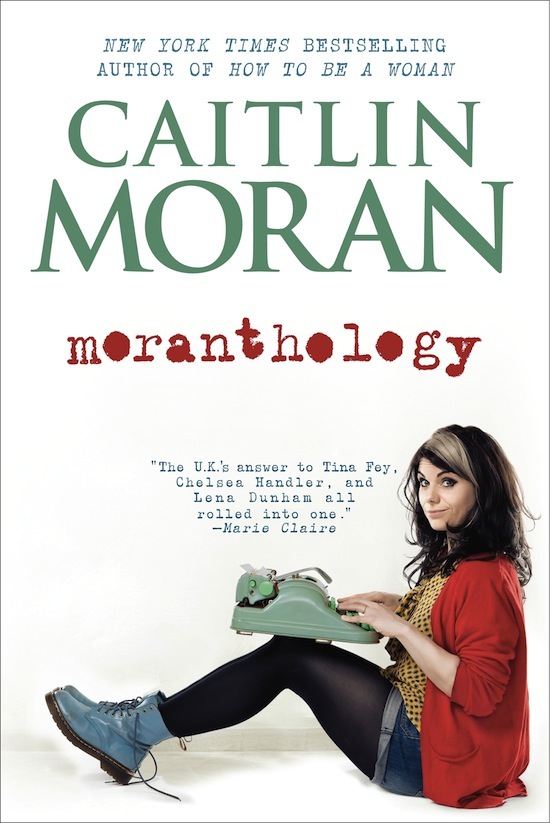
British columnist Caitlin Moran exploded onto the US scene this past July when her feminist memoir/manifesto, How to Be a Woman, became an instant bestseller. In honor of the American release of Moranthology (Harper Perennial, $14.99)—her follow-up collection of personal essays, celebrity interviews, and social commentary originally published in the Times of London—Moran talked about her unconventional start in journalism as a teenager, paywalls, writer’s block, and the trouble with unpaid internships.
How to Be a Woman has been a New York Times bestseller for 14 weeks now. Did you have any idea how successful it would be with American readers?
Not at all. When I came up with the idea I saw a hole—which you could also refer to as a massive gap—in the market for something that talked about feminism in a way that was amusing and approachable and had lots of anecdotes about vaginas in it. And I thought, “I’m good at oversharing; I could write that book!” But I don’t really travel much—I’m not really an international person, I think my writing is very British. So I thought it would sell okay [in the UK], but it’s now sold in 22 countries. And it keeps selling. It’s still absolutely baffling to me—I’ll get tweets from people in, like, Carolina! And then going to interview Lena Dunham on set of the Girls and having her stop the filming to say, “Everyone, this is a very important feminist from Britain.” I was going, “People from America have heard of me!”
Now you’re following it up with Moranthology. With nearly two decades of material from your career at the Times to pull from, how did you choose what to include?
It was a very, very simple thing in that I was pretty shit before about 2008! That kind of knocked out the first 14 years pretty rapidly. I could always write—I had a style, I used some 19th-century words—but it took me a very long time to realize what I should write about. I basically went, “RAH RAH RAH,” in an amusing and ornate way.
I started work when I was 16, and I was a home-educated, freaky, fat, chain-smoking, drug-smoking, hippy kid who hadn’t been to school and just crashed a job out of complete luck on the national press. And I didn’t want them to fire me, because I had no other employment prospects. So I just really tried not to draw attention to the fact that I was either young or weird or swear-y or alternative or very political or came from a very poor background, or had a very unusual worldview.
When I won my first award when I was 33 or 34—I got Columnist of the Year, and the year after that I got Critic and Interviewer of the Year—suddenly that felt like a mandate to finally start writing about the shit that I’m really passionate about, like feminism, politics, benefits, education, equality, mental illness, transsexuals, as well as how much I want to fuck Iron Man and how big I want my hair to be. Instead of trying to be the same as everyone else, I finally felt I could stand up and let my freak flag fly, as Crosby, Stills, and Nash put it. That, and my hard drive had crashed in 2007 and I lost everything I’d written before that. Those two massive indicators made the selection of the material very easy. And then I went onto Twitter https://twitter.com/caitlinmoran and asked people which columns they’d enjoyed, made a list of the ones everyone said and put them together in a book.
There’s a hilarious scene in the introduction where, after winning the Observer newspaper’s Young Reporter of the Year award, you botch your first editorial meeting and freeze when they ask you for some story ideas. How do you deal with idea panic now—especially with three columns a week to write?
I have a sticky on my laptop—not an actual sticky, but the ones on Apple Macs—and every time I see an interesting feature or quote or I just get an idea, I will make a note of it there. If I were driving an ambulance with a child dying in the back, it would still not stop me writing a column idea down. There’s nothing like the horror of knowing that in four hours you have to have filled the page and having nothing. I like to know what I’m going to write about a week in advance for my main column so it can sort of tick away in the back of my head.
There have been loads of studies about people who hear voices in their head—I have a great interest in mental illness; I have lots of friends who have schizophrenia and psychosis and hear voices—and it’s very closely aligned to a gene writers and creative people have. Novelists say there’s always a point when characters start doing things you don’t want them to do and start saying things you don’t expect, and that’s because you have a little Gollum in your head. And it’s the same when you’re doing journalism. If you know what you’re going to write about a week in advance, you can tuck that into the back of your head, and it can quietly tick away, like yeast rising in a bowl. And when you come to write that column, often you find your subconscious has done the whole thing for you and you can just sit and transcribe it all.
That’s in THEORY! In practice, sometimes you’re not as organized as that. [Then,] it feels like a really dry, thankless fuck. It’s just horrible, you’re gritting your teeth hoping to get to the end of a piece. Thankfully I very rarely have that. One, because I have that sticky. And second, my husband is really, really good at commissioning me—he used to be an editor and he’s also a writer. He’s really good at taking something he’s seen in the paper and going, “You should do a column on that.”
You talk in Moranthology about some of your early mistakes, like trying to emulate other writers’ voices and being really brutal in your work as a rock critic to try to impress more senior colleagues. Any advice to young journalists on finding your own authentic voice?
The last 10 years have been an era of cynicism and snarkiness, of angry and outraged people thundering very polemic pieces—and that feels old hat to me now. I see why that form of writing is appealing, because it’s a bit like doing a bump of cocaine to give you some confidence when you walk into a party. Sitting down and being very angry and indignant, with an invisible army you’re speaking for, is a really good way of falsely giving yourself the energy to get through a piece. But it’s unsustainable. It’s wearying and it really lowers the debate, not just in the media but politically and culturally. We’re coming to this very polemicized—THIS IS VERY RIGHT! and THIS IS ABSOLUTELY WRONG!—stuff that you see not just in journalism but in TV shows or news shows now. And this is what’s turned people off politically. This is why people are disengaging from bigger subjects and a proper understanding of economics or politics or climate change, because all they see is people arguing.
And I think that’s a very male thing as well. I’m much more interested in coming at a topic from an odd angle, rewinding, and asking, “Well, why has a certain set of circumstances come about?” or projecting into the future. If you’re taking that kind of angle, it’s very easy to inject humor into it. And I’d far rather be conversational, or evocative, or describe something or try to explain something.
You landed a job as a teenager without a degree, and without doing the unpaid internship route that’s the norm now. Would your path even be possible today?
People have to be aware of how the ecosystem of the media is changing. I can’t see how any working-class kid would be able to become a full-time journalist now, because there just aren’t jobs available. You would just be told to go away and blog instead. And then, that horrible thing of, “It should be a privilege to have people read your stuff for free.” Well, no. That’s like when people [ask me], “Wouldn’t you rather work for the Guardian so 86 million people can read your work?” [The Times famously instituted a paywall in 2010.] But what’s the point of having 86 million people read my stuff who don’t care about me enough to pay me to write and pay my mortgage? That’s like having someone say they really, really love you and then stand by while you’re drowning. If you love me, you have to pay me or I can’t afford to do this anymore. I’m very much in favor of the press charging for what it does. I despair of newspapers that think they can give their content away for free online, because they can’t. The statistics already prove that they can’t.
You’ve interviewed a lot of icons—Keith Richards, Paul McCartney. How do you keep from getting starstruck?
I’ve been through every possible way you could react to a famous person. In the beginning, I would tell them loads of personal anecdotes about myself in hopes they’d go, “I like you! I wanna be your friend! I’m gonna tell you about my suicide attempt that I never told anyone before!” That never happened. Then I went through a phase of trying to have sex with people I was interviewing—I didn’t really come up with any good interviews there, but I got some great anecdotes. Then I went through a phase of being really icy and cold. It took 18 years of being around famous people before I stopped being a dick around them.
The other thing is, the first 20 questions you think to ask someone famous? They will have been asked that already. I’ve done so many interviews promoting How to Be a Woman, and I literally have not been asked more than 15 questions in the last two years. So the best way to honor your hero if you go and interview them is by coming up with very intelligent questions that they haven’t been asked before. Give them a chance to talk about something else. And usually whatever your editor asks you to talk about—don’t do that. They’ll go, “Talk about the marriages and the drugs bust and the most famous album and at least two famous outrageous things that they did, those are all the quotes that we want.” Well, that’s what everybody will have talked to them about, so that will be a bit of balls, really. So you ask them something completely different instead and you end up talking about politics with Lady Gaga at 4 in the morning in a sex club in Berlin and you’re kind of like, “This is what I want, yes.”
That Lady Gaga piece appears in the book. How did you keep tabs on the story over the course of an all-nighter?
A proper journalist, I guess, would’ve pretended to be drinking all night but would’ve been pouring their gin and tonics into a plant pot, but I regret to say I’m not a proper journalist—I got completely fucking hammered! So I just ended up dancing with Gaga, trod on her cloak a few times, smoked some fags, ended up in the bathroom with her … What I always try to explain to the people I’m interviewing is, I don’t want an exclusive. I don’t want them to break down and tell me something enormous. My horror is I would get something out of someone and it’s worldwide news the next day. I just want to report what it’s like to be around them, and I only ever interview people I like as well.
Humor is your trademark, but in this collection you also do serious, insightful, and heartbreaking. Is it hard to change gears between these voices?
One of the greatest things about being a journalist is knowing other journalists, and I love the camaraderie and the way we can endlessly talk shop. But one thing I’ve become aware of by hanging out with writers almost exclusively is that I can’t really talk that much to them about [the process of] writing because I find it so fucking easy. One of my best friends, Grace Dent, who’s a columnist on [British daily paper] the Independent and also writes books, says, “It’s just like kicking a bag of shit around in front of you every day.” But I just find it so fucking joyful. My mouth salivates whenever I think about the next day’s work. I don’t find it difficult to shift between those gears at all. In fact, figuring out how I’m going to shift between those gears turns me on like a shag. But I would only say that to you, because if I was sitting in a room with a writer friend, they’d stand up and walk out after 30 seconds — they’ve done it before.
Has America ever needed a media defender more than now? Help us by joining CJR today.