

Molly Ivins: A Rebel Life | By Bill Minutaglio and W. Michael Smith | PublicAffairs | 360 pages, $26.95
On July 6, 1964, Henry Holland, the brilliant and eccentric scion of a wealthy Texas family, was driving his motorcycle down a country road when a dog ran into his path. Holland swerved, his bike slammed into a roadside guard rail, and he was killed instantly.
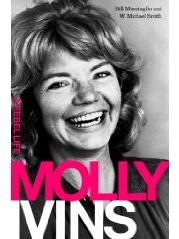
Holland’s death might have been lost to history—a meaningless tragedy among so many others—except for the fact that it would go on to produce, in a roundabout way, one of the most famous journalists in America. Holland was the boyfriend, and quite possibly the fiancé, and either way the soul mate, of a Smith College sophomore named Mary Ivins. Molly, for short. And his loss, suggest the authors of the new biography Molly Ivins: A Rebel Life, turned the future columnist away from the path for which she’d been groomed—a privileged existence among the Texas elite—and toward the one for which she’d be known.
The turnabout wasn’t merely a matter of Holland’s death, of course. She had shown a flair for writing at an early age, and despite a penchant for reading that would make her seem withdrawn (her family nicknamed her “The Mole”), she aspired to celebrity. Throughout her teenage years, she carried a note, addressed to her future self, folded in her wallet: If she hadn’t become famous by the age of twenty-five, she pledged, she would commit suicide.
Still, had a dog not crossed her boyfriend’s path that day in 1964, Ivins would likely have become Molly Holland—and we, in turn, would likely have been deprived of Molly Ivins, the Molly Ivins—the reporter who skewered politics and politicians in Austin and Washington and places in between; the columnist who combined her Texas roots and patrician education to brilliant (and devastating) effect; the advocate who fought relentlessly for civil liberties; the celebrity who, upon her death, was eulogized by everyone from President Bush to Maya Angelou; the writer who was compared, as a stylist, to Mark Twain, Ambrose Bierce, H.L. Mencken, François Rabelais, Lenny Bruce, and the prophet Jeremiah; the charismatic character—six feet tall, with a mega-watt smile and a shock of red hair—who swore with abandon, drank with even more, puttered around barefoot, laughed more loudly than was proper, and had a dog named Shit.
Ivins was “an extraordinarily fastidious self-chronicler,” the biographers Bill Minutaglio and W. Michael Smith note, and their book benefits not only from fresh interviews of Ivins’s relatives, colleagues, and many, many friends, but also from the information contained within the thousands of personal documents she donated to the public archives at the University of Texas at Austin—among them phone logs, travel itineraries, reporters’ notebooks, memos to and from editors, Broadway tickets, grocery lists, medical records, grade-school report cards, and intimately personal letters. The gift in this case was a nod toward generosity and transparency by a woman who valued both, but also, the authors speculate, a reflection of her desire to demonstrate that “in real life she was far more complex than the public persona familiar to millions of readers.”
If so, they have carried out her wish, and in meticulous detail. Minutaglio and Smith trace Ivins’s childhood in River Oaks, the ostentatiously wealthy Houston enclave where she grew up; her education at Smith, where she developed both her confidence as a communicator and her fondness for strong cocktails; and her summer spent in Paris, during which she perfected her French and became enamored of John Steinbeck, James Baldwin, and Charles De Gaulle. An internship at the Houston Chronicle, followed by a year at Columbia’s J-School, led to a short stint at the Minneapolis Tribune and a long one at the progressive Texas Observer.
It was at the latter, covering the Austin Statehouse, where she fully developed the writing voice—rollicking, wry—for which she’d be celebrated. The Observer, the authors note, gave Ivins “free rein not just to address issues that barely dented the pages of the mainstream papers—the out-sized issues of poverty, racism, systemic corruption—but to do it with a chiding, confiding derision that two-stepped back and forth between a mocking condemnation and a can-you-believe-it kind of wonderment.” And she embraced the freedom. Confronted with the swaggering, booze-fueled theatricality that was the Texas political scene of the early 1970s, Ivins found irreverence. The kind that would lead her, later on, to dub George W. Bush as “Shrub”—and to render such pronouncements as “Ronald Reagan is so dumb that if you put his brains in a bee, it would fly backwards.”
Her Observer days solidified both Ivins’s opposition to journalistic detachment as a value and a possibility (“There is no such thing as objectivity,” she would say; in fact, “I actually think it is pernicious as a goal”), and, relatedly, her progressive politics. It also set the stage for the one-foot-in, one-foot-out relationship she would have, throughout her career, with Establishment Journalism: She worked at The New York Times, but was never really part of it. She was nominated for a Pulitzer, but never won. Friends visiting her Austin home were amused to find that many of the awards she did win had been put to use as coasters, trivets, and serving trays.
In fact, an enduring quality of Ivins’s life was, as the book’s title makes clear, rebellion itself. A good many of her quirky Mollyisms were not truly quirks at all, the authors suggest, but minor mutinies that gradually coalesced into personal idiosyncrasies. Her parents named her Mary? She’d go by Molly. Her mother wanted her to become a Lady of Society? She swore, and smoked, and drank, and took up with fellow swearers and smokers and drinkers. Her father wanted her to become a good Republican? She cavorted with leftist radicals during a time when being a leftist radical actually meant something, and went on, sure enough, to become the most famous liberal columnist in the country. Her fans were eager for her to hurry up and finish her next book? She printed—and wore—a t-shirt emblazoned: DON’T ASK ABOUT THE BOOK.
A Rebel Life could easily have reduced Ivins’s life to a kind of ongoing dialectic: public persona versus private person, expectations versus here’s where you can put your expectations. It could have also devolved into a simple study of the journalist’s body of work. But thankfully, the authors resist reductive aesthetics in favor of something both more challenging and more rewarding: empathy. They provide a portrait of their subject that is loving in the most literal sense, one that treats her simply as a person, with the attendant freight of ego and insecurity, strength and frailty.
And since biography is one of the few contexts in which that modern scourge—voyeurism—is an asset rather than a weakness, A Rebel Life’s candor is immensely valuable, if sometimes also uncomfortable in its intimacy. The book shares, in searing detail, Ivins’s many brushes with tragedy. In addition to Holland’s death, there was the alcoholism (“I have wasted so much time getting drunk,” she wrote in a note to herself. “I have wasted so much time hating myself for it the next day”), there were the bouts of depression, the loss of friends to illness and accident, the breast cancer that would weaken her for years before taking her life, the suicide of a nephew she loved as a son, the relationship with her domineering father that ranged from tense to turbulent to, the authors suggest, traumatic.
In that sense, the biography is like its subject: unrelentingly honest, unapologetically unfiltered. Fuck it, this is how it was. Though Ivins may be remembered mostly for her work and, with it, her wit, her biography remembers her in the way that she probably would have preferred: as someone who fought against the pressures placed on her by retreating into, and then projecting out, her own humanity. By laughing. By listening. By being a good friend. And by combining those things in the most productive way she knew how: by writing.
Click here for a complete Page Views archive.

Megan's gushing appreciation forgot to mention Ivins' plagiarism (theft, to put it bluntly) from Florence King. It's an odd omission for a journalism review. King is a right-winger, though easily Ivins' match as a wit, so she lives in exile in the conservative media ghetto.
Ivins was also very thick with liberal politicians, most obviously ex-Gov. Ann Richards, which is not my idea of a born skeptic of power. She was no rebel; her politics were identical with those prevailing at such places as the offices of her onetime employer, The New York Times, and at the Seven Sisters/Ivy League schools at which she was educated. Glenn Beck takes more risks than Ivins did.
#1 Posted by Mark Richard, CJR on Fri 11 Dec 2009 at 12:59 PM
Molly Ivins: the quintessential right thinking progressive trapped in the land of the ignorant, gun toting, racist right wing Christanist Texas. Just another left wing hack pseudo journalist whose meteoric rise had more to do with being in the right place at the right time more than her abilities. Her carrer as a semi-prominent Austin columnist devoted to churning out Ann Richards’ hagiographies would have gone nowhere had it not been for the election of W in 2000 and the bulk of her success is due to that, no amount of acerbic biting wit.
She may have been a “rebel” for Texas (not in the true sense as Mr Richard’s points out), but he politics would have fit right in at Columbia.
#2 Posted by Mike H, CJR on Fri 11 Dec 2009 at 02:18 PM
Glenn Beck, indeed. Putting his brains in a bee would produce a catatonic bee.
Given Molly Ivins' prophetic predictions about the policies promulgated by the porcine GOP, it is understandable that some feel the need to badmouth her and her writings.
Mark- Unfortunately, just being able to spell hagiographies and acerbic does not make you intellectually astute enough to make valid criticisms of Molly Ivins. Did you learn big words like that at Bob Jones University or are you more of the Andover/Yale type of "intellectual"?
#3 Posted by Lee H., CJR on Tue 15 Dec 2009 at 12:32 PM
Lee H., if I were a lazy-enough a reader to ascribe Mike H's vocabulary to the wrong poster (me), I don't think I'd risk looking silly by questioning the intellignece of others. Take a reading-comprehension review class - I expect even one at Bob Jones University would probably help.
#4 Posted by Mark Richard, CJR on Tue 15 Dec 2009 at 01:06 PM
Hello Mark,
I guess that makes me a risk taker, like Glenn Beck.
By your logic, you should not be taking such risks either. Questioning the "intellignece" of others? If the little dotted red lines had shown up underneath your names, I would have corrected my dyslexic error.
See you at Bob Jones U.
#5 Posted by Lee H., CJR on Tue 15 Dec 2009 at 02:04 PM
Well, since I didn't accuse anyone of being less intelligent than I was, even yourself (the world I live contains intelligent people who simply disagree, usually in good faith), or even of being a lesser typist, I doubt if my typo doesn't have a moral attached to it.
#6 Posted by Mark Richard, CJR on Tue 15 Dec 2009 at 03:06 PM
Excuse me, the last sentence should read that I doubt if my typo has a moral attached to it. Too much quick editing. Still less of a sin than plagiarism, by the way.
#7 Posted by Mark Richard, CJR on Tue 15 Dec 2009 at 03:08 PM
Molly was in a completely different class than Glen Beck (who is totally classless). Molly actually was an intelligent person, one who actually thought about things before she talked about them. Mark, I am afraid you have no idea what you are talking about. Your ignorance shows through loud and clear in your posts here. You just like to shout out the Right Wing talking points that take no thought and have no depth. Molly had a wit that was unequalled and compassion too. If you knew anything about Ann Richards or about Molly you would know that they were both very skeptical of power and the people that wielded it. You might not really be able to understand her writing because you are so full of right wing talking points that you can't get through a sentence with out them bubbling out. It is hard to comprehend what you are reading when your ignorance is shining through your every thought.
#8 Posted by T Moore, CJR on Tue 15 Dec 2009 at 04:03 PM
BTW Mark, you can bet that Molly would never plagiarize any right winger.
#9 Posted by T Moore, CJR on Tue 15 Dec 2009 at 04:07 PM
Molly was in a completely different class than Glen Beck (who is totally classless). Molly actually was an intelligent person, one who actually thought about things before she talked about them.
No she wasn’t, she was a reflexive left winger who happened to be a decent writer, two of the primary qualifications to fit in amongst the liberal establishment.
Ivins did plagiarize Florence King, but to her credit she apologized for it.
You should step outside your bubble once in a while.
#10 Posted by Mike H, CJR on Tue 15 Dec 2009 at 04:40 PM
T. Moore, don't get in over your head. To begin with, nothing you write actually challenges any specific criticisms of Molly Ivins - just the usual sloganeering about evil right-wingers that convinces no one other than already True Believers. And she did plagiarize from the National Review humorist Florence King. She admitted it, apologized . . . but it didn't stop Don Imus from making a joke about it at one of those glitzy press/media/entertainment industry dinners a few years ago.
As for Ivins' wit, I never saw the slightest hint of irony that she, a child or privilege, was supposedly "helping" the underprivileged, you know, by penning guffaw-inducing bons mots for an audience that was the leftist counter-part to Ann Coulter's. If she ever found it humorous that the most enthusiastic backers of left-wing causes are denizens of places such as Malibu and Martha's Vineyard, she never shared it with that audience. I didn't find her 'wit' any more or less subtle than that of Coulter, or some other writer with opposing political tendencies. It's just politics.
#11 Posted by Mark Richard, CJR on Wed 16 Dec 2009 at 12:37 PM
I don't know much about Molly Ivins except the fact that she's not taking speaking engagements anymore from what I hear, but it's been my experience that you could brain someone with a spiked cudgel and still end up more subtle than what's inside an Ann Coulter book.
Which happens to be, by the by, occasionally plagiarized.
http://www.msnbc.msn.com/id/13803982/
Or pretty close anyways
http://www.dailykos.com/story/2006/7/7/11290/58796
#12 Posted by Thimbles, CJR on Wed 16 Dec 2009 at 12:58 PM
I work for a major insurance company and Ivins once reported that some agents had complained to the state civil right commission that the company was engaged in racial discrimination in homeowners coverage sales. Never did subsequently report that the commission ruled the charges were unfounded. It was my only experience with her, and it was dour.
#13 Posted by Old Geezer, CJR on Wed 16 Dec 2009 at 02:43 PM
"On more frivolous fronts the, the country is heading into a banana (it is considered seditious to use the word recession), the banking industry appears to be prepared to imitate the S&L debacle, and the administration's response is to deregulate the banks. I Love those articles on the bidness pages and in the bidness magazines explaining to us economic illiterates that though the banking mess looks like the S&L mess, smells like the S&L mess, and quacks like the S&L mess, it is not going to be like the S&L mess. And the reason deregulation, which caused the S&L mess, will save us is because what we need is bigger banks. So we can be competitive with the Japanese."
-Molly Ivins, The Progressive, February 1991
Now we have prospects for a lost decade of our very own.
#14 Posted by Phocion, CJR on Thu 17 Dec 2009 at 12:12 PM
Phocion, a stopped clock is right twice a day. Ivins and others on the Left always predict disaster for capitalism, and occasionally the predictions look valid for a time. The trouble with this 1991 piece is that social-democratic economies which have incorporated 'progressive' policies have had 10% unemployment and slow growth since - well, since about 1991, when Ivins' penned this piece. (The Japanese economy went into the tank around the same time, though its banks were so closely regulated as to be an arm of the government.) The decade which followed the supposedly disastrous S & L collapse was possibly the most prosperous the U.S. has ever enjoyed, the other industrialized countries stagnated in job creation and technological innovation. China and India didn't start becoming world economic powers until they began de-regulating their economies.
So, 18 years passed before Ivins' 'prophecy' gained credence. Where were her predictions about the more serious and long-term economic difficulties faced by countries like France and West Germany, which have all the minimum wage laws, leave mandates, unemployment insurance, and strong union benefits an American progressive could dream of? Capitalism has its ups and downs, but in the longer run it still out-performs social democracies when it comes to raising people out of poverty. That's why so many on this post are writing from the U.S. instead of from back in Europe, with its cultural inheritance from feudalism and greater tolerance of centralized power.
#15 Posted by Mark Richard, CJR on Thu 17 Dec 2009 at 03:46 PM
I'm always amazed at how goofballs seem to appear out of nowhere to spout right wing talking points whenever a progressive columnist or commentator is discussed. The fact is, Molly Ivins used wit, candor and her low tolerance for bullshit to write probing, penetrating articles that tore conventional wisdom to shreds. The Washington Post stopped doing that about the time of the demise of Punch. The New York Times spends too much of its time accepting without question Washington spin, most notably during the run up to and for much of the worst of the Iraq war.
Molly didn't, earning her the antipathy of the right forevermore.
As for Mark Richard's off-topic comments about the supposed "problems" of France, Germany and other European nations with adequate social safety nets, before you trash talk you ought to do some research into the subject. Nobel Prize winning economist Paul Krugman has done so, at length, and has been knocking down that straw horse for weeks, most recently at
http://krugman.blogs.nytimes.com/2010/01/11/white-mans-burden/
#16 Posted by Charley James, CJR on Wed 13 Jan 2010 at 12:27 PM
I'm always amazed at how goofballs seem to appear out of nowhere to spout right wing talking points whenever a progressive columnist or commentator is discussed. The fact is, Molly Ivins used wit, candor and her low tolerance for bullshit to write probing, penetrating articles that tore conventional wisdom to shreds. The Washington Post stopped doing that about the time of the demise of Punch. The New York Times spends too much of its time accepting without question Washington spin, most notably during the run up to and for much of the worst of the Iraq war.
Molly didn't, earning her the antipathy of the right forevermore.
When I was studying journalism at university, the professor who taught an introduction to reporting class kept making the point that a reporter's job is to cut through the nonsense sources will want them to believe. It's not a matter of being 'Liberal' or 'Conservative,' I remember him saying, but being conscientious. As a result, he taught us, journalists must always be small "l" liberals: Distrusting what we're told and looking beyond the quote for truth.
As for Mark Richard's off-topic comments about the supposed "problems" of France, Germany and other European nations with adequate social safety nets, before you trash talk you ought to do some research into the subject. Nobel Prize winning economist Paul Krugman has done so, at length, and has been knocking down that straw horse for weeks, most recently at
http://krugman.blogs.nytimes.com/2010/01/11/white-mans-burden/
#17 Posted by Charley James, CJR on Wed 13 Jan 2010 at 12:31 PM
Oh. One other point about Mr. Richards comments. I don't know about you but I've made more than two dozen trips to China over the past 15 years. China never "deregulated" its economy; it allows private enterprise but under a strict regulatory framework.
#18 Posted by Charley James, CJR on Wed 13 Jan 2010 at 12:34 PM
Don't want to continue off-topic, except to note that Europe is much more centralized than Charley probably would tolerate himself, that this leads to a degree of corruption unknown in high office here (Berlusconi, Chirac, Kohl), that the safety net also means high unemployment rates for young people, and that to maintain its welfare states, Europe has been forced, in order to be nastier to immigrants (also for cultural reasons) than even Lou Dobbs would approve of. Krugman doesn't get around to confronting these cracks in the statue. But then Krugman is debating a straw man, anyway. As for China, the deregulation and reforms preceded his experience of that country. It's possible that he has been able to travel to China so often because the dead hand of the dirigiste state was lightened on the country's economic activity.
I don't even know why this is a debate. We have examples right now in this country, where business-friendly Texas is surviving the recession much better than high-regulation California and New York. (The Economist got around to giving grudging notice to this, and the reasons why, a few months ago, but an American news media that is largely concentrated in New York, with its entertainment-industry cousins in California, doesn't seem to want to look into this.) Molly Ivins would not, given her ideology, be able to explain why, I suspect.
#19 Posted by Mark Richard, CJR on Thu 14 Jan 2010 at 04:28 PM
For clarity's sake above, the sentence should read that "Europe has been forced to be nastier to be immigrants . . . than even Lou Dobbs would approve of" (i.e., the welfare state is an insular economic system.) Also, I intended to note that the reforms in China preceded the experience of Charley, not Paul Krugman, in that country.
China's regulatory framework may be strict, but it is unquestionably more liberal than it was when Deng began looking at capitalist practices and policies in the late 1970s. China didn't grow rich by becoming more socialist. I wish American liberals could concede that taxes, regulations, etc., do have negative impacts, and the debate should be the trade-off between more security and more freedom. But the idea of honest trade-offs and cost/benefit analysis seems to be scary to such folks, who wish to assert that the governement can do it better, do more of it, and it ain't gonna cost the average citizen anything - except, maybe, a little superfluous spare change. There's a reason those wonderful European health-care systems still depend substantially on American medical technology and pharmaceuticals, for instance, but you won't learn that this is the case from reading Paul Krugman's newspaper columns. When intelligent people are in the emotional political mode, it doesn't usually bring out their best and most thoughtful sides.
#20 Posted by Mark Richard, CJR on Thu 14 Jan 2010 at 04:40 PM
"China never "deregulated" its economy; it allows private enterprise but under a strict regulatory framework."
@Charley: Your statement is silly. I live in Beijing and have done business in China for almost 20 years, witnessing countless moribund SOE's transform into successful privately owned businesses.
You may have visited China dozens of times, but there is a huge difference between coming as a visiting journalist and actually living here and doing business. Unfortunately American readers aren't in a position to know that, and US media coverage of China suffers as a result. I suspect your observations on Europe are equally blinkered.
#21 Posted by JLD, CJR on Thu 14 Jan 2010 at 06:34 PM
Molly Ivin's apology to King may be of interest to some:
#22 Posted by Leafy Geneva, CJR on Mon 18 Jan 2010 at 02:54 PM
hello ! writting to submit on the topic of the author and artist andre pace
his poem ID #A8927 and book titled " the wishing well series multi -volume ISBN 978-60880-18-6 . art and culture his works explain nature and self importance vist www. art review .com or culture inside.com thank you
andre pace
#23 Posted by andre pace, CJR on Fri 20 Aug 2010 at 08:55 PM
hello ! writting to submit on the topic of the author and artist andre pace
his poem ID #A8927 and book titled " the wishing well series multi -volume ISBN 978-60880-18-6 . art and culture his works explain nature and self importance vist www. art review .com or culture inside.com thank you
andre pace
#24 Posted by andre pace, CJR on Fri 20 Aug 2010 at 08:56 PM
