

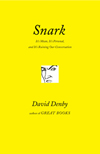
Sly, snotty, and often irresistible, snark has been flourishing in the petri dish of the American media for decades now. The Internet, however, has spread the contagion faster than ever. And according to New Yorker film critic David Denby, we may be reaching a new level of toxicity. That’s the gist of his slender new polemic, whose tongue-clucking subtitle pretty much says it all: Snark: It’s Mean, It’s Personal, and It’s Ruining Our Conversation. In a phone interview with CJR’s James Marcus, the author discusses his motives for writing the book, the epidemic of unease among established journalists, and the faint hope that the runaway train of snark can be slowed to a respectable crawl.
 Let me begin with a question about the genesis of this project. If modern, American-style snark has been around since the heyday of Spy in the eighties, what made it imperative to write this book now?
As I mentioned in the acknowledgements, the specific genesis was a dinner with [Slate founder and freestyle pundit] Mike Kinsley last March. We both had the same idea, and I think he was going to do it for Time magazine, but he ceded the turf to me. What was really getting to me, though, was the thought that Barack Obama might be done in by coded racist comments. Snark was the vehicle for those attacks: an appeal to “understood” notions among Republicans that this guy was alien, un-American, not right for leadership. Now, it turned out I was wrong. Obama was our Democratic Prince! And a lot of people, including Republicans, wanted to protect him in a way that most of us won’t be protected.
Were you returning fire in any sense?
There was no personal motive. I mean, I’ve been snarked like everybody else, but no more than other people. I just kept seeing the same kind of formulation in all sorts of places, including The New York Times. I sensed that Gresham’s Law was beginning to operate: because everyone wants to be funny in this country—which is actually very hard—the bad stuff was driving out the good stuff. And there’s going to be more and more of this, particularly because everyone in journalism is anxious. Older journalists are terrified of being left out of it, of not seeming hip, while the younger ones are battering at the gates trying to get in.
You write that one of the optimum cultural conditions for snark occurs when “a dying class of the powerful, or would-be powerful, struggles to keep the barbarians from entering the hallowed halls.” Are traditional journalists such an embattled class?
I think so. I just feel this tremendous collective anxiety among established journalists that somehow they’ll be left out. There will be a game of musical chairs and they’re not going to get a chair. So one way of seeming to embrace new media, one way of staying in the game, is to get snippy and sarcastic and snarky. They’re certainly not encouraged to be more analytic, more intelligent. I adore Josh Marshall—he’s the best thing to come along in years. But for every one like him, there are five who are just fucking around, trying to grab a little piece of our attention.
Snark, as you note, is not always easy to pin down. Its main identifying marks seem to be reflexive contempt and what you call “the little curlicue of knowingness.” Does that sound accurate?
Yeah. It’s not hate speech, it’s not trolling, it’s not simple insult. What I’m getting at is contempt, and a signal sent to a member of a club (which can be enormous or tiny) in which a certain kind of reference is understood, and stands in for an attitude that one wants to put down.
You do provide a potted history of the form, starting with Juvenal and the other great snark merchants of the classical era.
It’s a bit of mock scholarship. But I wanted to suggest that there’s a certain sensibility that grew, and to contrast the formal rules of invective in the ancient world with what we’ve got now.
Of course, Nick Denton of Gawker seems to have his own rules of invective: no think pieces, and no more than 200 words.
I had assumed that Nick Denton’s people would put me on a spit and roast me, but I haven’t heard a thing. I’m amazed only because they’ve gone after me in the past. Maybe I missed it. I don’t spend a lot of time relentlessly looking—if you do, you’re going to drive yourself nuts. I love the Internet, and I depend on it, but I don’t live in it, as many younger people do.
You make the point that in many cases, being beaten up on the Internet has a strangely unreal quality to it. If you don’t look, it’s hardly there.
Unless your helpful friends tell you, “Oh, that was awful.” Sometimes people do look at you weirdly, and you realize that something has been said and you don’t know what it is. We can certainly toughen up and shrug it off. But the old notion of personal honor is something that we’re going to have to jettison in the digital age.
So the traditional idea of reputation is going down the drain?
Yeah, you can’t just escape the way you did in America in the nineteenth century. Just pick up and go somewhere else. It’s crucial not just for people my age, but for kids. A lot of stuff they put on social networking sites, or on this scummy Juicy Campus site—it may pop out ten years later, when you’re applying for a job in a conservative profession.
Let’s return for a moment to your history of snark, in which Tom Wolfe occupies a pivotal spot. You discuss both his amazing talent and the sense that there’s really nothing at stake. What we see in a piece like “These Radical Chic Evenings” (1970) is like a higher form of dandyism.
When he was young, Wolfe was celebrating and discovering aspects of American culture that had been buried or hidden. But then he turned to things like this, and if you examine that piece closely, there’s nothing in it but contempt and rage. He seems to be angry not just at the Black Panthers, but at the mainstream civil rights leaders. He makes fun of the way they dress, how boring and middle-class they are. There’s a strain of anti-Semitism, too. All of these rich Jews trying to maintain their credibility in their twelve-room apartments. But in retrospect, it’s Wolfe who looks like a schmuck, not the people who went to that party. The piece now seems to me incredibly well composed and incredibly sour and nasty. He’s got nothing, no reforming instinct, just his taste against theirs. It doesn’t sit well anymore. And it was a transit point for Wolfe: he went from being an exuberant cultural celebrator to being a right-wing sourpuss.
At one point you note the so-called “Pacemaker Principle,” whereby the old “get their slowness clocked, their verbal flummoxes written down, their sags and humps measured.” Among your examples is a shaft fired by Charles McGrath at Jim Lehrer, which seems a little paradoxical, given that McGrath himself is in his early sixties. Is snark now so reflexive that we’re all devouring our own peers?
That’s a classic example of what I was talking about at the beginning of our conversation—the anxiety that you’re not keeping up. You’re getting old, you’re not hip enough, so you make fun of somebody who’s slightly older. I was shocked to hear that Lehrer was deeply wounded by that comment. They do the same thing they’ve been doing for thirty years on that show; it does have a kind of reliability. Why put it down?
I found an additional irony in the fact that the Times Book Review was notably un-snarky under McGrath’s tenure, but has become more so under that of Sam Tanenhaus.
They want to get your attention. They’ve published some good pieces and some awful things, which should have been much more tightly edited. It’s going for impact. But if you’re going to do a tough, nasty piece, you have to edit it very carefully, and you’ve got to have a great writer doing it.
Let’s return to something we touched on earlier. You’re at pains to separate yourself from such articulate Luddites as Lee Siegel, who insists that the Internet is destroying our humanity. But could you say a few words about the Web’s role as snark’s mightiest megaphone?
Lee’s book [Against the Machine: Being Human in the Age of the Electronic Mob] seemed to me excessively gloomy, an attempt to be eloquent about very small issues. Look, we’ve had a democratic revolution. Millions of people have gotten access to the presses, which were formerly controlled by the owners of the presses and their hirelings, like me. Suddenly, everybody can join. And that’s an incredible event in the history of democracy. But in the wake of any democratic revolution, you’re going to have an explosion of egotism and anger and pent-up rage. There’s an awful lot of that. You can ignore it, of course, unless you’re in a conversation about something that matters to you.
So where is this post-revolutionary hangover leading us?
I think our excitement over the Web should probably subside in another ten years. And we can already see that it’s really more useful if it’s tightly refereed. Everyone can speak, but there should be standards of common sense and civility. That’s a widespread feeling now: people have had enough of this annihilating crap, which seems to screw up so many conversations. I mean, just recently, Annette Insdorf did a piece about Holocaust movies on the Newsweek Web site, and within just a few exchanges, the comments fell into Holocaust denial and anti-Semitism. That was the end of that conversation.
The other thing, as I said before, is that everyone wants to be funny, because comics are culture heroes. So there’s a tendency to turn to snark as a way to make a character out of yourself, to create a kind of Internet doppelgänger. It’s anonymous writing, and you can cut yourself loose if anybody gets too close to you. But anonymity is a double-edged thing. It’s absolutely necessary for dissidents and whistleblowers. If you’re just attacking your neighbors or friends on campus without taking responsibility, it’s cowardly. And the fact that kids don’t see any moral issue there is kind of shocking.
In the book, you dwell on anonymity as a generational litmus test. You also note that for kids, “privacy doesn’t much register as a spiritual value and a sanctified space anymore.” Is this a reversible trend, or is privacy truly on the verge of extinction?
They want attention just like the rest of us. But they don’t realize that privacy is one of the great triumphs of bourgeois civilization: your own bedroom, your own diary, your own love affair. You have a sacred space in which you can say whatever you want, do whatever you want, but only for yourself, or for somebody you’re very close to. If you’re a seventeen-year-old posting the details of your love affair on a social networking site, you’re more or less joining the snark culture. It doesn’t induce empathy, it induces sarcasm.
Reviewing your book in New York magazine, Adam Sternbergh defends snark as “the angry heckler at the back of the room.”
And what use is the heckler at the back of the room? He’s not saying something very important or interesting. Sternbergh doesn’t want his pieces interrupted by angry hecklers, and neither does anybody else at New York magazine. There was a point-by-point refutation of that piece by Edward Champion, by the way, which was incredibly thorough.
A book about snark is bound to beget more snark.
There’s a lot of stuff floating around already. It’s inevitable. When you stick your chin out, it’s going to get hit. That’s fine. It’s part of saying something, not just doing the old soft-shoe down to the bottom of the page. My idea was to get a conversation going. Pile on!
Finally: do you think your book will have any effect on the runaway train of snark?
I doubt it. Although we may be entering a different era. There’ve been a lot of lies over the past eight years, and maybe snark was one way of dealing with lies, by turning everything into a joke. But if we’re not going to be genuinely witty, which is hard, we might as well talk sense to each other. And perhaps an anti-snark tract will help in that respect. Maybe not. It’s the media juggernaut: you can comment as it goes by, but derail it? No.
James Marcus is the deputy editor of Harper’s Magazine. His next book, Glad to the Brink of Fear: A Portrait of Emerson in Eighteen Installments, will be published in 2015.