

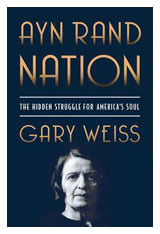
Ayn Rand Nation: The Hidden Struggle for America’s Soul | By Gary Weiss | St Martin’s Press | 304 pages, $24.99
Ayn Rand, the GOP’s crotchety, misanthropic little immigrant grandmother, is hot again. Her books are selling well; her works are animating the ideas of certain Republican congressmen. Even Brad Pitt and Oliver Stone said they were interested in making a movie version of The Fountainhead. Fox News TV personalities John Stossel and Sean Hannity enthusiastically promoted the cinema version of her most famous novel, Atlas Shrugged, which came out last year on Tax Day. (Though the movie tanked, its producers are still planning to shoot Atlas Shrugged: Part 2.)
 Rand, author and ideologue, inspired great devotion and derision for her best-selling novels The Fountainhead and Atlas Shrugged. Ridiculed for their wooden drama and characterizations, readers nevertheless loved the novels for the ideas contained therein. Rand’s philosophy, Objectivism, is based on the idea that personal happiness (or self-interest) is the supreme moral code; the only organization of society consistent with this ethical system is unfettered capitalism.
Though her philosophy has been largely ignored by the academy, it’s been consistently popular among members of marginal groups: precocious teenagers, Cato Institute employees, the Canadian rock band Rush, and, most recently, the Tea Party. In Ayn Rand Nation: The Hidden Struggle for America’s Soul, Gary Weiss chronicles the growing influence of Rand on America, who Ayn Rand’s followers are, and what they’re doing to the United States.
Weiss, an investigative journalist formerly with Business Week*, has made a career exploring the underside of American finance. In this book he looks at the rise of Objectivism from its early days—when Rand’s small cadre of followers regularly gathered at the author’s midtown Manhattan apartment— through the rise of Rand acolyte Alan Greenspan, up to today, where John Galt signs predominate at Tea Party rallies, the Republican Party simply refuses to govern or increase taxes, and certain congressmen (e.g. Paul Ryan) propose austerity budgets influenced by the dead novelist.
Such an exploration, understandably, takes one fairly seriously down the rabbit hole of Objectivist ideas. It was a fascinating trip. I had no idea, for instance, about the weird, communist-style purges that took place in the movement when Rand was still alive. She had a loyal group of followers but she wasn’t terribly loyal to them. Objectivists denounced and then ignored members of the group who disagreed with her. Once people were removed from her inner circle (which they ironically nicknamed “the collective”) they simply ceased to exist; they were never to be mentioned again. Nathaniel Branden and his wife, who were initially very prominent Objectivists, were removed and vilified when Branden simply decided to stop sleeping with Rand. The purges continue; today there are different sects of Objectivists, including the Atlas Society, which is opposed by the main, de jure Objectivists, affiliated with the Ayn Rand Institute. Objectivists and Libertarians also are bitter rivals.
It’s a pretty complicated journey, following Objectivism through the nooks and crannies of its intellectual evolution, though Weiss does a reasonably good job making it entertaining. The story of the early days of the Rand’s movement is fascinating. What he’s perhaps not so good at, however, is explaining the actual influence of Rand on contemporary America. At times he seems to argue that Rand is almost singlehandedly influencing most of the reactionary policy ideas we see today. Privatization of social security: Rand. Opposition to Obamacare: Rand. Hostility to consumer protections: Rand. Lack of sympathy for environmental safeguards: Rand. Support for weirdly low tax rates for the American superrich: that’s also Rand.
This isn’t entirely convincing. We’ve certainly seen a lot of signs at rallies, but how much does this movement really matter? Understandably Weiss spends a great number of pages on Alan Greenspan, who makes up a serious portion of Weiss’s proof of Objectivists’ influence. The man’s life makes a good story, but the extent to which he functioned as an agent of Randian ideology is difficult to determine. Greenspan helped advocate for limited government intervention in policies that helped rich people. Rand loved rich people. Ergo, Greenspan’s vast power helped to put Rand’s principles into practice.
But this is too simple an explanation. Last year, Ayn Rand Institute president Yaron Brook apparently said that Rand “would have never advocated for the kind of policies Greenspan instituted. By holding interest rates for two-and-a-half years below the rate of inflation, [Greenspan] encouraged the debt and credit boom we’re suffering the consequence of” today. Greenspan, “betrayed” Rand’s teachings, Brook complained, in his efforts to encourage economic growth in the aftermath of 9/11.
Furthermore, the role of the chairman of the Federal Reserve is to supervise and regulate banking institutions, protect the credit rights of consumers, and manage the nation’s money supply in order to achieve maximum employment, stabilize prices, maintain the stability of the financial system, and contain risks in financial markets. Perhaps I’m missing something, but the very notion of the Federal Reserve therefore seems anathema to Rand’s doctrine. She may have felt that the world should favor the rich, but she didn’t support the idea of the government setting up complicated machinery, like income tax deductions or allowing real estate developers to set up limited liability shell corporations to avoid financial responsibility when the project doesn’t make money, in order to help the rich out. She just wanted them to be free to make as much as they pleased.
Beyond this, Greenspan is so obviously an exceptional figure in the movement. He may have been an Objectivist with power, but most Objectivists, it seems, are people who live in dank basements and chain-smoke Merits and work at places like Office Depot. We are, for instance, introduced to a man in New York who gives walking tours of Murray Hill, “Ayn Rand’s New York.” A pleasant guy in his mid-fifties, he’s been a committed Objectivist since he was in college. A graduate of SUNY Cortland, he’s written “a rambling but intriguing self-published volume of Ayn-Rand-inspired thought” and works as a proofreader at a law firm. He meets other Objectivists regularly for meetings in coffee shops in Manhattan, where they chiefly seem to complain about Glenn Beck and Sarah Palin. The Objectivist movement doesn’t seem like a path to power. It, and the Tea Party, just seem like groups of ordinary, slightly unsuccessful middle class people who don’t much like the Democratic Party in general and President Obama in particular.
Weiss writes that the reason why many businessmen and Republican politicians today question the wisdom of workplace protections, Social Security, environmental regulations, civil rights, and child labor laws “lies squarely with Ayn Rand.” Really, not National Review, or AEI, or the consolidation of business into several large conglomerates? It’s all Rand? Weiss seems to argue that Rand influenced thought-leaders, thought-leaders influenced policy, and then the rank-and-file Republicans signed on to these ideas without necessarily understanding their origins. It’s an interesting point, but you can’t trace all this back to Rand with anything near the certitude that Weiss tries to muster.
The Republican Party, for instance, is not Objectivist. Even leaving aside the religious question, it just isn’t. Newt Gingrich, for example, likes to gut and even eliminate government programs. Rand wanted to eliminate most government programs too. The two of them might even use the same terms to explain their reasoning, such as encouraging work and discouraging parasitic behaviors. But Newt Gingrich isn’t an Objectivist. In fact, he’s really, really into governmental social planning, he just doesn’t like to pay for social welfare programs. Just because a policy is conservative doesn’t mean it’s Randian. A policy idea isn’t Objectivist just because it’s callous and unrealistic. Maybe it comes from Rand, but it’s probably more likely from Friedrich Hayek (or even some interpretation of Barry Goldwater or Ronald Reagan).
Greed is also not Rand’s invention. Weiss writes that, while hedge funds played no significant role in the financial crisis of 2007, “the salient feature of the hedge fund pay model is that it is totally selfish. There is no real downside to making reckless bets. That me-first structure…—and the financial system endangered by their recklessness—was conspicuously Randian.”
Perhaps, but Rand didn’t merely advocate selfish behavior. She didn’t just object to big government or nonprofit do-goodery, she also objected to failure, of any sort. This would include lots of people with real jobs. Working for those awesome producers, of course, would be a vast army of losers: warehouse guys who didn’t graduate from high school, women with pictures of cats on their desks, aging frat boys leaving to play golf early every Friday afternoon, and a whole lot of 4 pm cupcake parties. Rand loved capitalism, but seemed to have no interest in the sheer mindless drudgery of many, many parts of it. Is the person who answers the phone in an office a second-hander? Of course; but she’s still necessary.
Despite often being mediocre or incompetent, actual politicians and economists understand this. Even Greenspan admitted this. Rand quoted him in a 1963 piece she wrote for Cosmopolitan (really). While there was a big difference between those who produced money, and those who don’t create anything and merely redistributed it, using “social maneuvering” from other people to himself, Greenspan said that real producers probably constituted about 5 percent of Wall Street and perhaps 15 percent of industry.
The hedge fund pay model may be “conspicuously Randian,” but the actual U.S. financial system doesn’t operate as some version of American Psycho writ large. It wasn’t Ayn Rand who destroyed the economy.
Rand held altruistic acts in contempt. But compassion, like greed, is a human behavior. Can anyone demonstrate that greed has increased, without allowing that charity and nonprofit do-gooder altruism has also increased? Is one more prominent than another? Is Rand really winning? Is this competition even about Rand, or is it really just about human nature?
“We need to choose,” Weiss commands—“our heritage or Ayn Rand.” He presents his book as a story about the struggle for “America’s soul,” as if the representatives of good sense and responsible governance are being torn from the halls of government by crazy protestors wondering aloud about the identity of John Galt. But in sum Weiss doesn’t really present much of a picture of that. There are a lot of people who say they love Rand’s works, but they seem to be fairly normal people, albeit solidly Republican. And one gets the sense that, if Rand had never written a word, they’d still harbor more or less the same beliefs.
And that’s because Weiss’s call to arms is histrionic; Ayn Rand is our heritage, if only a small, fringe part. Actual citizens include the ignorant, the misfits, and the radicals. They’re Americans too; get used to it.
Correction: This piece originally implied that Gary Weiss had been employed by Forbes, which is incorrect. Though Weiss has written for Forbes, he has only done so sporadically, and on a freelance basis. The relevant sentence has been corrected. CJR regrets the error.
Click here for a complete Page Views archive.
Daniel Luzer is web editor of the Washington Monthly.