

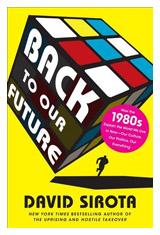
Back to Our Future: How the 1980s Explain the World We Live in Now—Our Culture, Our Politics, Our Everything | by David Sirota | Ballantine Books | 224 pages, $25.00
Readers searching for the thesis of David Sirota’s latest, Back to Our Future, need look no further than the subtitle, set in hot pink on the cover: “How the 1980s Explain the World We Live in Now—Our Culture, Our Politics, Our Everything.” It’s a provocative statement, and Sirota comes with an arsenal to defend it. Backed by extensive research (there are forty-two pages of citations), close readings of what’s become the late-night cable lineup, and reminisces of his upbringing in suburban Philly, Sirota adopts a take-no-prisoners attitude towards cultural history, delving into the decade with a half-fanboy, half-scholarly obsession. The result is a dense book that’s remarkably ambitious in seeing the past several decades through a pinhole camera.
 Rather than suggest that the eighties are a vantage into our present, Sirota believes, somewhat curiously, that the decade never really ended at all. Everything we regard as unique to the aughts is “rooted in the 80s—whether obviously or subtly,” he claims. The Wire is a remake of Colors; the BP spill is Exxon Valdez; Obama is Carter, the Wii is NES, and so on. (His analysis doesn’t venture beyond mainstream culture). On a more abstract level, attitudes we think of as transhistorically American, such as “how our society defines community, responsibility, and personal success” are also now mediated through eighties archetypes. Sirota does an impressive job tracing the lineages of cultural and political trends—conservatism’s appropriation of WWII nostalgia; reality TV’s quiet roots in the eighties—but his thesis often feels strained, refusing to acknowledge a version of history beyond that accepted in the family den.
According to Sirota, the eighties were the culmination of technology and timing. For the first time in history, American households were outfitted with TVs and VCRs, video game consoles and radios; creating the perfect storm of transmission for print and broadcast media, then under the control of fewer than fifty conglomerates. When a new movie came out, it wasn’t only in theaters, it was on lunchboxes and in Happy Meals, and Americans were still unaccustomed to onslaught of mass marketing. Meanwhile, culture was hawking the me-first attitude that would define the decade. Self-help literature was the response to Horatio Algers, and sixties communitarianism was being cast as anti-American.
The short essays included in Back to Our Future’s four sections elaborate on this shift. In the first chapter, Sirota details how sixties values came under attack by the cult of the yuppie. With his blue blazers and pot-smoking parents, Michael J. Fox’s Family Ties character symbolized this rift; and off-screen, the GOP replicated the dynamic in politics. By framing the fifties as quintessentially American, and aligning Democrats with the godless, freewheeling sixties, Republicans set the stage for Reagan conservatism. This proved such an effective tactic that it’s still in use. “Not surprisingly,” Sirota writes, “the goal of today’s Tea Party protesters is a return to the politics of the fifties-worshipping, sixties-bashing 1980s.”
In the second section, Sirota examines the libertarian streak that ran through celebrity culture, detailing how sports stars came to be held in higher regard than their teams. Here, Michael Jordan serves as a metaphor for what Sirota dubs the ‘Great Man Theory of History’—the nominally Nietzschean (but mostly capitalist) idea that history is propelled forward by select individuals. In Gordon Gekko and Nike’s ‘Just Do It’ campaign, Sirota reads the early rise of mass narcissism, now apparent in Wall Street’s blinkered self-perception and the ascendance of reality TV. Sirota is at his best in this chapter, linking today’s cult of self-empowerment to Ayn Rand and Glenn Beck with a fluidity worthy of the latter’s chalkboard, and an intelligence that’s never graced it.
Sirota’s writing is animated and feverishly referential. Armed with a trivia master’s repository of cultural arcana, he deploys David Foster Wallace footnotes to either spell out a point (typically about the details of Pentagon spending or Top Gun interpretations); or, more tediously, to carry on conversations with readers. A typical footnote begins: “The professional screenwriters and amateur film enthusiasts that I know often cite 1986’s Cobra’s first fifteen minutes as the most cartoonish rendering of the rogue cop ever to grace the silver screen…” and continues for nearly a paragraph. Suddenly, as if in a cliché eighties movie, readers are stuck at the nerd table in the cafeteria, privy to fights over cultural minutiae. Sirota is entertaining enough to make reading about Knight Rider or post-Vietnam military history engaging, but a vested interest in his subject matter comes in handy.
It’s not until the final half of the book that Sirota really lets his politics fly. He mounts a convincing, if excessively detailed, case for how politicians manipulating the media manipulationenabled runaway militarism; and traces the evolution of Huxtable-era racial attitudes into contemporary political discourse. (White America is okay with black people, but only if they’re appropriately ‘transcendent.’) By this point, readers are familiar enough with the source material/political subtext/bigger picture structure of Sirota’s arguments to see where he’s going pages before he gets there, and, more significantly, whether they’re willing to go with him. If you’ve still got the energy, one usually is.
That is, until the very last chapter. Invoking Fukuyama’s overplayed ‘end of history’ argument, Sirota wonders if American history really did culminate in the eighties, and if society is doomed to live out the decade, Groundhog Day-style, until further notice. His answer is no: grassroots politics are making a comeback, new college grads are going into public service, and the “1980s outlook is… outdated and inappropriate for the challenges at hand.” And this is where the book’s limitations are most obvious. Sirota uses his formative decade as an instrument for explaining pathologies in the American psyche—greed, rampant individualism—but never convincingly makes the case that these began, or ended, in the eighties. As a work of pop scholarship, Back to Our Future is impressive, but it could benefit from a lighter touch.
Click here for a complete Page Views archive.
Jessica Loudis is a writer and critic living in Brooklyn. Her work has appeared in Bookforum, The Believer, The New Republic, and the San Francisco Chronicle, among other places, and at one point in her life she knew all the words to the Honduran and Jamaican national anthems.