Sign up for the daily CJR newsletter.
“The question that mass amateurization poses to traditional media is ‘What happens when the costs of reproduction and distribution go away? What happens when there is nothing unique about publishing anymore because users can do it for themselves?’ We are now starting to see that question being answered.”—Clay Shirky
“The whole notion of ‘long-form journalism’ is writer-centered, not public-centered.”—Jeff Jarvis
“As a journalist, I’ve long taken it for granted that, for example, my readers know more than I do—and it’s liberating.”—Dan Gillmor
“As career journalists and managers we have entered a new era where what we know and what we traditionally do has finally found its value in the marketplace, and that value is about zero.”—John Paton
“The story is the thing.”—S. S. McClure
One
Ida M. Tarbell, a writer for McClure’s Magazine, a general-interest monthly, was chatting with her good friend and editor, John S. Phillips, in the magazine’s offices near New York’s Madison Square Park, trying to decide what she should take on next.
Tarbell, then forty-three years old, was already one of the most prominent journalists in America, having written popular multipart historical sketches of Napoleon, Lincoln, and a French revolutionary figure known as Madame Roland, a moderate republican guillotined during the Terror. Thanks in part to her work, McClure’s circulation had jumped to about 400,000, making it one of the most popular, and profitable, publications in the country.
Phillips, a founder of the magazine, was its backbone. Presiding over an office of bohemians and intellectuals, this father of five was as calm and deliberative as the magazine’s namesake, S. S. McClure, was manic and extravagant. Considered by many to be a genius, McClure was also just an impossible boss—forever steaming in from Europe, throwing the office into turmoil with new schemes, ideas, and editorial changes. “I can’t sit still,” he once told Lincoln Steffens. “That’s your job and I don’t see how you can do it!”
At McClure’s, there was always, as Tarbell would later put it, much “fingering” of a subject before the magazine decided to launch on a story, and in this case there was more than usual. The subject being kicked around was nothing less than the great industrial monopolies, known as “trusts,” that had come to dominate the American economy and political life. It was the summer of 1901.
The natural choice, in the end, was oil. Tarbell had grown up in Pennsylvania’s oil country; her father had run a business making oil barrels and a small refinery; her brother worked for one of the few remaining competitors in an industry 90 percent dominated by the greatest of all monopolies, the “mother of trusts,” John D. Rockefeller’s Standard Oil Company. She drew up an outline, and Phillips approved. But McClure, recovering from exhaustion, was on a doctor-ordered yearlong rest in Switzerland. “Go over,” Phillips said, “and show the outline to Sam.”
“I want to think it over,” McClure said after Tarbell pitched the idea in a Lausanne hospital. He then announced that they would mull over the story while traveling to Greece, where McClure’s family would spend the winter. “We can discuss Standard Oil in Greece as well as here,” he said. So they headed south, stopping along the way for tours of Italy’s Lake District and Milan—then to rest at the famous Salsomaggiore spa, where they took lengthy mud baths and “steam soaks” and contemplated just who and what they were about to take on.
Finally, eager to get started, Tarbell cut the trip short. Approval in hand, she returned to New York to begin reporting on what stands, to this day, as the greatest business story ever written.
Ah, old media. Good times. Savin’ the worl’. Remember when a single investigative reporter with the temerity to demand a decent living (McClure’s paid more than $1 million for the stories in today’s dollars) could pull the curtain back on one of the most powerful and secretive organizations on the face of the earth, a great lawbreaker as well as a value-creator? Tarbell is credited with triggering the great antitrust case that finally broke up the “octopus” in 1911. But her true greatness lies in how, using a mountain of facts carefully gathered and presented, she could explain to a bewildered and anxious middle class the great economic question of her age.
McClure’s had planned a three-part series, but, as copies flew off the newsstands, it soon became seven parts, then twelve, then a national sensation. New installments became news events in themselves, covered by other papers, including the fledgling Wall Street Journal. “The History of the Standard Oil Company” ended up as a nineteen-part series, quickly turned into a two-volume book. A cartoon in Puck would depict a pantheon of muckrakers with Tarbell as a Joan of Arc figure on horseback. Another contemporary magazine pronounced her “the most popular woman in America.”
No one reading this magazine needs to be told that we have crossed over into a new era. Industrial-age journalism has failed, we are told, and even if it hasn’t failed, it is over. Newspaper company stocks are trading for less than $1 a share. Great newsrooms have been cut down like so many sheaves of wheat. Where quasi-monopolies once reigned over whole metropolitan areas, we have conversation and communities, but also chaos and confusion.
A vanguard of journalism thinkers steps forward to explain things, and we should be grateful that they are here. If they weren’t, we’d have to invent them. Someone has to help us figure this out. Most prominent are Jeff Jarvis, Clay Shirky, and Jay Rosen, whose ideas we’ll focus on here, along with Dan Gillmor, John Paton, and others. Together their ideas form what I will call the future-of-news (FON) consensus.
According to this consensus, the future points toward a network-driven system of journalism in which news organizations will play a decreasingly important role. News won’t be collected and delivered in the traditional sense. It will be assembled, shared, and to an increasing degree, even gathered, by a sophisticated readership, one that is so active that the word “readership” will no longer apply. Let’s call it a user-ship or, better, a community. This is an interconnected world in which boundaries between storyteller and audience dissolve into a conversation between equal parties, the implication being that the conversation between reporter and reader was a hierarchical relationship, as opposed to, say, a simple division of labor.
At its heart, the FON consensus is anti-institutional. It believes that old institutions must wither to make way for the networked future. “The hallmark of revolution is that the goals of the revolutionaries cannot be contained by the institutional structure of the existing society,” Shirky wrote in Here Comes Everybody, his 2008 popularization of network theory. “As a result, either the revolutionaries are put down, or some of those institutions are altered, replaced or destroyed.” If this vision of the future does not square with your particular news preferences, well, as they might say on Twitter, #youmaybeSOL.
And let’s face it, in the debate over journalism’s future, the FON crowd has had the upper hand. The establishment is gloomy and old; the FON consensus is hopeful and young (or purports to represent youth). The establishment has no plan. The FON consensus says no plan is the plan. The establishment drones on about rules and standards; the FON thinkers talk about freedom and informality. FON says “cheap” and “free”; the establishment asks for your credit card number. FON talks about “networks,” “communities,” and “love”; the establishment mutters about “institutions,” like The New York Times or mental hospitals.
The blossoming of new voices, the explosion of conversation, has in fact been breathtaking, a modern marvel. News outlets have been forced to step down from their pedestals, and that’s mostly a good thing. The idea of communities reporting on themselves, pooling knowledge in service of journalism, is indeed attractive.
But if the FON consensus is right, then the public has a problem. You can call it the Ida Tarbell problem, or you can call it the Nick Davies problem. The problem is that journalism’s true value-creating work, the keystone of American journalism, the principle around which it is organized, is public-interest reporting; the kind that is usually expensive, risky, stressful, and time-consuming. Public-interest reporting isn’t just another tab on the home page. It is a core value, the thing that builds trust, sets agendas, clarifies public understanding, challenges powerful institutions, and generates reform. It is, in the end, the point.
Not only does the FON consensus have little to say about public-service journalism, it is in many ways antithetical to it.
For one thing, its anti-institutionalism would disempower journalism. Jarvis and Shirky in particular have reveled in the role of intellectual undertakers/grief counselors to the newspaper industry, which, for all its many failings, has traditionally carried the public-service load (see Pulitzer.org for a laundry list of exposés—on tobacco-industry conspiracies; worker-safety atrocities; Lyndon Johnson’s wife’s dicey broadcasting empire; group-home abuses in New York; redlining in Atlanta; corruption in the St. Paul, Minnesota, fire department, the Rhode Island courts, the Chicago City Council, the University of Kentucky men’s basketball program, and on and on). But their vision for replacing it with a networked alternative, or something else, is hazy at best.
Meanwhile, FON’s practical prescriptions—what it calls engagement with readers—have in practice devolved into another excuse for news managers to ramp up productivity burdens, draining reporters of their most precious resource, the thing that makes them potent: time.
The journalism stakes, then, are large. Just as it was an open question a hundred years ago whether a man like Rockefeller was more powerful than the United States president, it was far from clear only a hundred days ago who was more powerful in the United Kingdom, Rupert Murdoch or the British prime minister. Today, it is clear, thanks largely to reporter Nick Davies and his editors at The Guardian and their long, lonely investigation into the crimes and cover-ups of Murdoch’s News Corp. While the FON consensus is essentially ahistorical—we’re in a revolution, and this is Year III or so—we know journalism is a continuum. What Tarbell did, Davies does, and all great reporters do, always in collaboration with the community. Who else?
Indeed, the News Corp. case offers some intriguing glimpses of a future of news that is an alternative to the FON consensus, about which a word below.
Two
FON thinkers, who emerged only in the last few years, represent a new kind of public intellectual: journalism academics known for neither their journalism nor their scholarship. Yet, the fact is they are filling a void left by an intellectually exhausted journalism establishment, and filling it with crisp, readable—and voluminous—prose that offers to connect journalism to the technocratic vanguard.
Jarvis is author of What Would Google Do? (2009), a networking manifesto and paean to the search company, and Public Parts (2011), on the virtues of “publicness.” Rosen, director of a graduate concentration in New York University’s journalism department (correction: a previous version said he is the department’s chairman; he’s a former chairman), blogger (PressThink), and Tweeter, was a leader of the civic journalism movement (sometimes called public journalism), which predates the mainstreaming of the Internet but shares many traits with the networked journalism school. (Rosen, while certainly in the FON consensus, is actually something of a different breed of cat, as we’ll see.) Likewise, Gillmor (We the Media, 2004; Mediactive, 2010) is an advocate of crowd-sourced, community-involved journalism. Paton, head of the Journal Register Company, a newspaper chain, is the FON practitioner, having implemented many of the social media strategies the thinkers advocate, and certainly adopted its vernacular.
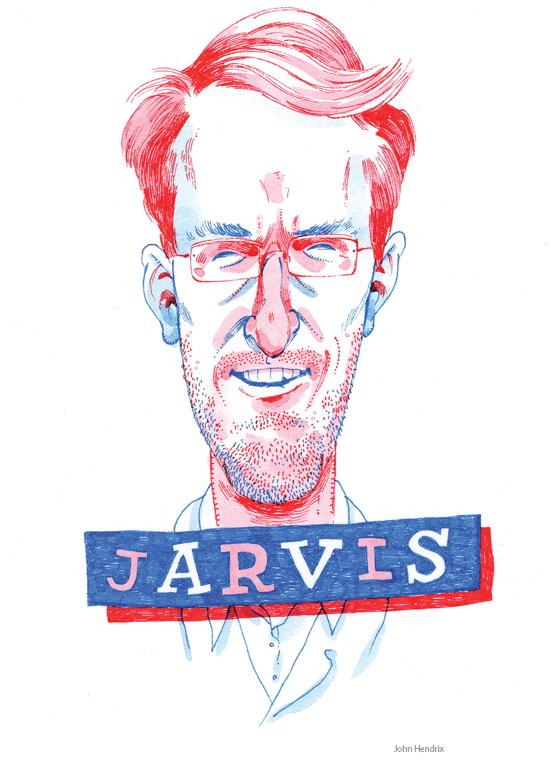
And while power in the media may have been dispersed, it remains a rather small world. Jarvis and Rosen (along with Emily Bell of Columbia’s Graduate School of Journalism) consult for Paton’s JRC. Shirky wrote the forward to Gillmor’s new book. FON thinkers appear on panels together, etc.
What their writings—particularly those of Jarvis and Shirky—share are a belief in the transformative power of networks, both for journalism and indeed for the world; and a related, but not identical, faith in the wisdom of crowds and citizen journalism, in volunteerism over professionalism, in the “journalism as conversation” over traditional models of one-to-many information delivery. The consensus believes that reporters and editors must enter into deep, if not constant, contact with readers via social media, especially Facebook and Twitter. The consensus favors “iterative” journalism—reporting on the fly, fixing mistakes along the way—versus traditional methods of story organization, fact-checking, and copyediting; it favors spontaneity and informality over formal style and narrative forms.
FON thinking has roots in the non-journalism academy, particularly in the notion of so-called peer production, the participation of citizen-amateurs in professionalized activities. Based on ideas promulgated by prominent legal theorist Yochai Benkler, media scholar Henry Jenkins, and Shirky himself, peer-production theory holds that dramatically lowered costs of organizing, communicating, and sharing will upend many sectors of modern life, journalism very much included. Advocates of peer production (also known as social production) often point to such successful open-source collaborations as the Linux operating system and Wikipedia as harbingers of the networked future.
As Shirky writes: “Social production: people you don’t know making your life better, for free.”
Peer production is itself a subset of a larger body of thought about networks and society. It tends to view a wired society as a fundamentally different one—less hierarchical, more democratic, more collaborative, freer, even more authentic—from those that preceded it. Manuel Castells, an important network theorist, contends that technology will transform nothing less than “the process of formation and exercise of power relationships.” Or as Nicholas Negroponte, currently on leave from the Massachusetts Institute of Technology, put it, the Internet is about to “flatten organizations, globalize society, decentralize control, and help harmonize people.”
If some aspects of peer-production theory and its FON offshoot sound familiar—anti-institutionalism; communitarianism laced with libertarianism; a millennial, Age-of-Aquarius vibe; a certain militancy—some scholars have traced its roots to 1960s counterculture. Fred Turner, a Stanford communications theorist and a cautionary voice on the potential of peer production, chronicled the development of a network of 1960s idealists surrounding Stewart Brand, the visionary founder of both the Whole Earth Catalog, the iconic communitarian manual, in 1968, and Wired, a New Economy-era magazine that is still the digital bible, in 1993. These “New Communards,” as Turner calls them, drew from California’s defense-centered research culture as well as the counterculture to become the vanguard of the digital revolution, helping transform the very idea of the computer from a symbol of bureaucracy and control to one of personal and social liberation.
There is a culture gap between the peer-production advocates and professional journalism, it seems safe to say. Where a professional journalist might think “Watergate,” peer-production adherents would think “pre-Iraq War coverage.” Where establishment journalism might fondly recall elegant Wall Street Journal narratives and great regional exposés at The Philadelphia Inquirer and The Miami Herald, FON adherents think “pre-financial crisis Wall Street coverage” and “Gannett.” In this, they have a point. What’s more, peer-production advocates have had to face down some predictably defensive and mule-headed responses from segments of the old guard—curmudgeons, J-school handwringers, public-funding types, and the corporate heads who sucked out value from newspaper companies and now complain about strangers running around on their lawn.
What Shirky, a New York University lecturer and consultant, has brought to the newspaper industry, if nothing else, is a salutatory sense of urgency. Essentially: wake the fuck up. In revolutionary times, Shirky reminds us in a widely quoted 2009 essay on newspapers’ predicament, it is the radicals who are rational, while the voices of caution are, in fact, mad:
Inside the papers, the pragmatists were the ones simply looking out the window and noticing that the real world increasingly resembled the unthinkable scenario. These people were treated as if they were barking mad. Meanwhile the people spinning visions of popular walled gardens and enthusiastic micropayment adoption, visions unsupported by reality, were regarded not as charlatans but saviors.
Like Jarvis, Shirky is a leading proponent of the idea that we are passing through a watershed, not just for our generation or era, but for all of human history. This is the idea of the “Gutenberg parenthesis,” coined by a Danish scholar, that holds that the Internet has the potential to revolutionize human social life to a degree that we cannot now understand, just as Johannes Gutenberg’s printing press paved the way for, eventually, modernity itself.
Shirky argues that our conventional views of work and incentives won’t hold in a new era when the costs of collaboration and sharing are so low. People can, and always have, come together for many reasons. For example, he compares Wikipedia to the Shinto shrine in Ise, Japan, which is periodically torn down and rebuilt by local priests (and whose work, like many Internet toilers, is not recognized by established authority, in this case, UNESCO). “It exists not as an edifice, but as an act of love,” he says. “Wikipedia exists because enough people love it and, more important, love one another in its context.”
In some ways, Shirky is the most subtle and careful member of the FON crew. Many of Shirky’s prescriptions for the economics of journalism are commonsensical and even wise. A point I find inarguable is that while some news models have been found to work in some contexts-—The Wall Street Journal’s pay wall, ProPublica’s fund-raising model (basically, one big donor), Talking Points Memo’s online ad-based system—nothing to date is scalable. There is no news business “model” at all. And who can argue with his call for constant experimentation? “If the old model is broken, what will work in its place?” he asks rhetorically. “The answer is: Nothing will work, but everything might. Now is the time for experiments, lots and lots of experiments. . . .”
If that last bit sounds a bit pat, another aspect of the FON debate is that ideas—even a lack of certainty—are expressed with absolute certitude. In 2010, Shirky discussed the confidence factor in a post mulling whether women “have what it takes to behave like arrogant self-aggrandizing jerks.” He recalls a turning point in his own youth when he bluffed about his drafting skills to the head of a graduate design program he was applying to: “That’s the kind of behavior I mean. I sat in the office of someone I admired and feared, someone who was the gatekeeper for something I wanted, and I lied to his face.”
Of course we know what he means, and it’s not about lying. But in FON debates, a little confidence goes a long way.
Which brings us to Jarvis. The head of the Tow-Knight Center for Entrepreneurial Journalism at CUNY’s Graduate School of Journalism, Jarvis leads by example. Like other FON thinkers, he lives the contradiction of extolling peer production and volunteerism from the security of an institution. It is doubly jarring in Jarvis’s case; an opponent of publicly funded journalism, his journalistic entrepreneurialism is, in fact, publicly subsidized. The “C” in CUNY stands for “City.”
Entrepreneurialism, certainly, is manifest in his many consulting gigs (The Guardian Media Group, The New York Times Company), speaking engagements (Edelman, Hearst, Hill & Knowlton), and self-promotional flair. He is a master of the buzzword—“googlejuice,” “generation G”—and the catchphrase—“customers are now in charge . . . the mass market is dead, replaced by the mass of niches . . . we have shifted from an economy based on scarcity to one based on abundance… small is the new big.”
Indeed, Jarvis presents himself as a walking experiment in social media, from his copious and profane tweets (“Asshole behind me on the Acela is using her phone as a speaker phone. A new frontier of train phone rudeness”[June 9, 2011]; “Hey, T-mobile, fuck your courtesy calls. Give me courtesy service” [February 19]) to providing public updates about his treatment for prostate cancer (“I’m about to see a Sloan-Kettering doctor about my dick; That makes this the most humble day of my life” [July 29, in a joking reference to Rupert Murdoch’s testimony before Parliament]). Jarvis created a spasm of buzz during this summer’s debt ceiling debate when he launched a Twitter protest campaign under the hash tag #fuckyouwashington.
His What Would Google Do? is almost a caricature of network theory, hailing the search company and Internet culture as ushering in new forms of capitalism and society (emphasis mine):
We no longer need companies, institutions, or government to organize us. We now have the tools to organize ourselves. We can find each other and coalesce around political causes or bad companies or talent or business or ideas. We can share and sort our knowledge and behavior. We can communicate and come together in an instant. We also have new ethics and attitudes that spring from this new organization and change society in ways we cannot yet see, with openness, generosity, collaboration, efficiency. We are using the internet’s connective tissue to leap over borders—whether they surround countries or companies or demographics. We are reorganizing society. This is Google’s—and Facebook’s and Craigslist’s—new world order.
This kind of rhetoric reminds us that, when it comes to the future of news, we’re dealing with an issue that is defined by its uncertainty and does not—to say the least—lend itself to empirical analysis. Journalists like facts, data. Here, there aren’t any. We’re in the realm of beliefs (see confidence factor, above).
While much of Jarvis’s journalism advice is less messianic and can be frequently commonsensical (“do what you do best, link to the rest,” etc.), he is, if anything, even more emphatic than Shirky that the old must make way for the new. What the new is is not yet clear, but it will involve technology, networks, entrepreneurialism, iterative journalism, conversations between users, and new forms of disseminating information. In this view, going “digital first,” a phrase gaining currency across journalism, means a radical revision of what news organizations do (my emphasis):
Digital first resets the journalistic relationship with the community, making the news organization less a producer and more an open platform for the public to share what it knows. It is to that process that the journalist adds value. She may do so in many forms—reporting, curating people and their information, providing applications and tools, gathering data, organizing effort, educating participants . . . and writing articles.
The emphasis shifts from fact-gathering and storytelling to other things, like mediating, facilitating, curating. As Jarvis wrote in a 2009 blog post that he said he’d like to have delivered as a speech to a gathering of news executives:
You blew it. . . . So now, for many of you, there isn’t time. It’s simply too late. The best thing some of you can do is get out of the way and make room for the next generation of net natives who understand this new economy and society and care about news and will reinvent it, building what comes after you from the ground up. There’s huge opportunity there, for them.
Old elites must give way to “people”—or at least, “the next generation” of “net natives.” This is Jarvis’s “we,” the “people,” who, in all probability, are not “you.” As he writes in WWGD? with a whiff of menace: “People can find each other anywhere and coalesce around you—or against you.”
Three
To the extent that FON thinkers mau-mau the news business—that’s a good thing. The problem is that FON thinkers (but not Rosen, as we’ll see) sometimes let slip a light regard for journalism itself, that is to say, what journalists actually do.
It’s not just Gillmor’s obsequious catchphrase, “readers know more than I do,” which may be true on some abstract level, sometimes, but on the important matters is often simply untrue. No reader—no community of readers—knew more about Standard Oil than Ida Tarbell, though, it is true, plenty of sources came out of the woodwork to help her along the way. Just so, “readers” could not be expected to know the sweep of the News of the World story and its implications. It’s not that Nick Davies is a genius, but he was working on the story for years, and after three decades in the business he’s well-sourced and may even—dare I say it?—have professional skills or other qualities that some readers, even academics, do not.
But it goes deeper than that.
FON thinkers put forward the idea of news as a commodity, describing it variously as abundant, undifferentiated, and of low value. As a consequence, FON thinking assumes, it won’t ever command much of anything in a market where the costs of distribution are basically zero.
If the argument were that the cost of replicating the news has crashed to zero, that’s one thing. But FON thinkers go further. They assert that news (as opposed to, say, writing about news) is a commodity by its nature.
As Shirky wrote (my emphasis):
One way to escape a commodity market is to offer something that isn’t a commodity. This has been the preferred advice of people committed to the re-invention of newspapers. It is a truism bordering on drinking game material that anyone advising newspapers will at some point say, “All you need to do is offer a product so relevant and valuable the consumer is willing to pay for it!”
This advice is well-meaning. It’s just not much help. The suggestion that newspapers should, in the future, create a digital product users are willing to pay for is merely a restatement of the problem, by way of admission that the current product does not pass that test.
Paywalls, as actually implemented, have not accomplished this. They don’t expand revenue from the existing audience, they contract the audience to that subset willing to pay. Paywalls do indeed help newspapers escape commodification, but only by ejecting the readers who think of the product as a commodity. This is, invariably, most of them.
Set aside the fact that a “subset willing to pay” defines any business’s customer base, anywhere. Notice that Shirky presents the fact that newspapers didn’t charge for news (wonder who gave them that advice?) as the market’s verdict that they couldn’t.
Jarvis, too, describes a media landscape of undifferentiated abundance:
Is there any scarcity left in media? . . . Some argue that trust is scarce. Well I suppose that’s always true, but I now have more sources for news than I have ever had—not just my local newspaper, but The Washington Post, The Guardian, the BBC, bloggers I respect, and more. Is quality still scarce? Yes, of course, but the more content that is made, the more opportunities there are for more people to make good content.
But wherever Jarvis lives, unless it is in Westminster, London, chances are the BBC doesn’t cover it. And does it really follow that the “more content that is made,” the higher the likelihood that someone will, what, cover Pawtucket City Hall? Out of love, perhaps?
I covered Pawtucket City Hall, and you had to pay me.
Seeing news as a commodity, and a near valueless one (Paton above says its value is “about zero”), is a fundamental conceptual error, and a revealing one. A commodity is the same in Anniston, Alabama, as it is in Pawtucket, Rhode Island. Whatever local news is, it’s not that.
As a consequence, FON thinkers have derided subscription pay walls as old-think by a generation that just doesn’t get it. Shirky and Jarvis, in particular, vocally dismissed The Wall Street Journal’s early successful pay wall (a then-heretical, now-vindicated decision made by Dow Jones’s then-CEO Peter Kann), then the Financial Times’s successful pay wall (financial news, somehow, is not a commodity; it’s magic), and other spot successes as anomalies. Nor did they hesitate to point to the collapse of TimesSelect, The New York Times’s early experiment in 2005.
Jarvis, if anything, was even more certain. “The Times killed the service in 2007 and freed its content for a few simple reasons: first, it increased the audience to the paper’s site. . . . Second, the Times could make more money on the advertising shown to digital audiences. Third, . . . ” And so on.
But now look: the new Times paywall, a metered system allowing some free access, but charging for unlimited use, is working. After just four months, 224,000 users were paying for access to the paper’s website, far ahead of projections. As Advertising Age noted, combined with the 57,000 Kindle and Nook subscribers and the roughly 100,000 users whose digital access was sponsored by Ford’s Lincoln division, that meant the paper had monetized close to 400,000 online users. (Another roughly 765,000 print subscribers registered their accounts online.)
And if the argument was that only financial premium papers will be allowed to charge readers, the trend actually is now heading in the other direction, as more and more papers adopt some kind of content-pay system. Even dowdy Lee Enterprises, the Davenport, Iowa-based newspaper chain, announced it was charging small amounts—$1 to $2.95 a month—for access to sites of papers in Wyoming and Montana. Rick Edmonds, the Poynter business blogger, now describes the major players who haven’t adopted a fee system—Gannett, McClatchy, and The Washington Post Company—as “holdouts.”
Is this a panacea? No, Shirky’s right. There isn’t one. Lee shares trade for under a buck. But as many, including Shirky himself elsewhere, have pointed out, news isn’t a commodity, but a “public good”—something that benefits everyone and, in the economic sense, something whose value doesn’t diminish no matter how many people use it (and whether they pay for it or not). Framing the news as a commodity and ultra-abundant makes it easier to give away. It also suggests a lack of understanding of what it takes to produce great beat reporting, let alone accountability journalism.
But we can see now that the news-as-cheap-commodity argument was all along an ideological one couched in economic terms. The idea that “information wants to be free” (a partial quote of Stewart Brand, who well understood information’s value) was a catechism, a rallying cry, voiced by a certain segment of the digital vanguard. Subscription services, “walls,” don’t fit into a networked vision. It’s worth pointing out that the commodity idea gained traction only because of the generalized collapse of news-business advertising models, a collapse that had nothing to do with editorial models. This isn’t to say that the content was good or not good, only that the collapsing ad model had nothing to do with it.
The problem with conceiving of news as a commodity is that it can become a self-fulfilling prophecy. If that is what you think of it, that is surely what it will become. It may be okay for academics to sell this thesis, but shame on journalism executives for buying it.
In his role as provocateur, Jarvis also takes aim at the idea of storytelling. In a video talk at the #140 new-media conference, he adopted the persona of the news professional defending the idea of the story as an arrogant jerk worried about saving his job (emphasis his):
It’s my job as the storyteller to tell you the story, got it? That means I decide what the story is. I decide what goes in it. I decide what doesn’t go in it. I decide what’s the beginning and the end because a story has to have a beginning and an end, so it fits in the hole I put it in. . . . When you question the form of a story, you’re trying to put me out of a job.
Part of Jarvis’s stock-in-trade is to throw bombs and then claim he was mischaracterized by critics, who, having been duly provoked, often do get a bit hot under the collar. After a thinking-out-loud post titled, “The Article as Luxury or Byproduct,” drew criticism, he later protested, in another post:
First, far from denigrating the article, I want to elevate it. When I say the article is a luxury, I argue that using ever-more-precious resources to create an article should be taken seriously and before writing and editing a story we must assure that it will add value. Do most articles do that today? No.
But wait. Jarvis denigrates news as supremely abundant, storytelling as an affectation or, worse, a form of oppression, and professional journalists as hacks; he consigns news organizations to the humble role of curators for people like Jarvis, if they aren’t swept away all together. Then, he tells us he is the article’s greatest friend.
Don’t believe it.
As it happens, opposition to the “article” and to “storytelling” has a long, not-very-distinguished pedigree on the corporatist side of the journalism debate, from bean counters, news bureaucrats, and hacks. Most consequentially, Rupert Murdoch has long derided long-form (that is, in-depth) journalism as an affectation, journalists-writing-for-other-journalists, or, as his biographer Michael Wolff put it, the very idea of journalism as “a higher calling, of blah blah responsibility, of reverential bullshit.” His acquisition of The Wall Street Journal’s parent resulted in a gutting of the paper’s copydesk and page-one storytelling operation, and a rapid increase in news productivity requirements, a victory for “iterative” journalism, and little else.
But Murdoch knows what he’s doing. As journalists from Tarbell to those at the paper Murdoch now owns have demonstrated, the long-form narrative is journalism at its most subversive. One of the most devastating WSJ page-one “leders” of 2000, for instance, chronicled the unlikely rise from obscurity to position of influence at News Corp. of one Wendi Deng, Murdoch’s wife. As it happens, leders are now an endangered species at News Corp.’s WSJ. It figures.
Four
Certainly, FON thinkers express fealty to public-interest reporting, the apple pie of journalism debates. Shirky more than once cites The Boston Globe’s world-changing work over the years on the sexual predations and cover-ups in the Catholic Church as a reminder of the stakes. He frames the debate as between those who believe resources are best expended shoring up existing institutions versus those who believe, like him, that:
. . . the current shock in the media environment is so inimical to the 20th-century model of news production that time spent trying to replace newspapers is misspent effort because we should really be transferring our concern to the production of lots and lots of smaller, overlapping models of accountability journalism, knowing that we won’t get it right in the beginning and not knowing which experiments are going to pan out.
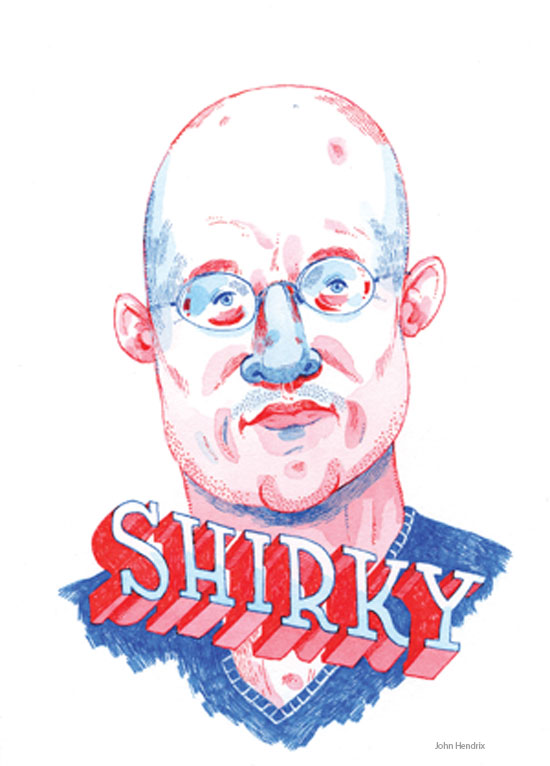
But while Shirky and other FON thinkers argue that upending current structures and institutions is inevitable, I would note that there’s a point at which predicting institutional decline blurs into rooting for it, and then morphs into hastening it along, as the anti-pay wall debate shows. Arguing in favor of experimentation, is, as Shirky might put it, well-meaning, just not very helpful. If this argument is really about public-interest journalism, the only question is, what helps it, and what doesn’t—now, not five hundred years from now.
“We need the new news environment to be chaotic” to facilitate experimentation, Shirky writes. In fact, though, only consultants “need” the news environment to be chaotic. The public, not so much. And who speaks for the public? Jarvis, Shirky & Co., say they do, but as Internet doubter Nicholas Carr and others have noticed, the FON vision of news’s future looks very much like FON thinkers and their acolytes themselves: not just online, but thoroughly plugged-in, following the news with an obsessiveness that would make a wire editor proud, and in jobs that allow, if not encourage, media-centric work lives and even personal lives. This is all to say that no one should kid himself that when old elites fall, new ones won’t take their place.
In that spirit, I’m going to make a bold leap and predict—eenie meenie chili beanie—that for a long time the Future of News is going to look unnervingly like the Present of News: hobbled news organizations, limping along, supplemented by swarms of new media outlets doing their best. It’s not sexy, but that’s journalism for you.
I’ll go further and posit as axiomatic that journalism needs its own institutions for the simple reason that it reports on institutions much larger than itself. It was The New York Times and Gretchen Morgenson, followed quickly by Bloomberg’s late Mark Pittman, who first pried loose the truth about the bailout of American International Group: namely, that it was all about Wall Street, led by Goldman Sachs. Those tooth-and-nail battles were far from fair fights—Goldman’s stock-market capitalization is about fifty (that’s “five-oh”) times that of the Times’s parent. Whether it be called The New York Times or the Digital Beagle, we must have organizations with talent, traditions, culture, bureaucrats, geniuses, monomaniacs, lawyers, health plans, marketing divisions, and ad salespeople—and they must have the clout to take on the likes of Goldman Sachs, the White House, and local political bosses.
The public needs them, and it will have them. As Michael Schudson wisely wrote back in 1995, “Imagine a world, one easily conceivable today, where governments, businesses, lobbyists, candidates, churches, and social movements deliver information directly to citizens on home computers. Journalism is momentarily abolished.” After initial euphoria, confusion and power-shifting, someone credible would have to sort through the news and put it in some understandable form: “Journalism—of some sort—would be reinvented. A professional press corps would reappear. . . .”
Five
It pays to remember that the most triumphalist FON works were written in 2008 and 2009, during journalism’s time of maximum panic. But now, panic time is over. It’s this non-apocalyptic moment that makes Rosen an interesting, non-millennial thinker. There is probably no more fervent believer in the potential of community involvement in journalism than Rosen, a longtime leader of the public journalism movement, which has long envisioned a much more intimate, porous, and, in Rosen’s view, equal relationship between journalism and the public. His What Are Journalists For? (1999) explored well-intentioned, and in many ways successful, mid-1990s public journalism experiments in which newspapers actively participated in trying to solve local problems (e.g., the Dayton Daily News in 1994 led a search for redevelopment solutions after a big defense plant closed).
Similarly, few academics are more withering, and in my view, trenchant, in their critiques of mainstream media and its multiple, florid failings. In writings over the years, he has likened American press culture to a church, and a bureaucratized one, that equates mechanically playing it down the middle with finding truth, and one that takes refuge in platitudes (“if both sides are criticizing us, we must be right”). He has called the press out on its “quest for innocence,” the idea –that it just reports facts and has no stake in them, is not responsible for rendering judgment, and can’t be held responsible, in any way, for outcomes. He has examined how mainstream news cultures tend to marginalize ideas outside certain intellectual boundaries that, when examined, prove not only to be arbitrary, but conveniently allow newsrooms to avoid hard subjects.

While hacks fight geeks over who gets to be called a “journalist,” Rosen has it exactly right when he says the answer is: whoever does the work. “In journalism, real authority starts with reporting. Knowing your stuff, mastering your beat, being right on the facts, digging under the surface of things, calling around to find out what happened, verifying what you heard. ‘I’m there, you’re not, let me tell you about it.’ ”
The value of Rosen’s critique is that it engages news organizations, prods them to be better, rather than dismisses them or sheds crocodile tears about their inevitable-but-oh-so-regrettable demise.
Rosen, to his credit, has also asked hard questions about his own movement. In a post before a blogger conference in 2006, he wrote that it was a “put up or shut up” moment for what he called the users-know-more-than-we-do school. As he wrote, it’s not that the idea isn’t desirable (all agree, it is) or even possible (or, why, he writes “did god give us the Internet”): “But how? I mean exactly how?” He was probably wrong about 2006 being a put-up-or-shut-up moment (after all, peer-production advocates tend to think in five-hundred-year chunks). But it is fair to point out that five years later, the “how” is far from clear. Indeed, in reading FON literature, it is telling that the same anecdotal FON success stories— Talking Points Memo’s US Attorney coverage, “macacca,” “bittergate”— keep reappearing. While Shirky says “nothing will work,” the fact is that it’s peer production that isn’t really working for news, while institutions still do.
This is not to say that the FON debate hasn’t sparked important discussion about what kinds of environments best foster journalism. News pros argue, correctly, that institutions not only provide reporters resources and backup, the best ones create valuable news cultures by aggregating people of a certain mindset. Put it this way: a lot of people are smart and skeptical, but not everyone wants to devote his or her life to uncovering graft at the public buildings authority. On the other hand, peer-production advocates have a point when they wonder whether there is something about news bureaucracies that strangles as much journalism as it nurtures. The question then becomes, though, what replaces them?
Alas, like other FON thinkers, Rosen is quicker to see the upside of disruptive technology than the problems it brings to journalism. In an interview in August with TwistImage, a blog run by a digital marketing executive, Mitch Joel (“digital marketing and media hacking insights and provocations from his always on/always connected world”), Rosen makes a true, if oft-repeated point, that old journalism was captive to its production requirements, the press run, the trucks, etc.
. . . because the thing about journalists is that they have to produce every day and have to reproduce the world every twenty-four hours. And so, the production routine becomes their god, and what journalists before the web actually specialized in was fitting the world, and what they learned that day into the very narrow slots that their production routine made available.
The irony, though, is that in the second decade of the twenty-first century—thanks in no small part to FON thinkers, including, sad to say, Rosen—journalism is now enslaved to a new system of production. Publishing is now possible all the time and in limitless amounts, forever and ever, amen. And, given the market system, and the way the world is, that which is possible has quickly become imperative. Suddenly, the “god” of the old twenty-four-hour news cycle looks like lovely Aphrodite compared to the remorseless Ares that is the web “production routine.” And this new enslavement—trust me here—hurts readers far more even than it does the reporters who must do the blogging, tweeting, podcasting, commenting, and word-cloud formation until all hours of the day and night. This is why, IMHO, journalism is great these days at incremental news, not so good at stepping back and grabbing hold of the narrative. In some circles, this is frowned upon.
The cruel truth of the emerging networked news environment is that reporters are as disempowered as they have ever been, writing more often, under more pressure, with less autonomy, about more trivial things than under the previous monopolistic regime. Indeed, if one were looking for ways to undermine reporters in their work, FON ideas would be a good place to start:
• Remind them, as often as possible, that what they do is nothing special and is basically a commodity.
• Require them to spend a portion of their workday marketing and branding themselves and figuring out their business model.
• Require that they keep in touch with you via Twitter and FB constantly instead of reporting and writing.
• Prematurely bury/trash institutional news organizations.
• Promote a vague faith in volunteerism.
• Describe long-form writing as an affectation or even a form of oppression; that way no one will ever have time to lay out evidence gathered during extensive reporting. Great for crooks, too.
In “The Hamster Wheel” (CJR, September/October 2010) I wrote that in the late 1990s, the 300-odd members of The Wall Street Journal’s unionized editorial staff produced about 22,000 stories a year, while doing epic work and two full-length narratives a day. By 2008, a smaller staff was cranking out nearly twice that amount. Peer-production thinkers, whatever else they have accomplished, have not been able to crack journalism’s law of physics: to do their jobs properly, reporters need time and to think.
Now that we’re done panicking, it’s time for journalism thinkers to turn to the real task: how to re-empower reporters, the backbone of journalism, whoever they are, wherever they may work, in whatever medium, within institutions that can move the needle.
My model would take lessons from The Guardian/News Corp. case and would be institution-centered, network-powered. In that case, traditional investigative reporting broke the story, while social media propelled it to the stratosphere—heights the paper never could have achieved on its own. More than 150,000 people used social media, for instance, to register opposition to News Corp.’s takeover of bSkyb, which was soon scuttled. I don’t know how to secure The Guardian, which is on an ominous track financially, but we should agree, at least, that it must be secured. (Maybe it should take a page from the Times’s playbook, instead of going, as it has announced, “digital first.”) Since buzzwords are the coin of the FON realm, I’ll call it the Neo-Institutional Hub-and-Spoke Model.
A fundamental tenet of my Neo-Institutional school is that it doesn’t care about the institution for its own sake, only for the kind of reporting it produces. I can’t say the same for peer-production theorists and their networks.
Rebuilding or shoring up institutions is going to take some new, new thinking, but it can be done. In the words of that original media guru, Marshall McLuhan: “There is absolutely no inevitability as long as there is a willingness to contemplate what is happening.”
Has America ever needed a media defender more than now? Help us by joining CJR today.