

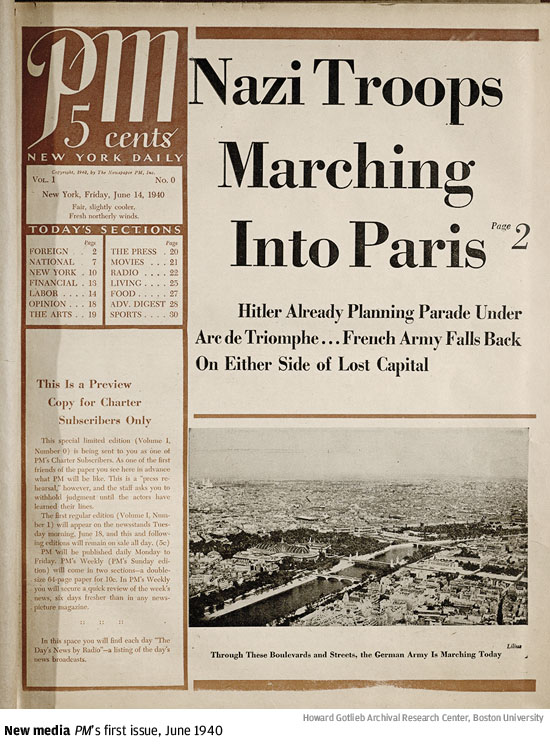
For months, the journalism world had been abuzz with the rumor that Ralph Ingersoll, the editorial genius behind Time, Fortune, and Life, was leaving Henry Luce to start his own publication. Supposedly, it was going to be a daily newspaper in New York City.
Finally, on the morning of June 18, 1940, Ingersoll was poised to unveil what he called not only a new newspaper, but a new kind of paper—a smart, ad-free, unabashedly liberal, writer’s paper, one with the wit of a magazine and the pace of a daily. It was to be called PM, and after many months of fundraising, designing, and fretting, it was ready.
Then, the fire department showed up.
During the frenzy to prepare the first edition, smoke began wisping through the PM newsroom near the corner of Sixth Avenue and Bergen Street in Brooklyn. While firefighters tromped around looking for the source (it turned out to be a minor blaze, most likely from an errant cigarette), Ingersoll and the staff soldiered on and got the paper out.
Because there were no ads, PM had to be priced higher than the other dozen or so dailies in the city. Still, it had attracted more than 150,000 charter subscribers, and vendors at newsstands across the city were waiting. Months of pre-launch hype in other publications ensured that PM would not be overlooked; as the trucks rolled out, customers swarmed them, forcing the drivers to stop and sell copies out the back. People were offering quarters for a paper priced at a nickel. By day’s end, the entire press run—some 450,000 copies—was gone.
The only problem was that the charter subscribers, the ones who were going to sustain the paper until it was profitable, never got copies of that first edition. The PM circulation manager lost the postcards with their names and addresses. This was typical of the way things went at PM. During the eight years it was published, it was a hell of a newspaper but a disaster as a business.
It was an appropriately uneven beginning for a daily with big ambitions that blazed an important, if not widely acknowledged, trail across American journalism, then burned out as quickly as it came. Today’s new-media startups will no doubt recognize in PM’s story the money woes, the chaotic business practices, the struggle to stay alive and deliver a new kind of journalism. Some, too, will identify with its anticorporate ideology. But the real takeaway for our times is PM’s attempt, however flawed, to produce a publication that serves the interests of people who are closer to the bottom than the top in terms of power and influence, the proverbial little guy. That attempt is what made PM great, and worth remembering at a time when the distance between the top and the bottom is as great as it’s ever been.
Marshall Field III was an unlikely backer for an experimental left-wing publication. Born in Chicago, he was a grandson of the original Marshall Field, who had made a fortune with his eponymous department store. In the winter of 1905/06, his father committed suicide and his grandfather died, leaving the boy half of a $75 million estate. After serving in the First Illinois Cavalry during World War I (he was, after all, an accomplished polo player), Field plunged into a life of lavish estates, posh yachts, and quail hunts. When the Depression hit, Field experienced some kind of awakening. Divorced from his second wife, he began psychoanalysis in 1934 and emerged a more mature person with a newfound social conscience. Field became, at mid-life, a liberal. He dissolved his Wall Street investment company and set up the Field Foundation to start giving away his money.
Shortly before that time, he had met Ralph Ingersoll. A graduate of Hotchkiss and Yale, Ingersoll had already been working for more than a decade near the top of the publishing world in Manhattan. He had joined The New Yorker in 1925 as one of Harold Ross’s first hires, and served as Ross’s right-hand man, doing all sorts of editorial chores, including trying to flim-flam writers by stalling on their payments. The New Yorker founder was exasperated in 1930 when Ingersoll defected to the camp of Ross’s great enemy, the Time Inc. president Henry Luce, who made Ingersoll a top editor at Fortune.
During the Great Depression, Ingersoll underwent a personal conversion similar to Field’s; both men even saw the same psychoanalyst, Dr. Gregory Zilboorg. At Fortune, Ingersoll also came under the political tutelage of poet and leftist Archibald MacLeish, who extolled the virtues of the labor movement, socialism, and Franklin Delano Roosevelt.
Through the mid-1930s, Ingersoll grew unhappy with running magazines for Luce, with whose right-wing ideas he increasingly disagreed. In 1937, Ingersoll took a month off and went to his country house in Lakeville, Connecticut, where he came up with the initial prospectus for what would become PM. Meanwhile, he continued to bounce around the Luce empire, and while working at Time he started trying to line up editorial talent for his secret project. It wasn’t hard. In an era when most newspapers and magazines were slashing their staffs, there was no shortage of writers and editors looking for work. Some ten thousand applicants poured in for fewer than 200 jobs.
Securing investors proved more difficult. Ingersoll, who was good at running publications, reckoned he would need about $5 million to launch PM. Eventually, he decided to launch with about $1.5 million, which he raised in fifteen shares of $100,000 each. Field bought two shares.
As editor, Ingersoll wanted others to know where his paper would stand. A phrase from his prospectus, boiled down a bit, became PM’s motto: “We are against people who push other people around.” With that call to arms, Ingersoll attempted to reinvent the daily newspaper. For one thing, PM would be beautiful. It was printed in a single-fold, stapled tabloid format. Stories would not jump from page to page, and color ink would break up the traditional gray columns of type. As in Time, stories would be organized into departments. Ingersoll insisted on high-quality paper and inks, because he wanted the photos to pop from the newsstand murk. In a snub to the Fortune set, there would be no stock tables.
PM would be editorially innovative, too. Reporters chose their own topics and wrote in their own styles. Articles were edited lightly, if at all, in part as a matter of principle and in part out of necessity—Ingersoll acknowledged that he never managed to hire enough staff.
His most radical step was to shun advertising. (This was unusual, but not entirely unprecedented. A few other papers had attempted to survive on circulation alone—notably a Chicago-based paper called Day Book, which had been founded before World War I by E. W. Scripps and lasted about six years.) The business model for the big-city daily paper was, and still is, based on the dual-revenue stream: income from both advertising and circulation. Despite many misgivings, all publishers had come to rely on ads, and most tried to ensure that their products were congenial environments for bringing together advertisers and consumers.
Ingersoll’s views on advertising traced back to his old boss at The New Yorker. Like Harold Ross, Ingersoll believed that advertising corrupted the English language and threatened the independence of journalists by giving them a financial master. In PM, Ingersoll proudly dispensed with seasonal features urging women to buy entire new wardrobes, and proudly attacked wartime contractors without worrying about retaliation from big advertisers like General Motors or Ford.
Instead, Ingersoll planned to charge the top rate for subscriptions and let his readers support the paper. At first, PM went through some wild swings in circulation. From an early high of about 400,000, the demand settled to about 150,000 copies a day—which would have been fine, except that Ingersoll had calculated that his break-even point was about 200,000. He called his goal of 250,000 readers “a substantial figure, but still no more than the weakest of the eight competing New York dailies.” Within months, the initial backers began to panic. Just in time, Field stepped in and bought out all the other investors for about twenty cents on the dollar, emerging as the sole owner for the bargain price of a little over half a million dollars.
With Field’s money and Ingersoll’s ideas, PM made quite a splash. Reporters like I.F. Stone wrote hard-hitting exposés, revealing, among other things, how US companies shipped oil to Hitler’s Germany through Franco’s Spain. The paper also reported that the Red Cross segregated blood donations by race, and it took on big business, isolationist Charles Lindbergh, and the Catholic Church. Cartoonists like Theodor Geisel (later known as Dr. Seuss) lampooned bullies, and Hodding Carter critiqued the press, while Max Lerner handled most of the editorials. Margaret Bourke-White and Weegee shot photos, and Heywood Broun, Ernest Hemingway, Ben Hecht, and Dorothy Parker all contributed articles.
One of PM’s trademarks was its extensive coverage of the labor movement. After making historic breakthroughs in the 1930s, the cio unions in steel, auto, coal, and other heavy industries became important to the war effort. PM’s labor desk got a full page to fill every day, and the paper covered union elections as if they were congressional races.
But content wasn’t all hard news and big ideas. While foregoing spreads on the latest fashions, PM told its readers how to look good in clothes they already owned. Editors also summarized the contents of ads that department stores ran in other newspapers, so readers would not miss out on sales. And PM’s use of photos, graphics, color, and maps would not be equaled until the launch of USA Today in 1982.
The paper was unabashed about what it did and did not support. “PM’s own staff… embraced many shades of political opinion, all vehement,” wrote The New Yorker’s Wolcott Gibbs, but some articles of faith were absolute: the paper was consistently pro-FDR, pro-labor, pro-democracy. And from its earliest days, PM had one paramount enemy: Adolf Hitler. Ingersoll and most of his writers shared the view that Hitler was an unprecedented evil. From that premise, they reached two tragic conclusions. One was that any ally in the fight against Hitler was welcome. Carried to an extreme, this caused most PMers, and many others on the left, to minimize or even deny the brutality and mass killings carried out by America’s ally in Moscow, Joseph Stalin. (This pro-Soviet bent would come back to haunt many PM contributors during the 1950s.)
The other conclusion was that because Hitler was so dangerous, any tactic in opposing him was acceptable. Indeed, years before Joe McCarthy’s Red Scare, PM’s writers led a disturbingly similar witchhunt for supporters of Hitler, using many of the same deplorable tactics: the big accusation based on little evidence; guilt by association; the equation of dissent with treason; disregard for civil liberties; demands that suspects rat out friends and acquaintences. They were running a school for scoundrels.
Over the years, the financial losses at PM mounted, reaching $25,000 a day. For all Ingersoll’s planning, PM was never really on solid ground. It was undercapitalized (“Between the high resolve to create a new kind of newspaper and reality, there was a gap ten million dollars wide,” Ingersoll wrote later), and never managed to hire as many reporters, editors, and photographers as Ingersoll would have liked. It was also overpriced, so it never really caught on among the city’s blue-collar readers whose issues it trumpeted. Though PM could be for the working class, it would never really be of the working class.
Field gave Ingersoll and the editors all the leeway they wanted; he sometimes disagreed with things he read in “his” newspaper, but never interfered. From time to time, though, the publisher had to remind Ingersoll and the rest of the editorial team that there were limits to his generosity. As he once put it, “You know, Ralph, PM is not the New York Philharmonic. It is not an eleemosynary institution. I am not an eleemosynary institution.” Eventually, after losing at least $4 million on PM, Field insisted on a new approach.
On Election Day in 1946, PM announced that it would begin accepting ads. Ingersoll resigned the same day. But even with the new revenue, the paper still could not attract enough readers to break even, and in the spring of 1948, Field sold it. The new owners renamed the paper The New York Star, ran it for a while, and folded it for good in January 1949.
It remains an open question whether PM’s collapse was inevitable. Many saw its demise as proof that a newspaper could not depend solely on circulation revenue, when all the competition had money coming in from circulation plus ads. Ingersoll also refused to recognize a basic fact: readers like ads—or, at least, some readers like some ads some of the time. In all probability, PM could have survived without major changes if Ingersoll had raised more money to begin with, and if the people in charge had figured out a way to peel more readers away from the Daily News—perhaps with more sports, scandal, or sex.
In the end, the collapse of PM dumped a lot of talent on the market. Marshall Field turned his full attention to his hometown and bought the Chicago Times in 1947 to provide a liberal alternative to the arch-conservative Tribune. (Field later merged it with the Sun and lost $25 million until the Sun-Times began paying off in the 1950s.) Ingersoll decamped for the wilds of northwestern Connecticut and reinvented himself as the publisher of a group of medium-size monopoly newspapers. I. F. Stone went on to found his famous Weekly, and the rest of the PM gang dispersed, but most did not go far, working for newspapers or magazines in New York City. As they told anyone who would listen, when PM died, American journalism became less progressive, less attractive, and less interesting.
Christopher B. Daly