

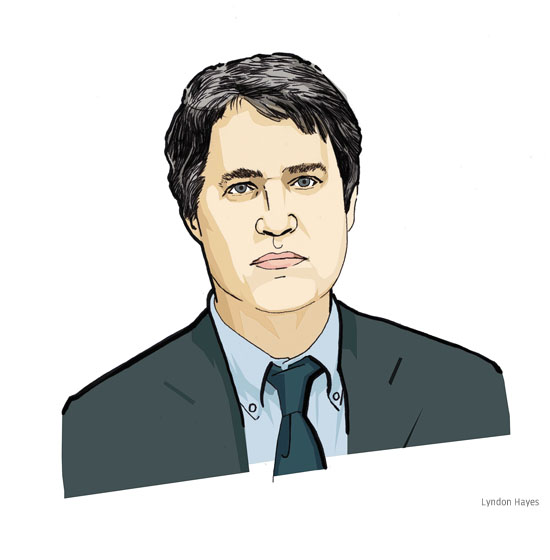
Mike Hudson began reporting on the subprime mortgage business in the early 1990s when it was still a marginal, if ethically challenged, business. His work on the “poverty industry” (pawnshops, rent-to-own operators, check-cashing operations) led him to what were then known as “second-lien” mortgages. From his street-level perspective, he could see the abuses and asymmetries of the market in a way that the conventional business press could not. But because it ran mostly in small publications, his reporting was largely ignored. Hudson pursued the story nationally, via a muckraking book, Merchants of Misery (Common Courage Press, 1996); in a 10,000-word expose on Citigroup-as-subprime-factory, which won a Polk award in 2004 for the small alternative magazine Southern Exposure; and in a series on the subprime leader, Ameriquest, co-written as a freelancer, for the Los Angeles Times in 2005. He continued to pursue the subject as it metastasized into the trillion-dollar center of the Financial Crisis of 2008—briefly at The Wall Street Journal and now at the Center for Public Integrity. Hudson, 5250, is the son of an ex-Marine and legendary local basketball coach. He started out on rural weeklies, covering championship tomatoes and large fish and such, even produced a cooking column. But as a reporter for The Roanoke Times he turned to muckraking and never looked back. CJR’s Dean Starkman interviewed Hudson in the spring of 2011.
Follow the ex-employees
The great thing about The Roanoke Times was that there was an emphasis on investigation but there was also an emphasis on storytelling and writing. And they would bring in lots of people like Roy Peter Clark and William Zinsser, the On Writing Well guy. The Providence Journal book, the How I Wrote the Story, was a bit of a Bible for me.
As I was doing a series on poverty in Roanoke, one of the local legal aid attorneys was like, “It’s not just the lack of money—it’s also what happens when they try to get out of poverty.” He said basically there are three ways out: they bought a house, so they got some equity; they bought a car so they could get some mobility; or they went back to school to get a better job. And in every case, he had example after example of folks, who because they were doing just that, had actually gotten deeper in poverty, trapped in unbelievable debt.
His clients often dealt with for-profit trade schools, truck driving schools that would close down; medical assistant’s schools that no one hired from; and again and again they’d be three, four, five, eight thousand dollars in debt, and unable to repay it, and then of course prevented from ever again going back to school because they couldn’t get another a student loan. So that got me thinking about what I came to know as the poverty industry.
I applied for an Alicia Patterson Fellowship and proposed doing stories on check-cashing outlets, pawn shops, second-mortgage lenders (they didn’t call themselves subprime in those days). This was ’91. We didn’t have access to the Internet, but I came across a wire story about something called the Boston “second-mortgage scandal,” and got somebody to send me a thick stack of clips. It was really impressive. The Boston Globe and other news organizations were taking on the lenders and the mortgage brokers, and the closing attorneys, and on and on.
I was trying to make the story not just local but national. I had some local cases involving Associates [First Capital Corp., then a unit of Ford Motor Corp.]. Basically, it turned out that Ford Motor Company, the old-line carmaker, was the biggest subprime lender in the country. The evidence was pretty clear that they were doing many of the same kinds of bait-and-switch salesmanship and, in some cases, pure fraud, that we later saw take over the mortgage market. I felt like this was a big story; this is the one! Later, investigations and Congressional hearings corroborated what I was finding in ’94, ’95, and ’96. And it seems so self-evident now, but I learned that finding ex-employees often gives you a window into what’s really going on with a company. The problem has always been finding them and getting them to talk.
I spent the better part of the ‘90s writing about the poverty industry and about predatory lending. As a reporter you don’t want to be defined by one subject. So I was actually working on a book about the history of racial integration in sports, interviewing old Negro-league baseball players. I was really trying to change a little bit of how I was moving forward career-wise. But it’s like the old mafia-movie line: every time I think I’m out, they pull me back in.
Subprime goes mainstream
In the fall of 2002, the Federal Trade Commission announced a big settlement with Citigroup, which had bought Associates, and at first I saw it as a positive development, like they had nailed the big bad actor. I’m doing a 1,000-word freelance thing, but of course as I started to report I started hearing from people who were saying that this settlement is basically giving them absolution, and allowed them to move forward with what was, by Citi standards, a pretty modest settlement. And the other thing that struck me was the media was treating this as though Citigroup was cleaning up this legacy problem, when Citi itself had its own problems. There had been a big magazine story about [Citigroup Chief Sanford I.] “Sandy” Weill. It was like “Sandy’s Comeback.” I saw this and said, ‘Whoa, this is an example of the mainstreaming of subprime.’
I pitched a story about how these settlements weren’t what they seemed, and got turned down a lot of places. Eventually I went to Southern Exposure and called the editor there, Gary Ashwill, and he said, “That’s a great story, we’ll put it on the cover.” And I said, “Well how much space can we have?” and he said, “How much do we need?” That was not something you heard in journalism in those days.
I interviewed 150 people, mostly borrowers, attorneys, experts, industry people, but the stuff that really moves the story are the former employees. Many of them had just gotten fired for complaining internally. They were upset about what had gone on—to some degree about how the company treated them, but usually very upset about how the company had pressured them and their co-workers to mistreat their customers.
As a result of the Citigroup stuff, I got a call from a filmmaker [James Scurlock] who was working on what eventually became Maxed Out, about credit cards and student loans and all that kind of stuff. And he asked if I could go visit, and in some cases revisit, some of the people I had interviewed and he would follow me with a camera. So I did sessions in rural Mississippi, Brooklyn and Queens, and Pittsburg. Again and again you would hear people talk about these bad loans they got. But also about stress. I remember a guy in Brooklyn, not too far from where I live now, who paused and said something along the lines of: ‘You know I’m not proud of this, but I have to say I really considered killing myself.’ Again and again people talked about how bad they felt about having gotten into these situations. It was powerful and eye-opening. They didn’t understand, in many cases, that they’d been taken in by very skillful salesmen who manipulated them into taking out loans that were bad for them.
If one person tells you that story, you say okay, well maybe it’s true, but you don’t know. But you’ve got a woman in San Francisco saying, “I was lied to and here’s how they lied to me,” and then you’ve got a loan officer for the same company in suburban Kansas saying, “This is what we did to people.” And then you have another loan officer in Florida and another borrower in another state. You start to see the pattern.
People always want some great statistic [proving systemic fraud], but it’s really, really hard to do that. And statistics data doesn’t always tell us what happened. If you looked at some of the big numbers during the mortgage boom, it would look like everything was fine because of the fact that they refinanced people over and over again. So essentially a lot of what was happening was very Ponzi-like—pushing down the road the problems and hiding what was going on. But I was not talking to analysts. I was not talking to high-level corporate executives. I was not talking to experts. I was talking to the lowest level people in the industry— loan officers, branch managers. I was talking to borrowers. And I was doing it across the country and doing it in large numbers. And when you actually did the shoe-leather reporting, you came up with a very different picture than the PR spin you were getting at the high level.
One day Rich Lord [who had just published the muckraking book, American Nightmare: Predatory Lending and the Foreclosure of the American Dream, Common Courage Press, 2004) and I went to his house. We were sitting in his study. Rich had spent a lot of time writing about Household [International, parent of Household Finance], and I had spent a lot of time writing about Citigroup. Household had been number one in subprime, and then CitiFinancial/Citigroup was number one. This was in the fall of 2004. We asked, well, who’s next? Rich suggested Ameriquest.
I went back home to Roanoke and got on the PACER—computerized court records—system and started looking up Ameriquest cases, and found lots of borrower suits and ex-employee suits. There was one in particular, which basically said that the guy had been fired because he had complained that Ameriquest business ethics were terrible. I just found the guy in the Kansas City phone book and called him up, and he told me a really compelling story. One of the things that really stuck out is, he said to me, “Have you ever seen the movie Boiler Room [2000, about an unethical pump-and-dump brokerage firm]?”
By the time I had roughly ten former employees, most of them willing to be on the record, I thought: this is a really good story, this is important. In a sense I feel like I helped them become whistleblowers because they had no idea how to blow the whistle or what to do. And Ameriquest at that point was on its way to being the largest subprime lender. So, I started trying to pitch the story. While I had a full-time gig at the Roanoke Times, for me the most important thing was finding the right place to place it.
The Los Angeles Times liked the story and teamed me with Scott Reckard, and we worked through much of the fall of 2004 and early 2005. We had thirty or so former employees, almost all of them basically saying that they had seen improper, illegal, fraudulent practices, some of whom acknowledged that they’d done it themselves: bait-and-switch salesmanship, inflating people’s incomes on their loan applications, and inflating appraisals. Or they were cutting and pasting W2s or faking a tax return. It was called the “art department”—blatant forgery, doctoring the documents. You know, it was pretty eye-opening stuff. One of the best details was that many people said they showed Boiler Room—as a training tape! And the other important thing about the story was that Ameriquest was being held up by politicians, and even by the media, as the gold standard—the company cleaning up the industry, reversing age-old bad practices in this market. To me, theirs was partly a story of the triumph of public relations.
Leaving Roanoke
I’d been in Roanoke almost 20 years as a reporter, and so, what’s the next step? I resigned from the Roanoke Times and for most of 2005 I was freelancing fulltime. I made virtually no money that year, but by working on the Ameriquest story, it helped me move to the next thing. I interviewed with The Wall Street Journal [and was hired to cover the bond market]. Of course I came in pitching mortgage-backed securities as a great story. I could have said it with more urgency in the proposal, but I didn’t want to come off as like an advocate, or half-cocked.
Daily bond market coverage is their bread-and-butter, and it’s something that needs to be done. And I tried to do the best I could on it. But I definitely felt a little bit like a point guard playing small forward. I was doing what I could for the team but I was not playing in a position where my talents and my skills were being used to the highest.
I wanted to do a documentary. I wanted to do a book [which would become The Monster: How a Gang of Predatory Lenders and Wall Street Bankers Fleeced America—and Spawned a Global Crisis, Times Books, 2010]. I felt like I had a lot of information, a lot of stuff that needed to be told, and an understanding that many other reporters didn’t have. And I could see a lot of the writing focused on deadbeat borrowers lying about their income, rather than how things were really happening.
Through my reporting I knew two things: I knew that there were a lot of predatory and fraudulent practices throughout the subprime industry. It wasn’t isolated pockets, it wasn’t rogue lenders, it wasn’t rogue employees. It was really endemic. And I also knew that Wall Street played a big role in this, and that Wall Street was driving or condoning and/or profiting from a lot of these practices. I understood that, basically, the subprime lenders, like Ameriquest and even like Countrywide, were really just creatures of Wall Street. Wall Street loaned these companies money; they then made loans; they off-loaded the loans to Wall Street; Wall Street then sold them [as securities to investors]. And it was just this magic circle of cash flowing. The one thing I didn’t understand was all the fancy financial alchemy—the derivatives, the swaps, that were added on to put them on steroids.
It’s clear that people inside a company, one or two or three people, could commit fraud and get away with it, on occasion, despite the best efforts of a company. But I don’t think it can happen in a widespread way when a company has basic compliance systems in place. The best way to connect the dots from the sleazy practices on the ground to people at high levels was to say, okay, they did have these compliance people in place; they had fraud investigators, loan underwriters, and compliance officers. Did they do their jobs? And if they did, what happened to them?
In late 2010, at the Center for Public Integrity, I got a tip about a whistleblower case involving someone who worked at a high level at Countrywide. This is Eileen Foster, who had been an executive vice president, the top fraud investigator at Countrywide. She was claiming before OSHA that she was fired for reporting widespread fraud, but also for trying to protect other whistleblowers within the company who were also reporting fraud at the branch level and at the regional level, all over the country. The interesting thing is that no one in the government had ever contacted her! [This became “Countrywide Protected Fraudsters by Silencing Whistleblowers, say Former Employees,” September 22 and 23, 2011, one of CPI’s best-read stories of the year; 60 Minutes followed with its own interview of Foster, in a segment called, “Prosecuting Wall Street,” December 14, 2011.] It was very exciting. We worked really hard to do follow-up stories. I did about eight stories afterward, many about General Electric, a big player in the subprime world. We found eight former mortgage unit employees who had tried to warn about abuses and whom management had shunted aside.
I just feel like there needs to be more investigative reporting in the mix, and especially more investigative reporting—of problems that are going on now, rather than post-mortems or tick-tocks about financial disasters or crashes or bankruptcies that have already happened.
And that’s hard to do. It takes a real commitment from a news organization, and it can be a high-wire thing because you’re working on these stories for a long time, and market players you’re writing about yell and scream and do some real pushback. But there needs to be more of the sort of early warning journalism. It’s part of the big tent, what a newspaper is.

And the fraud machine grinds on, doesn't it?
Hudson has long been one of the best in the business, staying on this story even after the "reforms" and settlements of the late '90s. The Monster is a must-read.
Strange how so few national news outlets have covered this. Odder still that prosecutors have done so very little to collar the perps.
One would almost think that the business practices Hudson has exposed are not some cancer on our economic body, but part and parcel of the capitalist system as it is now understood and practiced in the U.S..
#1 Posted by Edward Ericson Jr., CJR on Thu 3 May 2012 at 12:46 PM
"Strange how so few national news outlets have covered this. Odder still that prosecutors have done so very little to collar the perps.
One would almost think that the business practices Hudson has exposed are not some cancer on our economic body, but part and parcel of the capitalist system as it is now understood and practiced in the U.S."
Considering the way the government treats ">its whistleblowers (see ryan's quick write up of a devastating washington post article here) yeah, if you hand over evidence of crime, they try to stick you with a 30 month jail sentence, deny you access to whistleblower status (no percentage of recovery as reward here), and the judge ups your sentence to 40 months to teach you (and other potential whistleblowers) a lesson. Meanwhile, the guy you committed your crimes on behalf for (Igor Olenicoff) has to pay a $52 million fine, suffer 2 years probation, and serve 120 hours of community service.
This is your government: your choices are the rotten Obama justice department and the bottom of the septic tank Republican justice dept.
And it's a pretty great system, if you're rich.
#2 Posted by Thimbles, CJR on Thu 3 May 2012 at 08:04 PM
oooo, bugger my Time "Why Is the UBS Whistle-Blower Headed to Prison?" link over some commas will you? Fine.
I'll just post the post link directly and the Forbes link to the one that got away here.
#3 Posted by Thimbles, CJR on Thu 3 May 2012 at 09:34 PM
"Poor" people in America are "poor" (if obese people can be considered "poor") because they do stupid things. Like refusing to work and like borrowing money on stupid terms instead of saving money and spending wisely.
If we banned high-interest lending entirely, then criminals would take over and the leg breakers would run the high-risk loan business.
What the liberals don't understand (or refuse to concede) is that there is a demand for credit, just as there is demand for alcohol, cocaine and heroin. You CAN'T regulate this demand out of existence. It WON'T work.
Just like the Prohibition didn't work and just like the "War on Drugs" will never work.
ECON 101.
If you clamp down on legitimate lenders and make it unprofitable for them to do business, they won't lend the money. Then these "poor" people will turn to illicit sources and interest rates will increase as fast as the crime rates will.
The way to minimize the adverse social consequences of high-risk, high-interest borrowing is make people accountable. Stop doling out money and Snickers bars and force these people to take care of themselves. This would put and end to most of it.
#4 Posted by padikiller, CJR on Fri 4 May 2012 at 09:57 PM
"If we banned high-interest lending entirely, then criminals would take over and the leg breakers would run the high-risk loan business."
I smell the smoke of a straw man. Did someone let padi play with the matches again?
Nobody has claimed high interest consumer lending should be banned, though perhaps a case could be made for legislative steps to mitigate the harm caused.
And perhaps the economy would be more stable and people more better off if we didn't promote the economic conditions which made credit products a necessity.
But no one is claiming that high interest products, sub prime products, payday loans, etc... are inherently bad.
That's the lazy style of argument which you are fond of.
Cont.
#5 Posted by Thimbles, CJR on Sat 5 May 2012 at 02:12 PM
"If we banned high-interest lending entirely, then criminals would take over and the leg breakers would run the high-risk loan business."
I smell the smoke of a straw man. Did someone let padi play with the matches again?
Nobody has claimed high interest consumer lending should be banned, though perhaps a case could be made for legislative steps to mitigate the harm caused.
cont.
#6 Posted by Thimbles, CJR on Sat 5 May 2012 at 02:13 PM
(Really Mr. CJR spam filter? We're going to put posts containing two links in the spam kennel now? I has a sad.)
And perhaps the economy would be more stable and people more better off if we didn't promote the economic conditions which made credit products a necessity.
But no one is claiming that high interest products, sub prime products, payday loans, etc... are inherently bad.
That's the lazy style of argument which you are fond of.
All we're asking for is that the institutions which offer these products don't employ art departments (as detailed in the LA Times, Mike Hudson story above) and other tools of fraud to push systemically dangerous products onto the market, products which benefit NO ONE except the bonuses of the bankers, brokers, and raters which made them.
Cont.
#7 Posted by Thimbles, CJR on Sat 5 May 2012 at 02:32 PM
Oookay.
It appears whatever I write is going into the spam kennel now.
Cheers.
#8 Posted by Thimbles, CJR on Sat 5 May 2012 at 02:45 PM
@Mike Hudson - please stop by Yves Smith's (Econned) NC (naked capitalism) blog . There are a lot of us there who are among the few who understand what happened and how totally useless the Obama DOJ is on this (among other things). The huge shame is that despite your work and the work of others to make clear how the cycling of money thru securitization of the garbage loans with AAA bond ratings allowed the creation of massive fraudulent credit which in the end destroyed the credit system, wrecked the economy and ruined investors and banks worldwide, the MSM continues to this day to perpetuate the 'move along, nothing to see, this is about a lot of deadbeats' meme, rather than exposing it for what it was -- massive, massive fraud.
Unfortunately, Obama and his DOJ were worse than useless so nobody has been prosecuted and we are doomed to see even worse a bit further down the road, because the rot has not been removed from the financial services industry and they own Congress and the president and the courts.
Mike, I'm sure you will be on this beat for the rest of your life!
#9 Posted by Norcal_Steve, CJR on Sat 5 May 2012 at 04:41 PM
padi, i think you need to ask yourself why we ended up having to pay trillions of taxpayer money to bail out the banks if this was a matter of a few (or many deadbeats). Why did the banks keep pushing the originators to make billions of dollars worth of loans to anybody who could breathe at the top of the market.
They are in the risk business - did they not understand the risk of offering no money down house loans at the top of a bubble market? Or did they not care because they were making so much in bonuses for packaging loans and selling them quickly to pass the risk on to their counterparties who bought the bonds (because the banks paid the rating agencies to look the other way and rate garbage as AAA bonds. Do you understand that the AAA rating is reserved for debt like US Treasuries?).
No, this story is about massive fraud in financial securities and also the mortgage servicers file false (ie fradulent) documents in almost every forclosure case, and rob home owners in trouble and the investors who own the loans with totally bogus accounting.
Wake up - the whole system is rotten to the core and even now the bad guys are smiling and getting paid mucho. Just ore huge bills for taxpayers are waiting down the road, my friend.
#10 Posted by Norcal_Steve, CJR on Sat 5 May 2012 at 05:06 PM
Thimbles whines: It appears whatever I write is going into the spam kennel now.
padikiller notes: Maybe if you didn't pepper every thread with fifteen 600 word clippings from "rortybomb.blither.net" your fate would be a different one...
Nobody wants to read 7 of your posts in a row.
#11 Posted by padikiller, CJR on Mon 7 May 2012 at 09:05 AM
Where this story completely falls short for me is the reporters refusal to identify the causation of the abuse he documents. If you don't have the Community Reinvestment Act that sets quotas for subprimes banks never learn about this market. If you don't have Fannie Mae and Freddie Mac clearing the books of groups like Citibank by providing an unending supply of liquidity for all those second mortgages how can they write them? You only write a bad mortgage because you know there is a schmuck to sell it to. The schmuck was the US taxpayer holding the bad for Fannie and Freddie. Where is that in this great piece of investigative journalism? If Citibank has to keep those mortgages they go under.
No reason to even mention the fact that the exclusion of real estate profits from capital gains in 1997 fueled a speculative bubble when talking about the meltdown. I appreciate the knowledge about the corruption, but it doesn't take place without Fannie and Freddie and the Community Reinvestment Act.
#12 Posted by Dave Thomas, CJR on Mon 7 May 2012 at 09:24 AM
@Norcal: We didn't "have to" bail out the banks or any other failing businesses.
And what "fraud"?
Sure there will aways be fraudsters, just as there will always be a certain percentage of criminals. But WHO exactly committed WHAT specific act of "fraud" that is going unpunished?
The meltdown came BECAUSE of the Gubmint and DESPITE the intensive regulation of and direct intervention into the financial markets.
The Gubmint decided to attempt to eliminate risk in financial investments first through regulation, then through direct insurance of investments, and finally through bailouts. A large percentage of idiotic Americans have come to expect that they can't lose money, and when the Reality Bell tolls -when the crap hits the fan and they do lose money - they immediately suppose that a "crime" has occurred and that the Gubmint owes them something.
Indeed the Thimbilistic Chittumites - the silliest of the leftist crowd - think that the ONLY way to be "fair" is filter all commerce though the treasury under the oversight of Gubmint bureaucrats. They believe that a company that makes money is stealing the money from the treasury, the consumers and the workers. Conversely, a company that loses money (excepting "green" companies that Obama funds) has committed a "fraud". Either way, these daft lestist loonies (who can no longer be called "commies" under Pravda's.. er, I mean CJR's comment censorship policy) believe that somebody should go to jail.
And the Gubmint fixes everything in Chittumland. Indeed, as one of the founders of Thimbilistic Chittumism has proclaimed here, he believes that the proper role of the Gubmint is to actually "oppose" business. He went further to equate doing business to engaging in "criminal activity".
People need to experiences CONSEQUENCES of their conduct. Only this will make things better for society.
The lender who committed fraud needs to lose his job and go to jail.
The borrower who committed fraud needs to lose his house and go to jail.
The investor who invested imprudently needs to lose his money, and the investor who invested wisely needs to make money.
Using the public treasury to prevent the adverse ramifications of idiotic behavior is not only stupid, but counterproductive and unjust.
#13 Posted by padikiller, CJR on Mon 7 May 2012 at 09:29 AM
"Where this story completely falls short for me is the reporters refusal to identify the causation of the abuse he documents. If you don't have the Community Reinvestment Act that sets quotas for subprimes banks never learn about this market."
Dear lord, search the archives. This has been debunked since 2009 on a REGULAR basis.
"padikiller notes: Maybe if you didn't pepper every thread with fifteen 600 word clippings from "rortybomb.blither.net" your fate would be a different one...
Nobody wants to read 7 of your posts in a row."
There are people I can accept lectures from. You ain't one, guy who writes 7 indistinguishable posts on 7 very distinguishable topics. Whatever happened to the oppressed little peasant screaming "Censorship! Censorship! Why do you leftists all have to resort to unforgivable censorship!? HUH?!?!"
Guess it's all good when it's a leftist getting censored, hypocrite.
Back to the subject of skipping records:
"And what "fraud"?
Sure there will aways be fraudsters, just as there will always be a certain percentage of criminals. But WHO exactly committed WHAT specific act of "fraud" that is going unpunished?"
You know, nevermind. If MIchael Hudson's reporting, linked above, from 2005 to now on the various art departments and scam centers hasn't been enough to convince you, nothing will. You aren't interested in being convinced by evidence.
Which puts you in the company of Obama's "socialist" justice department:
http://www.thedailybeast.com/newsweek/2012/05/06/why-can-t-obama-bring-wall-street-to-justice.html
#14 Posted by Thimbles, CJR on Mon 7 May 2012 at 02:16 PM
More on the topic of the justice department:
http://www.mcclatchydc.com/2012/05/07/147755/4-years-after-wall-street-crash.html
And the "leg breaker" tactics being employed by "legit" debt collectors:
http://www.mcclatchydc.com/2012/05/06/147886/debtors-seethe-sue-over-collectors.html
#15 Posted by Thimbles, CJR on Mon 7 May 2012 at 02:35 PM
Painting with a broad brush, American history is a string of banking (usually real estate-related) scandals. There are a lot of interests who like it this way and are trying to get the next one started. There are usually enough padikillers around and folks who staff the industry, who originate transactions, who like their paychecks to get it going again. While each one is different, it is usually just nuance. What they have in common is that cheating gets rewarded in the extreme. The "no-doc" loan was really just a system that eliminated steps (income verification) that originators weren't doing honestly anyway. Nominal "gatekeepers" didn't get paid to keep people from getting through the gate. They got paid to push them through. Their bosses got paid to widen the gate, or ultimately, to get rid of the gate altogether. The CRA is a convenient scapegoat - "the government made us do it" - but clearly was not a primary cause of endemic bad lending. What does cause it is that a lot of people - bottom to top - make a lot of money doing it. Retail channel subprime branch managers could make a million a year - on the books, before vendor kickbacks (that they might have to share with their managers). Their sales people (frequently, financial disasters themselves) could easily make six figures following the script and working the system ("art department," bait and switch, "refi churning"). The real cause is that bad lending is a money machine, until it isn't, but then the mess is somebody else's problem.
#16 Posted by Jack Straw, CJR on Tue 8 May 2012 at 09:53 AM
Jack...
Cheating only gets "rewarded in the extreme" when the Gubmint doles out money to cheats... An outcome I cannot possibly have decried any more forcefully.
I advocate PUNISHMENT for cheats.
Don't dump this bailout BS on me!
Using the treasury to keep people from feeling the consequences of their own stupidity or malfeasance is an idiotic proposition...
Whether it is baling out financial institutions or fraudulent borrowers.
#17 Posted by padikiller, CJR on Tue 8 May 2012 at 12:41 PM
"Cheating only gets "rewarded in the extreme" when the Gubmint doles out money to cheats... An outcome I cannot possibly have decried any more forcefully."
That's ideological libertarian hooey. While government policy via HUD, the Fed, state and local governments certainly do have a distorting macro-effect on what I'm talking about - purposeful bad lending - they do not effect the basic economics of reward. The well-known lenders' had compensation policies and internal production "ethics" that paid cheaters well, that discouraged hard looks at quality, and looked the other way at solicitation of commercial bribery (top management jobs frequently had better off-the-books pay than their official salary). These companies also generally did better in the higher interest rate environment of pre-2003 than the one that followed. Bail-outs did not cause this, except in the sense that the bail-out makes it nearly certain it will re-occur.
Delete "only" and you have a point approaching reason, but as it stands, you are ideologically blind. I'm a pro-market guy, and I don't think it would be a good development to have government perform gate-keeper functions on "policing" loan quality as to security value, title and escrow integrity, credit quality, risk-pooling, etc., but the when those functions are compromised by 1) competitive bidding including kick-backs; and 2) only getting paid when transactions close, the one reasonable observation to make is that it is a wonder it works at all: that enough people are not crooked.
#18 Posted by Jack Straw, CJR on Tue 8 May 2012 at 02:37 PM
he saw the info. on predatorix.com now you can see it on conorix.com
#19 Posted by avram, CJR on Tue 8 May 2012 at 04:21 PM
What you've got to understand about padi is that he's not interested in white collar crime and wrongdoing. You can have a discussion with rational people about the shortcomings of unsupervised market anarchy.
This?
"The well-known lenders' had compensation policies and internal production "ethics" that paid cheaters well, that discouraged hard looks at quality, and looked the other way at solicitation of commercial bribery (top management jobs frequently had better off-the-books pay than their official salary)."
Even highly free market economists made these claims in 2005:
http://chronicle.com/article/Larry-Summersthe/124790/
"Rajan pointed out that the structure of financial-sector compensation, in combination with complex financial products, gave bankers huge cash incentives to take risks with other people's money, while imposing no penalties for any subsequent losses. Rajan warned that this bonus culture rewarded bankers for actions that could destroy their own institutions, or even the entire system, and that this could generate a "full-blown financial crisis" and a "catastrophic meltdown.""
Rational people can agree. A rational person can look at this situation and try to address it. Padi looks at this and says:
"Hey you! If we banned high-interest lending entirely, then criminals would take over and the leg breakers would run the high-risk loan business. GUBMINT IS EBIL!"
Padi's goal is not discussion, it's obstruction. Just giving you a head's up before you sink too deep into it with him.
#20 Posted by Thimbles, CJR on Tue 8 May 2012 at 04:40 PM
Speaking of irrational people:
http://www.salon.com/2012/05/07/americas_idiot_rich/singleton/
"Here’s a brief list of insane things that are apparently common knowledge among the billionaire class:
That President Obama and the Democratic Party have treated wealthy finance industry titans maliciously and unfairly.
That the fact that they are perversely wealthy and growing richer during a period of mass unemployment and staggering debt is a sign that the economy is functioning correctly.
That poor people, and not the finance industry, are responsible for the financial crisis and subsequent recession.
That the ultra-wealthy are wealthy because they are smarter and work harder than everybody else, and that they are resented for their success.
That the ultra-wealthy in general, and finance industry executives in particular, are the victims of widespread prejudice akin to that faced by ethnic minorities.
There can be no reasoning with people this irrational. Any attempt to do so will fail, as Barack Obama, whose main goal is to maintain, not upend, the system that made these people so disgustingly wealthy, is learning. It’s growing harder and harder to pretend that the fantastically wealthy have a sophisticated understanding of politics — or math, or economics, or cause-and-effect."
Something about this sounds familiar.. Hmmn. Mystery.
#21 Posted by Thimbles, CJR on Tue 8 May 2012 at 05:05 PM
Some of you with decent credit scores who haven't been there don't get it. It's about crooks. Thankfully, my wife and I saw what the mortgage originator was trying to pull, otherwise we would be adding another horror story to Mr. Hudson's collection.
#22 Posted by Cliff, CJR on Tue 8 May 2012 at 11:08 PM
The game of pass the buck is still going on. I would like to see some heads roll. Where are the criminal prosecutions? Nothing has changed.
#23 Posted by Theotherguydid it, CJR on Wed 9 May 2012 at 11:13 AM
I'm glad Mike Hudson is getting the appreciation he is due. I purchased several copies of Merchants of Misery. I gave them to Mass. Treasurer Steve Grossman, Mass Auditor Lois Bump, U.S. Rep Mazie K. Hirono (D-HI), and members of the Boston City Council.
There is an outcry of high school students being physically unfit. This is a fact. To be educated, students, and their parents must be Fiscally fit to understand these scemes.
Does your high school or community college have a course in Consumer Education? If not, why not?
#24 Posted by David Reno, CJR on Thu 10 May 2012 at 04:01 PM
